
About Me

My photo
Spofford, New Hampshire, United States
Jeff Newcomer had been a physician practicing in New Hampshire and Vermont for over 30 years. Over that time, as a member of the Conservation Commission in his home of Chesterfield New Hampshire, he has used his photography to promote the protection and appreciation of the town's wild lands. In recent years he has been transitioning his focus from medicine to photography, writing and teaching. Jeff enjoys photographing throughout New England, but has concentrated on the Monadnock Region and southern Vermont and has had a long term artistic relationship with Mount Monadnock. He is a featured artist in a number of local galleries and his work is often seen in regional print, web publications and in business installations throughout the country. For years Jeff has published a calendar celebrating the beauty of The New England country-side in all seasons. All of the proceeds from his New England Reflections Calendar have gone to support the Pulmonary Rehabilitation Program at the Cheshire Medical Center. Jeff has a strong commitment to sharing his excitement about the special beauty of our region and publishes a blog about photography in New England.
Showing posts with label rainbow. Show all posts

Sunday, June 18, 2017

Five More Photographic Secrets


Dummerston Sunset
A few months ago I discussed 10 of my Favorite Secrets of Photography. These were just a few of the “take-away” points that have come from several of my, over 350, blog articles.  As I assembled that list, I realized that I had come up with many more than just 10 “secrets”, so here, in no particular order, are 5 more.  I’m sure that these won’t be the last.   


These tips are short and sweet, but I have included links to more detailed discussions found elsewhere in my blog.


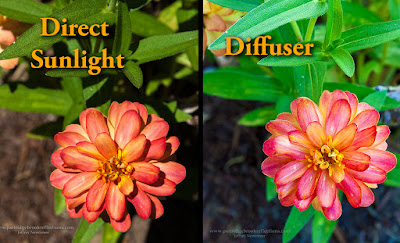
11) Diffuser should be held as close as possible to the subject.

A diffuser can block the harsh contrasts created by bright light and prevent stark reflections that tend to mute underlying colors. It is just one of the ways to deal with the challenges of bright midday sun.  Diffusers are available in many sizes.  Bigger is better, but regardless of size, they work best when held as close as possible to the subject, without intruding on the frame.  When positioned close, the light tends to be softer and more diffuse, seeming to wrap around the subject.  When locating the diffuser care should also be taken to avoid hot spots in the background created by areas not shielded from the sun.


12) Rainbows are seen when you turn your back to the sun and look at the receding edge of a rain storm.

 
It’s simple physics.  Rainbows form when the droplets in a storm cloud are illuminated by direct sunlight. The reflection and refraction of light within each drop divides the beam into its spectrum of colors.   Given the general flow of our storms from west to east, this means that, as  late afternoon fronts pass by,  the setting sun can shine on the clouds predictably creating a rainbow. 


Rye Beach Rainbow

It isn’t Leprechaun magic, given the right conditions, it will happen every time.  To see the strongest colors all you need to do is stand with your back to the sun and look into the dark receding rain-filled clouds.   The only other requirement is that the sun must be below 42 degrees, otherwise the colors will be reflected into the ground.  This means that Today (June18th), in my corner of southwestern New Hampshire, regardless of all the other conditions, I can’t expect to see a rainbow until after about 4:30PM.   


13) Get under a roof to avoid the snow blotches.


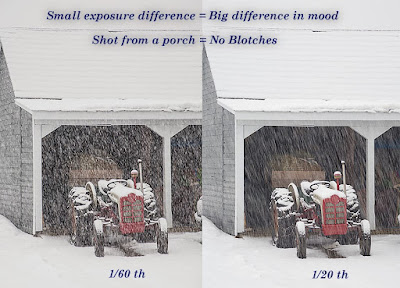
There is no other condition that so dramatically demonstrates weather conditions in photographs as does images of falling snow. Snow makes precipitation vividly palpable, and its appearance can be dramatically altered by both natural factors, and how the flakes are captured in the camera. The size of the flakes, as well as the density and rate of the fall are important, and changes in the shutter speed can make a gentle flurry look like a raging blizzard.


The Blotches

Another issue is “the blotches” which is the bane of my falling snow images.  You have undoubtedly seen beautiful atmospheric images of snow storms, but here and there are big blotches of white that seem out of place.  These white smudges come from the snowflakes that are close to the lens when the image is captured.  They are invariably out of focus and, to me at least, extremely annoying.  Happily, there are. number of ways to eliminate the blotch.  


Blotches can be removed in post processing, but this can be a time-consuming chore. In the field, they can be minimized by shooting with wider apertures and focusing on distant objects, but they are most effectively eliminated by shading the lens from nearby flakes.  In the tractor comparison, I shot from under a porch roof.  Magically, no blotches.  When a roof is not at hand, an umbrella or a piece of card board can also help.  Just keep your shade out of the frame.


14) Under harsh, bright midday sun, trans-illuminate the foliage.

Ashuelot Park Bridge, Keene NH

Bright sunlight can be terrible for capturing the full color of foliage and flowers.  This light results in high contrast between brights and darks, and causes reflections that mute the colors.  As discussed above, there are various techniques to block or diffuse the bright illumination, but another solution is to use the light to trans-illuminate the foliage.  Light shining through foliage or flowers can intensify their color, creating an electric brilliance.  This technique can be a lifesaver for the midday sun, but it is equally effective during the “Golden Hours”, when the sun is low in the sky.


15) During the Golden Hour, turn your back to the sun and make images using the warm light.

The “Golden Hours” are notable for the opportunity to capture the audaciously brilliant colors of sunsets or sunrises, but, while you are busy being enchanted, take a moment to turn away from the spectacle and notice the lovely effect that the warm light creates on everything behind you.  


Sally Lightfoot at Sunset, Galapagos Islands

 Even ordinary subjects can take on a magical glow and these often contrast nicely with the deep blues of the evening sky.  So, as the sun rises or drops toward the horizon, go ahead and capture the garish colors smeared across the sky, but that’s the easy part.  Then turn away and explore all that can be done with the soft warm light.

Point Judith Moonrise


That makes 15 quick tips.  Stay tuned for more.


Jeffrey Newcomer
partridgebrookreflections.com
603-363-8338


Saturday, August 3, 2013

Rye Beach Weekend Photography

 
Trying Again for an "Eddington Moment"


Every summer our friends Tom and Paula rent a cottage for a month on the New Hampshire seacoast at Rye Beach. The beach is
lined with beautiful and extravagant houses, but Tom and Paula's place stands out as a rustic throwback to earlier times when beach houses was supposed to be simple and time at the shore was more like camping without an elegant modern structure blocking the experience of the sea. During their stay on the beach, Tom and Paula entertain many of their friends and every year we join the group for "Chesterfield Weekend". It is a great chance to be on the coast, to sit and watch the waves, eat and drink and of course talk. We do love to talk.

For me it is a treasured annual opportunity to photograph the New Hampshire seacoast. We are only there for a couple of days and my photography is strictly controlled by the weather, but for a poor landlocked guy, it is always an exciting opportunity. Even when the weather is terrible I can scout out interesting locations for another time. Besides, bad weather is often the best time to shoot. Except when I’m looking to capture a sunrise.


Whaleback Sunrise

Last year I had carefully planned to catch the sun rising behind
Last Year's Disappointment
Whaleback Lighthouse at the entrance to Portsmouth Harbor. I used The Photographer's Ephemeris to find the perfect location on Frost Point in Odiorne State Park. I got up at four am and hiked through the predawn dark to reach the beach, but the clouds remain stubbornly impenetrable and I had to be satisfied with moody shots of the restless gray ocean. I was happy with the images, and philosophical about the vagaries of nature, but that was not what I came for and certainly not why I dragged my old body out of bed at four AM. You can read about my adventure and my failure to experience an "Eddington Moment" in my blog article from last summer.


Persistence


Notice the Alien at the Helm

This year I decided to give it another try. Again the weather seemed marginal, but I was there and it seemed worth another shot. Since we always visit around the same date, the optimal location on Frost Point had not changed. Four AM came just as early as last year, but the sky looked clearer. When I got to the beach there was overcast on the horizon, but just as I was ready for another disappointment, the sky lit up. The golden clouds were a perfect back drop to the lighthouse and the passing boats. This is what I came for and it was worth the two early mornings. As the sun rose above the clouds, and became excessively bright, I began concentrating on the warm light which bathed the rocks and sea grass along the shore. It was a great morning to be by the ocean, peaceful and quiet, and with surprisingly few mosquitoes. While I was wandering the beach, I set up my field recorder on a rock near the water to record the relaxing sounds of the waves and sea birds. 


You can also listen to the ocean music on YouTube or as the background for my Atlantic Coast slide show (If you have Flash). 


I lingered for awhile, but I had to get back to nap before I joined the crew at the Golden Egg for a perfect breakfast. I enthused about the spectacular sunrise; attempting to make my lazy friends feel sorry that they didn’t join me on the beach. I failed, but, for me, it was still a perfect example of the power of persistence. Eddington would have been proud.


 Gifts from the Sea
I bagged my sunrise, but I always try to get the most from my trips to the coast. Although the full moon had passed I scouted around for good moonrise locations. I found that the view from Fort Stark in Portsmouth Harbor would work well. Sadly clouds were an issue on both nights, but soft overcast light worked well for other subjects, such as one of my favorite run down tidal shacks in Rye.


Atlantic Arch
The Best Laid Plans
Not all photographic opportunities come based on careful planning. Sometimes you have to be ready when luck plays its part. While beginning to prepare for dinner in the cottage on Friday night, My friend Bob suddenly began screaming for me to come quickly and to bring my camera. A rain shower was passing out to sea and the setting sun had just broken through the clouds, the perfect situation for a rainbow. And there it was, a spectacular full double rainbow floating on the ocean. I leaped back into the house to grab my 16-35 mm wide angle lens and started shooting. My choice of foregrounds was limited, but I was able to incorporate the small deck. Even with the wide angle, I couldn’t catch the full double, so, before the color melted away, I quickly grab a 5 image panorama which happily included Paula and Lynne watching in stunned amazement from the beach.  As much as I have learned about how rainbows form, I can rarely anticipate when one will appear. The conditions usually come together in an instant and are gone just as quickly. The best I can do is try to be ready when the miracle happens. This time it worked. This photography stuff is Great!


Before I headed home Sunday afternoon, I wandered the rocks along Rye Beach at low tide. The light was still flat, but I was able to catch some modest surf and tidal pools. I managed to keep my camera dry, but very little else. After drying off I reluctantly headed for home. 


Chesterfield Weekend at Rye Beach is always a great chance to visit with friends away from the distractions of home, and happily, there is always time to get out to capture the magic of the ocean. I was sad to leave, but excited to get home to dump my image into the computer and begin exploring my seacoast treasures. If nothing else, it was a refreshing break from the cows and trees.


Jeffrey Newcomer
Partridgebrookreflections.com

Tuesday, July 24, 2012

Rainbow Photography


Finding the Pot of Gold


Rainbows have always been a popular subject for photography. They are among the most dramatic and colorful of the natural phenomena. It is little wonder that rainbows have always been a subject of superstition and mythology, and our scientific understanding of their origins and behavior has only minimally diminished our sense of wonder at their surprising beauty. Part of the mythology about rainbows describes a Leprechaun's elusive pot of gold that can be found at the end of these colorful celestial arcs. Of course a rainbow is not a physical structure and it's end can never be defined, but I would suggest that, in a photographic image, a rainbow can have a visual pot of gold and that treasure has to do with the strength and interest of the foreground.

Not Just a "Pretty Thing"
Photographs of rainbows always show a lovely spectrum of colors, but the best images are more than just a "picture of a rainbow".  It is the surrounding compositional elements which provide a sense of place and context, that makes a rainbow image compelling and not just a snapshot of a colorful "pretty thing". This is actually one of my central compositional rules. A great landscape photograph is seldom just a picture of a" pretty thing". Whether it is a spectacular mountain, a quiet lake or a colorful autumn tree, images are made especially memorable by how you arrange the elements around the "pretty thing" to provide contrast, context, balance and to draw your eye. This particularly true of rainbows.

Foreground Hunting

Chesterfield New Hampshire Town Hall
When I see a rainbow forming my first thought is "Where can I go
to place something interesting in front of the color".  An immediate corollary of that thought is, "How far can I go before the rainbow disappears and from what angle is the light coming".  I was working in my studio one afternoon when I noticed a beautiful rainbow forming in the eastern sky. I grabbed my camera and leaped into my car.  I knew that time was fleeting, so I headed up to Chesterfield Town Center and arrived just in time to have about 2-3 minutes of the bright colors, against the dark sky, before the sun sank into the clouds. The colors were beautiful, but It was the old stone town hall, bathed in the sunset glow that made this picture special. 


The Physics, I Promise, NO Equations
Sometimes catching a rainbow in a great location is a matter of

Light Through a Raindrop (Wikipedia)
luck, but a basic understanding of the physics of rainbow formation can help you improve your chances. Rainbows are formed by the summation of light refracted and reflected through millions of rain drops. The light is refracted (bent) as it enters the drop. Light of different waves lengths or color are bent by different amounts during refraction, the red light is bent less than the blue, creating the rainbow effect. The light is then reflected off the back of the drop and refracted once again as it passes out of the drop and on to your eye. In the atmosphere, the reflected light comes out of the drop at an angle of about 42 degrees down from the angle of the sun's rays. The light can actually bounce around in the raindrop twice creating a secondary rainbow which is less intense and  is seen above the original.  Interestingly secondary rainbows show the colors in reverse order. Tertiary rainbows are also possible, but are quite rarely seen.


Double Rainbow


My goal here is not a physics lesson, but the physics does provide some helpful photographic lessons.

  1. First rainbows are always most intense when shot with your back to the sun. A simple way to think of this is to try to place your shadow on a line between the sun and your foreground subject.
  2. The colors become more intense as the sun drops toward the horizon and, because of the angle of refection, rainbows don't generally appear until the sun drops to below 42 degrees in the sky. Before that time, unless you are at altitude, the rainbow is actually below the horizon. In southern New Hampshire, during July, this means that we would not expect to see rainbows until after 4:30 in the evening.
  3. Of course you can't have a rainbow without the combination of raindrops and sunlight. Most often this comes from a clearing storm, but fog or sea mist may also create a rainbow. The best bet is to wait until the first light after an evening storm has past by and look away from the sun. With luck, the rainbow will be shining against the receding dark clouds.
  4. Finally, since rainbows are often fleeting and pop up unexpectedly, you might want to keep your own list of prime observing sites close to home. Look for interesting foregrounds that can be viewed against the eastern sky with the sun at your back.  Technology can help improve your odds of finding a great show.  Using my IPad I can now follow the progress of storms on radar and then find the best locations using the Photographers Ephemeris to discover the direction of the sun at any time.

So keep your eyes on the sky after a storm, feel the warmth of the sun on your back, watch the foreground and you may just find your own pot of gold.