About Me

My photo
Spofford, New Hampshire, United States
Jeff Newcomer had been a physician practicing in New Hampshire and Vermont for over 30 years. Over that time, as a member of the Conservation Commission in his home of Chesterfield New Hampshire, he has used his photography to promote the protection and appreciation of the town's wild lands. In recent years he has been transitioning his focus from medicine to photography, writing and teaching. Jeff enjoys photographing throughout New England, but has concentrated on the Monadnock Region and southern Vermont and has had a long term artistic relationship with Mount Monadnock. He is a featured artist in a number of local galleries and his work is often seen in regional print, web publications and in business installations throughout the country. For years Jeff has published a calendar celebrating the beauty of The New England country-side in all seasons. All of the proceeds from his New England Reflections Calendar have gone to support the Pulmonary Rehabilitation Program at the Cheshire Medical Center. Jeff has a strong commitment to sharing his excitement about the special beauty of our region and publishes a blog about photography in New England.
Showing posts with label Cape Elizabeth. Show all posts

Sunday, September 10, 2017

Portland’s Six Lighthouses : A Gallery


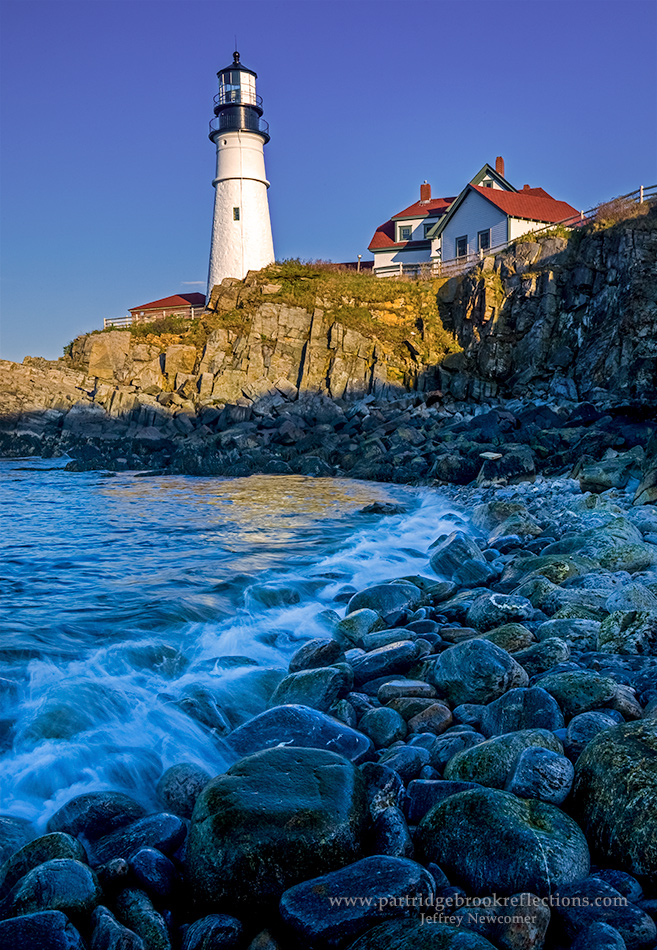
Portland Head Light

Portland Maine has six Lighthouses protecting its rocky coast.  This week, in a blog article for the New England Photography Guild, I highlighted each of these beacons.  Radar and GPS have revolutionized the process of coastal navigation, but, especially for smaller craft, they have not replaced the importance of Lighthouses in lighting the way to safe harbors.  Photographically, New England’s lights are one of my favorite subjects whenever I get back to the coast.


Check out my Guild article for details about each of Portland’s six Lighthouses.  They range from the isolated and abandoned Rear Range Tower of the Twin Lights, to the majestic Portland Head light, arguably the most impressive example of New England’s coastal beacons.  Here, To supplement my article, I have collected a few more of the many images of these lighthouses that I have captured over the years.


You can check out the locations on my map and follow the GPS locations.  I decided to tour the lighthouses from south to north starting with the most challenging ones to approach, the Twin Lights.

                -------------------------------------------------------------------------------


1-2)  Twin Lights, Cape Elizabeth

43.5643N, 70.1989

Only one of the two Twin Lights is still functioning and both are on private property.  Both were built around 1828.  In 1924, the government dismantled the West (Rear Range) Tower.  It is closed off and now is a private residence.  The other light is closer to the shore and, although it is still operating, it can’t be closely approached.  

Rear Range Tower - Inactive
East Tower - Active


           -------------------------------------------------------------------------------


3) Portland Head Lighthouse, Cape Elizabeth

43.6232N, 70.2079W


The Portland Head Lighthouse was commissioned by President George Washington and completed in 1791. It is the oldest lighthouse in Maine.  Sitting heroically on a rocky point extending toward Portland’s main shipping channel, it is easy to see why it is the most photographed lighthouse in New England.
Obviously, it is one of my most photographed Lighthouses.


           -------------------------------------------------------------------------------


4) Ram Island Light

43.6314N, 70.1876W

Across the entrance to Portland Harbor from Cape Elizabeth and Portland Head Light, is Ram Island Lighthouse.  Built in 1905, It sits precariously on a ledge that threatens the northern side of the harbor channel.  The lighthouse can be photographed from Fort Williams Park with dramatic images often including Portland Head Light in the frame.


Distant Ram Island Light


           -------------------------------------------------------------------------------

 5) Spring Point Ledge Light

43.6499N, 70.2255W

Located next to the Campus of Southern Maine Community College, Spring Point Ledge Light was built in 1897 to mark a dangerous Ledge which lies to the west of Portland’s main shipping channel.  Originally built on a caisson in open water, in 1951, the lighthouse was attached to the mainland with a 600 foot granite breakwater and can be viewed from the beach or breakwater.  


           -------------------------------------------------------------------------------


6) Bug Light

43.6556N, 70.2349W

Little Portland Breakwater Light, which is also called “Bug Light”, was built in 1875 to mark the entrance to Portland Harbor. Bug Light Park includes a memorial to the New England Shipbuilding Corp shipyard.  During WW II, the massive yard constructed over 200 of the Liberty Ships that were so crucial in transporting American industrial output across the Atlantic.  Now, all that is left is a skeletonized bow,  representing one of the ships.


Liberty Ship Memorial


Jeffrey Newcomer


603-363-8338

Sunday, June 5, 2016

Is It Me, the Software, or My “Eye”

All the pictures here, of Portland Head Light,  are from my 2008 explorations of Cape Elizabeth  Maine

Three related questions for my personal reflection and, perhaps, your own.  


  1. Is my photography better than it was eight or ten years ago?
  2. If yes.Is it me, or the software that has improved?  
  3. And has my "Eye" changed over the years?


Among the Rocks, Portland Head

As I was reviewing my Atlantic coast images in anticipation of last weeks article on photographing coastal surf, I became distracted by a picture that I took of the rocks under the Portland Head Lighthouse back in 2008.  The shot was challenged by the presence of the brightly illuminated lighthouse above the contrastingly deep shadows on the rock strewn beach.  I had done the best I could, using my capability with the available tools, to bring the scene's wide dynamic range into balance, but I thought that using current editing software and my understanding of their use, I could do a better job.  And then I was pleasantly sucked down the rabbit hole.


I went to the Maine coast images from those days in May of 2008 and started looking for the rocky shore among the original unedited files.  Before I could find the image, I was diverted by all the interesting angles that I had captured of the iconic Portland Head Lighthouse.  


Looking at the pictures with "new" eyes, I was struck by the number of fresh and interesting perspectives.  I wondered why I hadn't worked on many of these images immediately after they were captured.  I am sure that I am now a better photographer when it comes to the technical aspects of capturing an image.  I believe that I'm more skilled at handling difficult light and composition and I can get more from my images during post-processing, but what about my "eye".


There can be no question that the capabilities of today's image editing software is much greater than it was 7 or 8 years ago.  New versions of Lightroom and Photoshop make it possible to better tame the extremes of wide dynamic range, in either a single image or multi-image HDR.  Auto-alignment and Auto-blending tools allow the use of focus stacking to capture previously impossible depth of field, and color balance and vibrancy controls capture a rich gamut of color.  In many blog articles, I have extensively discussed how all these capabilities have changed the process and the content of what can be considered "Getting it Right in the Camera", but have all these layers of technical "craft" distracted from the simple wonder of being part of the scene.  Looking at my pictures from 2008, I question whether today I would miss the full range of possibilities within the location by virtue of spending too much time arduously crafting just one or two images.  Just review last week's article in which I contrived to capture 7 or 8 images to blend into a single picture with full DOF and the perfect wave.  On my shoot at Nubble light I captured a total of 775 images, but from all of those pixels I ended up so far with only 3 unique scenes.  I love the results but was it worth the potential loss of 5 or 6 other interesting perspectives of this classic location, and has my focus on the technical aspects of photography altered my natural eye for light and composition.


Window on Ram Island Ledge


The Eyes Have it

 
Despite the importance of technical ability in photography, I still believe that by far the most important quality that a good photographer can have is his or her "eye", the ability to balance the components of a scene to create a composition that draws the viewer through the picture to settle on the focal point of the image, and most importantly, on the emotion of the scene.  Exposure, focus, and color are all important, but without that balance of composition, the image will be a failure and, conversely,  given an unusually strong composition all the rest may be of minor importance.


So, has my eye changed?  Perhaps.  I believe that the combination of experience and technology has allowed me to capture individual images with greater precision and quality, but I may also be missing a bit of my old spontaneity and wonder.  I refuse to accept this as an inevitable consequence of growing older and my new plan is to try to be more open during my shoots.  I don't think it is possible or even fully desirable to shelve all of my hard won skills , but my goal will be to come home with fewer pictures of the same thing and more of a wide range of perspectives.  I'll start with simple exercise that might be of help to us all.


One and Done

It seems simple.  Go out on a shoot and consciously limit yourself to just one shot of each composition.  OK, maybe this will actually be unnecessarily difficult.  I will let you take a couple images to get the exposure right, but then, take the time to pick one optimal focus point and shutter - click and move on.  Come home with 30 different pictures instead of 10 images of just 3 scenes.  The results may lack technical precision, but I'm guessing that, like I discovered in my 2008 lighthouse images, you will find some refreshing perspectives.


A Main Street "One & Done"


I wrote much of this article while sitting outside the Bagelworks Cafe in Keene New Hampshire and, after finishing, I decided to try my "one and done" approach to a stroll along Keene's beautiful Main Street.  I tried to capture a large collection of images that reflected Keene's vibrant downtown.  Few grand heroic perspectives, but instead I tried to notice the detail that I would normally pass right by.  It was great fun and I look forward to  more of this once I can manage to place one foot 


The Hip Comes First
My plan is to show the images from my "One and Done" exercise in next week's blog, but sadly, tomorrow I go in for a hip replacement, and it is equally likely that my next article will be filled with 30 imaginative ways to capture the view from my bed and chair, and perhaps a few of Susan growling about my incessant whining.


Keene Art Walk
Next week I will be showing a few of my pictures in the windows of the Keene Housing office on Central Square, a small part of Keene's annual Art Walk. The Art Walk is a great community event with stores up and down Main Street hosting displays of the widely varied work of local artists.  It all makes for a lovely early summer stroll and a great chance to capture fresh perspective on your photography.


Jeffrey Newcomer