About Me

My photo
Spofford, New Hampshire, United States
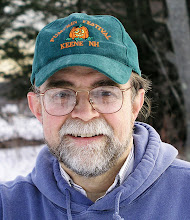
Jeff Newcomer had been a physician practicing in New Hampshire and Vermont for over 30 years. Over that time, as a member of the Conservation Commission in his home of Chesterfield New Hampshire, he has used his photography to promote the protection and appreciation of the town's wild lands. In recent years he has been transitioning his focus from medicine to photography, writing and teaching. Jeff enjoys photographing throughout New England, but has concentrated on the Monadnock Region and southern Vermont and has had a long term artistic relationship with Mount Monadnock. He is a featured artist in a number of local galleries and his work is often seen in regional print, web publications and in business installations throughout the country. For years Jeff has published a calendar celebrating the beauty of The New England country-side in all seasons. All of the proceeds from his New England Reflections Calendar have gone to support the Pulmonary Rehabilitation Program at the Cheshire Medical Center. Jeff has a strong commitment to sharing his excitement about the special beauty of our region and publishes a blog about photography in New England.

Wednesday, March 16, 2011

Crushing the Future of Photography


In the last few years I have done my share of hanging my ego out to dry by submitting my work to various competitions and juried shows. Much more than my successes, my failures have made me wonder about the process of judging photography. Frequently rejections are softened by reminders that the jury procedure is inevitably a subjective matter of individual taste. With this realization, before I submit to a show, I will often try to look at the jurors images. I may reconsider a submission if I find nothing but abstract B&W photographs in my inquisitioner's portfolio - Hey, I know what I do! Following this kind of research, I recently added one B&W image to a group of my usual color photos submitted to a juried show. It was the B&W that was accepted. I don't fault the jurors. They produce and appreciate work that they like.

With this in mind I just finished seeing the process from the other side. I was honored to be asked to judge a very prestigious photography contest. Ok ... it was actually the New Hampshire Regional 4H Competition and the photographers ranged from 8 - 18 years old, but still it was interesting and a bit scary to be given the responsibility of judging all those kids who are just beginning to grasp the magic of photography.

So, the process went like this. I was given boxes with over 70 framed pictures to review. Actually I started with half of the images and then swapped with the other juror in the competition. We were given a form to fill out with 20 criteria to rate. It was difficult to place numerical values on these criteria.  I guess I rebelled a little against the idea that these expressions of art could be reduced to columns of numbers, so it was in the comment section that I tried to focus my real evaluation. Perhaps because of some unpleasantness in the past, we were told to start out with positive comments before ripping the kids apart. As a frequent Flickr poster I had the positive comment thing solid. The constructive comments were a much tougher issue.  It was clear in most of the images that these kids had great investment and pride in their work. Unfortunately I can't show any examples here, but there were some really nice images. As you might expect from a 4H group, many of the strongest pictures were of animals, but there were also many landscapes and a few macros. From the start It was important to understand that most of the pictures went straight from the camera to Walgreens for printing. With a few exceptions the pictures did not benefit from cropping, color correction or any of the adjustments that we, in the digital world, consider a necessity. Allowing for this there were still many marvelous images and many learning opportunities.  I tried to keep my suggestions in very positive, constructive terms. I used phrases such as "Next time you might try ...", "This might be a bit stronger if you ..." and "Very cute, but you might ...".  I certainly did not want to crush the enthusiasm of the next Ansel Adams!


It was interesting that many of my comments fell into just a few recurrent themes. These included :

"The composition might be stronger if the subject was moved away from dead center". This was far, far and away the most common issue. It shouldn't be surprising that kids (and adults) tend to aim the camera directly at the subject, but it seemed that the center of most of the pictures contained a black hole sucking in everything of importance. Often I tried describing how the frame might be cropped and in some situations I actually drew a picture showing how the composition might be improved. As I was approaching the end, I suggested in a couple cases that the kid might try Googling "Rule of Thirds".


"Beautiful donkey, but it might have been better if you didn't cut off his nose". Cropping or framing was also a common issue. For each image in which the framing was too tight there was another in which the tiny horse was lost in a sea of unnecessary background.


"Next time you might try exposing to get more detail in the shadows". Exposure was a frequent issue both over and under. I believe all of the images were digital so there is hope that as the kids learn to use their LCDs and histograms this will become less of a problem.

As might be expected, other issues included sharpness of focus,  leaning horizon lines and busy distracting backgrounds, really all the usual suspects.

Overall, this was a valuable experience.  I saw an impressive collection of interesting work reflecting great enthusiasm and potential, and I had the opportunity to relearn many of the fundemental tenets of good photography. I found myself envious of all the great discoveries that lie ahead for these kids as they develop their skills in a digital world that makes experimentation and learning a much easier endevour.  That is assuming I didn't destroy their willingness to ever pick up a camera again.

If you would like to see the kids work, they will be on display in Morrison Hall at Keene State College begining on March 27th.
 

Sunday, March 6, 2011

The Canadian Rockies and Image Management Workflow

Two Jacks Lake, Alberta
I love photography in the winter, but enough is enough. I have been taking so many moody achromatic images that I think my sensor has lost its ability to see red. This week however I have escaped the icy grip by going back though my images of the spectacular Canadian Rockies taken in the spring of 2008. It has been great to discover with fresh eyes images that I never got to process. I guess it shouldn't be surprising that there were some keepers still hidden in the pile. I did come back from the trip with over 3000 pictures. As I've been working on these images I have been reminded of two important lessons.


First, although our most recent pictures often seem to have the greatest attraction, it is always good to visit the archives from time to time.


Silverton Falls, Alberta

Sunwapta Falls, Alberta
The second lesson is about the importance of a careful image management workflow. In 2008 my approach was to import the raw images and back them up. (Period) In those days I didn't take the time to input metadata detailing identifying information. Somewhere there is undoubtedly a notebook or slips of paper on which I recorded the locations of images from this trip, but as I worked through them, now nearly three years later, I realized that I was at lost to identify locations. The Canadian Rockies are resplendent with gorgeous mountains and waterfalls, but which is which? Thank god for the internet and guide books helping me solve the mysteries, but this experience, has reinforced the importance of rigorously following my current approach to image management.

The most important thing about image management is to DO IT. Come up with a workflow and follow it faithfully. I little bit of effort now can save a world of aggravation in the years to come. When I come home after shoot I still can't wait to start working on the images, I struggle to resist the temptation to dive right in and first go through my workflow steps. There are as many workflows as there are photographer, but here is my approach - today - I'll probably change it tomorrow:

 
* First I download my RAW images and then immediately convert them to Adobe DNG. Although DNG probably has an archival advantage over proprietary file formats, my primary reason for converting is that DNG files incorporate the metadata within the image file itself. There are no pesky little sidecar files to try to keep track of and invariably loose. After converting to DNG I move the original RAW files to a separate disk as a backup.


*Next I rename the files using my own numbering format. I simply name each file with the date taken and a number. The date and number format is yymmddxxx. With this convention the files can be ordered chronologically by a simple alphabetical sort. The first image from today would be; 110305001. I presume I will never take more than 1000 images in a day, but who knows. Many photographers include a description of the project in their naming format, but my projects always seems to be "pretty pictures". To each their own.

 
*At this point I typically GPS label my images. I have a GPS logger that I usually carry with me. I match coordinates with images using GeoSetter (Windows Freeware at http://www.geosetter.de/en/). The program employs Google Maps which can be used to fix locations without a logger. I suspect this step will be done automatically in the camera of the near future.

*Finally I dive into the metadata. I use Adobe Camera RAW to edit the information. I start by placing a copyright announcement and then applying simple titles which include subject and location. I populate the key word section with important search terms. This will always include town, state and season, but I'll also throw in other identifiers such as the names of models, time of day and descriptors of the subject matter (eg barn, road, waterfall, naked lady). I will occasionally add other information in the Description Box, eg contact information, thoughts about the best time of day to come back to reshoot or other critical information such as "poison ivy in the field". This step tends be time consuming, but can be streamlined by batching information entry for similar images.


Thats it.


My trip back to the Rockies has reinforced for me value of careful image management.  There are many solutions to this problem.  I would be interested in hearing about how you deal with the challenge.

Wednesday, March 2, 2011

Wrong Place - Right Time

What does a photographer do when he has just one day to capture one of the most spectacularly beautiful spots on the planet. Of course he prays for great or at least interesting weather. He does his research, talks to the locals and THEN he goes to the wrong place for his one and only sunrise on Lake Louise in the Canadian Rockies


Recently I was reminded by a comment from a "Flickr Friend" of our amazing trip to British Columbia and Alberta in the spring of 2008. That also reminded me of an image of Lake Louise and the Fairmont Hotel at dawn that I had never processed. Perhaps I have avoided the image because it was not the one I was supposed to get - but maybe it didn't work out so badly after all.


Susan And I arrived at the historic Fairmont Chateaux Hotel on Lake Louise in the evening after a long, breathtaking drive from Jasper along the Icefields Parkway (Highway 93). The Hotel is a classic and classically expensive but we were treating ourselves that night. We were heading to Banff the next day so I knew I had only one shot at sunrise on Lake Louise. The weather sounded iffy, but I had no choice but to set my alarm to get up before dawn. After my research and conferring with our waiter at dinner, I decided that in the predawn I would climb to a ridge overlooking the lake and hope for the best.


As I ascended in the dark the next morning it seemed that my anemic flashlight only served to illuminate me for all the hungry bears coming out from hibernation. Somehow I survived the climb unmauled and found a nice overlook. With a little awkward leaning I was able to set the tripod for a good angle and I felt a certain smug satisfaction that I got the best spot before the crowd of photographers arrived. As the eastern sky behind the hotel began to lighten with nice color, I started experimenting to find the best exposure to manage the contrast of the scene. I wasn't doing much HDR at the time. It was then that it occurred to me that I was STILL the only person at this overlook - where were the crowds. As I pondered this question, I began noticing distant voices and the sickening sound of dozens of shutters clicking furiously several hundred feet below. As dawn broke over both Lake Louise and my sleepy cranium the conclusion was obvious - I was at the wrong location. As it turns out the classic - once in a lifetime - spot for sunrise on Lake Louise is traditionally from in front of the hotel looking up the lake as the morning sun illuminates the glacier. I packed up and ran down the trail, bears be damned. Fortunately I didn't miss all of the show. The sunrise light on the lake and mountains changes minute by minute and, although it wasn't the best weather, I was able to grab some nice shots. I also had the reassuring company of about twenty other photographers all wondering why I was out of breath.


Tonight, as I finally went back to the image from above the lake, I realized that I was actually lucky to get two perspectives from my one sunrise at Lake Louise. And amazingly, I think I prefer the "wrong" one .

 You can check out some of my other images from the Canadian Rockies on my web site: partridgebrookreflections.com
or in my flickr set at: http://bit.ly/ezlVVA


Monday, February 21, 2011

When It Comes to Covers - You Never Know

It seems silly to have to say that we always submit our best work for show juries or publications, but I am often surprised by which images end up getting selected, especially when it comes to print. I find myself often saying, to myself, "You really want that one?". It actually has much more to do with what wasn't selected than what was, as editors pass over what I think is my best stuff. As I've struggled to push ego out of the way, I've come to appreciate, that editors have many more considerations beyond pure "art". They have to decide whether the image tells the desired story, whether it fits into the available space and, in the case of a cover photo, whether the image can survive having text splashed all over it. Recently this last point was brought home to me once again.


A couple of weeks ago I was excited to learn that New Hampshire To Do Magazine had selected one of my photographs for the cover of their March 2011 issue. They had chosen an images from the Stonewall Farm's Sap Gathering Contest in Keene, NH. Each year folks from throughout the Northeast gather with their horse teams to celebrate traditional maple sugaring techniques and I get the chance to temporarily escape from the efficient but ugly tubes that are invading our forests. Over the last three years I've been able to capture some nice images of the whole process and a couple of years ago one of these photos actually took first place in the NH Tourism Bureau's State Photography Contest. You can check out some of these pictures in my Sap Gathering Set on Flickr (http://bit.ly/eSRmH5) or on my web site (partridgebrookreflections.com).


The editors at NH To Do had access to all of my web images and I was surprised when they chose one that I have always found a bit disappointing. I had set up to capture a single bucket in the foreground with the sled approaching. With my camera fixed on a tripod, I first took an image focused on the bucket and then was able to composite this foreground image with the images focused on the sleds as they came by. The horses were moving much too fast to capture this extreme depth of field in a single exposure without unacceptably long shutter speeds and high ISO. In the selected image I felt that I had hit the shutter a second too late as the horses were passing. The composition would have been much stronger if the team was in a more balanced position in the upper right quadrant of the frame rather than both team and bucket on the left side. But, on reflection, I suspect that it was this imbalance that made this image attractive for the cover. All that open space on the right provided room for the required text and there was enough headroom in the image to provide space for the title at the top. It probably also helped that they could flip the image horizontally without the number on the bib giving them away.

I tend to brutally crop and recrop my images to focus on a few simple components. I am always looking to remove elements on the periphery that distract from the story. The point here is that when it comes to covers you never know what might work. Often it is the image with extra head room and areas of open space that will win the prize. This is one reason I usually delay cropping until fairly late in the editing process and then I always save an uncropped copy. You just never know.

Friday, February 11, 2011

The Plunge & Why I Will Never be a Wedding Photographer

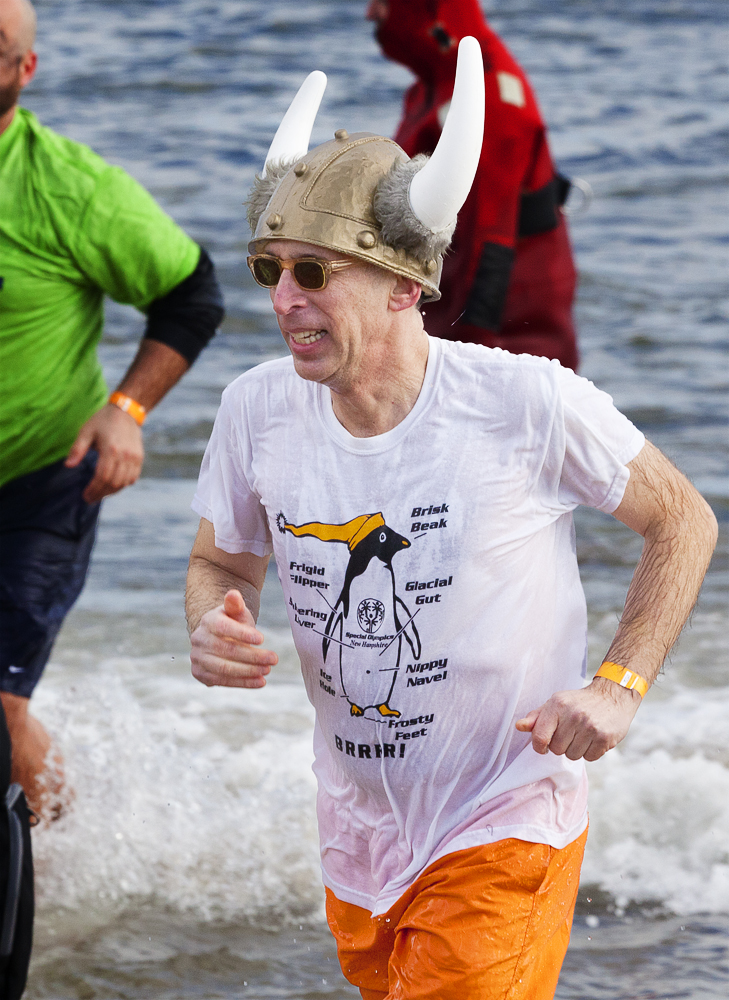
Last Sunday I spent the day photographing Cheshire Medical Center’s "Frozen Sections" as they participated in the 12th annual New Hampshire Penguin Plunge at Hampton Beach, NH. This year over 700 volunteers raised money for the privilege of rushing insanely into the frigid Atlantic Ocean at Hampton Beach. The Plunge is a great event raising money to support the Special Olympics and our group from Keene NH has been a leader in that effort. This Sunday, for the fourth straight year, the "Frozen Sections" won the "Super Flock Award" as the group that raised the most money. In total, this year’s plunge brought in over $670,000.

Although at heart I am a landscape photographer I do enjoy recording the human drama that is seen when hundreds of otherwise normal people rush willingly into an environment incompatible with life. It is great to see their excitement as they sprint towards the frozen surf, and even more fun to see the mixture of triumph and numbed shock as they straggle back up the beach after the plunge. I have realized for a long time that I am fascinated with the human face and I enjoy working to bring out the character and individuality of each person. And that is the problem.

As was true last year I came back from the plunge with just a couple hundred images and as much as I tell myself that I am going to be brutally efficient with editing, I find that I unavoidably slip into "landscape mode" and want to fine tune each frame. I start with a quick crop, color and brightness adjustment, but then I start using masks to highlight the important subjects and cloning to deal with facial glare. Of course I occasionally have to move a head from one image to another to replace a squinting scowl with a more pleasing expression. Two minutes becomes 15 and I’m dead in the water. In two nights I have produced 45 finished images and probably have another one or two nights to go.
The fact is I love doing this kind of work especially when I’m successful at keeping the manipulations effective and transparent, but I can’t imagine how I would survive trying to edit a couple of thousand wedding photos.

This sort of event photography is not precisely the same as weddings. There are much fewer "Set Piece" shots and lighting can be more difficult to precisely control. On the other hand there are no brides to deal with in non-wedding events.

 Next year I will undoubtably return to help document what these crazy people do to support the wonderful folks in the Special Olymics.  It has the magnetic fascination of a car wreck but with a much better outcome. I will try again to do a better job with lighting.  I especially will, finally, figure out how to use my flash. I will discover the ideal places to stand to get the best angles without being trampled by crazed plungers and I will use more efficient batch processing to cut my editing time to something less than four days. But my conclusion will inevitably be the same ... NO WEDDINGS!

 
The Special Olympics State Winter Games are coming up in early March at Waterville Valley.
For more information on Special Olympics and the Penguin Plunge, visit sonh.org.

Sunday, January 23, 2011

I Do Windows ... Is That Wrong


Whenever I can't decide where to go shooting I know I can't go wrong by heading south on Route 124 from Keene NH. I don't believe there is a stretch of road in the Monadnock Region that can match the concentration of classic New England scenes along the 12 miles from Marlborough to Jaffrey. Mt. Monadnock's dramatic profile is the major attraction, but one of my favorite stops is the old Jaffrey Center with its quintessential colonial New England meeting house. It is an amazing building with an amazing story. The Jaffrey Meetinghouse was raised on June 17, 1775, the day of the Battle of Bunker Hill. It was recorded that the workers could hear the distant canon fire from Charlestown over 60 miles away.

I have captured the meetinghouse from all angles and in all seasons. On this day I was concentrating on framing the pristine white building with the surrounding trees. As I came around to the front I was horrified to discover that the three windows along the spire had been removed and replaced with black wood panels. I assume that this is part of necessary renovations, but they COULD have checked with me first! Nothing to do but take the shots. The view looking up the road to the front provides nice framing and had the added advantage of being relatively straight on making adjustments in post a little easier.
Back at home I had to decide what to do with this image. To me there was little choice. The black panels clearly did not reflect the essence of this historic structure and since my goal was not to faithfully record the progress of the renovation, I had to move some windows. This is where purist are allowed to gasp ..... OK moving on. Happily the front of the building is full of excellent candidates for copying. I elected to select the window panes to a new layer rather than cloning since this allows the necessary rotation and scaling to make the proper fit. It wasn't too complicated. Just took a tittle time. The small features, such as getting the snow on the sill to remain in front of the glass, were the most painstaking. I believe that the result represents what you see when the meetnghouse is in its glory. The windows are identical to those that were there originally and my window replacement service is A LOT cheaper.


I hope few are offended, but this is just one of the miracles of digital photography. Ansel Adams once commented on criticism he received for spotting out graffiti that had polluted the rocks on one of his classic images; "I am not enough of a purist to perpetuate the scar and thereby destroy - for me, least - the extraordinary beauty and perfection of the scene". If I am criticized I can only respond, "Ansel made me do it".

Tuesday, January 18, 2011

Dumb Luck and Foreshortening

Yesterday, after some errands in Keene NH, I decided to loop my way home through Gilsum, Alstead and Walpole to take advantage of the late afternoon light. On the way I stopped at the Filter Connection in Gilsum to pick up some sensor cleaning solution. A few years ago I was surprised to discover that a great on-line filter reseller was actually just down the road. I have since become friends with the owner and staff, but they were initially surprised when I informed them that I would be dropping by to pick up my order. Their building is remarkably unimpressive, but their stock, prices and knowledgeable support are first rate. Most importantly, they also welcome my dog Nellie to come in and play with the office canines. Check them out at 2filter.com and yes, the Lamas belong to the owner.


As I wandered along, the evening light was warm and clear, but I didn't find much that I found exciting to photograph. I had just about given up, but sometimes you just have to accept dumb luck. On the way home from Walpole, I thought I would check out how the sunset light was playing on the hilltop of Alyson's Orchard. Looking up I was floored by the nearly full moon positioned perfectly over the great Oak at the top of the hill. If anyone asks, I had checked the tables and planned my arrival for this convergence. I started at the bottom using my 400mm to magnify the moons appearance over the tree. Then I work my way up the hill. Each switchback provided different angles to exploit and also gave me a nice example of the phenomena of foreshortening with a long lens.


Foreshortening refers to the apparent enlargement of distant objects compared to the foreground when telephoto lens are used. It is argued that this is actually just an optical illusion and it is true that when taken from the same location images recorded with long and wide angle lens have the same perspective. When the wide angle image is enlarged to match the telephoto they appear identical with exception of the narrower depth of field with the telephoto. The power of foreshortening comes when you move. As can be seen in these two images, when I was further away from the subjects using a longer focal length the moon appeared much larger in relation to the tree. The upper image was taken from the bottom of the hill at 235mm, the lower was closer and at 160mm. I frequently back up to increase the size of background elements in a composition. The important thing is to avoid backing into the lake or off the cliff. So a day that hadn't been working out well ended up yielding a nice photo opportunity and a couple of images that I suspect will find their way into a talk sometime.

Dumb luck rules!