
About Me

My photo
Spofford, New Hampshire, United States
Jeff Newcomer had been a physician practicing in New Hampshire and Vermont for over 30 years. Over that time, as a member of the Conservation Commission in his home of Chesterfield New Hampshire, he has used his photography to promote the protection and appreciation of the town's wild lands. In recent years he has been transitioning his focus from medicine to photography, writing and teaching. Jeff enjoys photographing throughout New England, but has concentrated on the Monadnock Region and southern Vermont and has had a long term artistic relationship with Mount Monadnock. He is a featured artist in a number of local galleries and his work is often seen in regional print, web publications and in business installations throughout the country. For years Jeff has published a calendar celebrating the beauty of The New England country-side in all seasons. All of the proceeds from his New England Reflections Calendar have gone to support the Pulmonary Rehabilitation Program at the Cheshire Medical Center. Jeff has a strong commitment to sharing his excitement about the special beauty of our region and publishes a blog about photography in New England.
Showing posts with label shade. Show all posts

Sunday, July 10, 2016

The Magic in a Bright and Sunny Day


Beautiful Bright Sunny Day


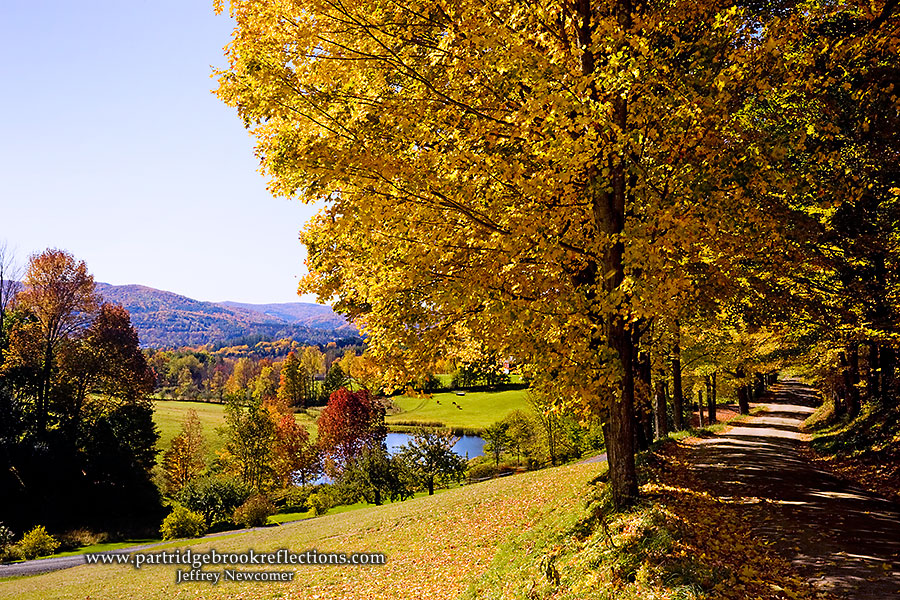
Ask any photographer and he will tell you, the worse time for landscape photography is in the bright midday light.  The rest of the world will insist that a bright and sunny day is a glorious time to enjoy the beauty of the outdoors, and they assume that it is also a great time to shoot.  We photographers must scoff and patiently explain that the bright sun creates stark contrasts, with both deep, fathomless shadows and brilliant highlights, which are impossible, given the limited dynamic range of both film and digital sensors, to capture completely.  


The human eye has a dynamic range which is probably only slightly broader than current DSLRs but, by virtue of the ability of our eyes to seamlessly transition from dark to light and our brains capacity to assemble an image from this input, we perceive a far greater dynamic range.    A single DSLR image may capture a dynamic range of 8-10 f stops, but, by constantly adjusting to the brightness of the area of our attention, our eyes can appear to record more than 24 stops.  The camera works like an eye whose pupil has been fixed, which is why you are given sun glasses after your eyes have been dilated at the ophthalmologist.  


Exposed for the Highlights

Enough physiology.  The point is that eyes can fully appreciate the lovely contrast between the brilliant light and the cool inviting shadow, but the same conditions have always posed a challenge for photographers. 


Exposed for the Shadows

 I remember, from my film days, a constant frustration with the inability to capture scenes such as when dappled sunlight illuminated a lovely trail in the woods. I always had to choose between exposing for the shadows and, as a result, blowing out all detail in the highlights or exposing for the highlights and losing the shadows.


Full Dynamic Range - Single Image


  If we call the warm light of sunrises and sunset the “Golden Hours”, for us the midday sun is the “Lead Hours”, but the fault isn’t in the light.   The real difficulty comes from the limitations of our photographic tools and techniques to capture what the eye can see and interpret.


I have discussed all of this in greater detail in my article this week in the New England Photography GuildBlog.  As I said there; The good news is that, with the expanded capabilities of modern digital cameras and powerful image editing tools, we can better capture the magic of the bright sunny day. Our job as photographers is to stop whining about the "terrible light" and start finding ways to push beyond the limitations of our medium, and capture the midday glory that is so apparent to everyone else.


Within the Guild article I discuss how the combination of a properly exposed digital image or images can be rendered in editing software such as Lightroom or Photoshop, to capture the full dynamic that range that we can perceive.  Something I never could accomplish in my beloved film days. 


Shade

 I also reviewed other methods that can bring the “bright sunny day” within the range of our limited digital sensors.  I discussed the use of  shade, fill flash, reflectors and diffusers. Of course, I couldn’t leave out the value of a polarizing filter to cut through glaring reflection to allow the rich colors to shine through.


Polarizer


I refer you to my Guild article for this discussion.  In this blog, I wanted to present a Gallery of images that that try to capture the true beauty of the “beautiful sunny day”.  Every kind of light offers its own attractions and challenges and I encourage you not to hide from the Lead Hour.  Accept the challenge and glory in the brilliant sunlight!

Broad Dynamic Range


Trans-Illumination 


 In the Shade


Soft Shade Light


Check out my New England Photography Guild article
"Photography in the Lead Hours"
for more on shooting in the bright sunlight.

Jeff Newcomer
partridgebrookreflections.com


Sunday, August 9, 2015

Working With the Light (Part 1)


Glorious "Context" - Nubble Light at Dawn


I'm beginning to panic. This fall I'm scheduled to teach a class on digital photography for our local community education program and I have to get serious about putting together the materials. I have done plenty of talks for regional groups including camera clubs, Rotaries, Audubon Societies, and retired teacher groups, but I've never tried to assemble a reasonably coherent curriculum. Over the last year I have written several blogs about the basics of photography with the idea of covering topics that I could use in an introductory photography course, but now I have to get focused on putting it all together.My biggest worry is that I have no way of gauging the knowledge and experience of those who will sign up for the classes. I tried to aim my course description toward folks with an interest in learning about controlling exposure, focus and composition in landscape photography, but I could end up with some who are only interested in using their cell phones to take snapshots of their lunch. Its a crap-shoot, but I plan to combine classroom discussion with photo shoots and critique, it should be fun.

This week's blog is intended as another prep for the course. I plan to talk about how to approach a photographic situation and the first step is to recognize the quality of the light. Each type of light provides its own challenges and opportunities and working within those bounds can result in great images in any situation. So lets briefly consider a few kinds of light.

 Also check out Part 2 of "Working with the Light" discussing some of my favorite "lights", overcast, fog, mist and extremes of weather

Golden Hour : Sunrise Sunset

One Gull Short of Pretty, but BORING?
I begin with what many photographers consider the gold standard of light, the "Golden Hour". The light around sunset and sunrise shines in beautiful warm hues of red, yellow, orange and gold. It may seem almost impossible to take a bad picture, all you have to do is snap a glowing sunset and the likes and favorites come rolling in to Facebook. The problem is that all that golden light can make you lazy. The same rules of composition and context apply and, to me, without those elements a sunset can be just a boring splash of color smeared across the frame. 


Context

 As is true in all landscape photography, the key is context and interest. When facing a spectacular morning or evening sky your first thoughts should be devoted to finding interesting stuff to put in front of all that color. Look for interesting foregrounds, reflections and framing to provide a sense of place and story. It is also helpful to show some detail in the silhouetted shadows. Expose to the right or consider a multiple image HDR rendering. Remember to keep the horizon line straight and away from the DEADLY, dead center of the image. It all comes down to the difference between a snapshot of some color and an image that allows the viewer to lean against that tree and fully experience the glorious moment. But there is much more to the golden hour than a crimson sky.


Framing


Turn Your Back On the Sun
Even mundane subjects can come alive when illuminated by the warm light of the golden hours. Don't forget to turn your back on that brilliant disc and  take advantage of the soft glow which often contrasts beautifully with the deepening blue of the evening sky.


The Blue Hour
  

 Unfortunately, many photographers arrive just at sunrise or retreat right after the sun dips below the horizon. The golden hour is lovely, but often the best light comes in the few minutes just before sunrise and after sunset. The "blue hour" is a great time to capture soft images without the harsh contrasts created by the unfiltered sun. 


Blue Hour Lights


It is also one of the best times for night photography. A little light in the sky allows foreground detail to shine through and the blue sky is the best background for evening lights and the rising moon. The difference in feel between blue and golden hours could not to more striking and it is what makes sunrise and sunset such a rich time for a broad range of images.


----------------------------------------------------------------------------------------


Bright Sunlight -  The Lead Hours


Stop Whining and Start Shooting!
After reveling in the glorious Golden Hours it is time to go from best to worst. Bright midday sun is universally considered the worst condition for landscape photography. Unfiltered overhead light creates harsh shadows, with impossibly stark contrasts and the rich colors of flowers and foliage are obscured by brilliant reflections. Perhaps the best approach is to take a nap until the sun begins to set. After all you did get up at 3AM to catch that heroic sunrise, but if you can stay awake, all is not lost.

A Beautiful Sunny Day
Midday sun is unquestionably the most challenging light, but non-photographers are always saying, "What a beautiful sunny day. You must have gotten some great pictures." We want to laugh, but there must be something these unschooled rubes are seeing that we smug photographers are missing. The truth is that the beauty is there, but the problem is in the limitations of our photographic tools to capture it.

Taming the Contrast

 Bright sunlight produces harsh contrasts that were impossible to capture with the narrow dynamic range of convention film photography. Without the use of supplemental illumination such as reflectors or fill flash, the decision always had to be made between recording the highlights or the shadows, but things have changed with digital photography. The dynamic range of digital sensors is improving, but they still struggle with high contrast. The difference is in the ability to bring a precisely exposed images into powerful software which, almost miraculously, can protect highlights while salvaging detail in the shadows, and the blending of variably exposed images and the use of sophisticated HDR software has further expanded our ability to record the midday light. To me the greatest attraction of bright sunny illumination is the cool shade that it inescapably creates and now our images can languish under the tress without being oppressed by a surrounding curtain of blown out highlights.


There Must Be Sun for Shade           


It is the contrasts between light and dark that give "bright sunny days" their special attraction.  Our job as photographers is to stop whining about the "terrible light" and start finding ways to push beyond the limitations of our medium, and capture the midday glory thiat is so apparent to everyone else.


Filling the Shadows
A Touch Of Fill Flash
For Portrait or Macro photography, shadows can be illuminated with light from a reflectors or fill flash. Happily color balance with artificial flash is not a challenge since the strobes are generally set to match sunlight. The key to reflectors is to go big and close. The larger and closer to the subject the more the light will wrap around and appear soft. I have a couple of reflector disks of different sizes but the light bouncing off the large brightly lite wall can work as well. The advantage of a wall is you don't have to struggle with with folding it up after you're done.


Taming the Reflections

The rich colors of flowers and foliage are blunted or obscured by the reflection created by unfiltered sunshine, and sadly there is no perfect solution within current editing software. Midday is not the best time to capture macro images of flowers or the full glory of an autumn hillside, but, if you must, there are a couple of techniques that can help.


Polarizers
 

Given the right angle of the sun a polarizing filter can cut deeply into reflections and unveil the underlying color. Direct sunlight reflecting off most surfaces becomes polarized to a specific angle which can be filtered by rotating the polarizing filter to block that angle. 


Colors Revealed


The degree to which a polarizer can filter out the glare is related to the direction of the light, being most effective when it is at 90 degrees to the subject. On the other hand, when the light comes directly from in front of the subject the effect is essentially nonexistent. Polarizers are often used on sunny days to darken the blue sky and highlight the clouds, but its real magic comes from its ability to penetrate the glare and when the light is right colors can explode in your images.


Shade
Tulip Tree Flower in the Shade
The other approach to both reflections and high contrast is to retreat to the shade. Shielded from the sun's glare, the sky acts like a gigantic soft box which can wrap light around your macro images and portraits. 


Full Shade


With the mix of light from the blue sky and the green of trans-illuminated foliage, color balance can be a challenge, but when shooting in RAW the color balance can be finely tuned. The sun can also be filtered or blocked with the use of a diffuser or your own shadow. Once again, the key is to get the diffuser as close as possible to the subject and to watch for distracting hot spots of bright light around the edges.


Trans-Illumination
- Glory in the Brilliance
 

When all else fails, the bright sunlight can be used as a source of trans-illumination. Even the dullest foliage flowers come alive when strongly lite from behind and the back-light can create a shimmering rim light around the edges.


YUK
Yesterday, I stopped by Madame Sherri's Castle in Chesterfield to explore my old favorite in the "miserable" brilliant midday light.  The direct view was predictably horrible. but then I circled around to the back.  The light was lovely as it illuminated the insides of the arches with a golden glow and the thick summer foliage came alive with the shimmering back-lighting.  180 degrees and I found a treasure.  The secret is not to give up on the light and adapt to what nature provides.


The Arches revealed


So the next time we are plagued with bright midday sun, avoid the nap, accept the challenge and find out why everyone else thinks clear skies and bright sun is so inexplicable beautiful


I've tried to suggest how our photography can accommodate what may be seen as the extremes of light, the glorious golden hour and the harsh midday sun, but the key to shooting in any light is to recognize what nature is providing and to modify our subjects and approach to get the most from the conditions.
Sometime the Context Can Be As Simple As a Wave
Kiawah Island Sunrise, South Carolina


Next week I will discuss a few more of my favorite "lights', including, overcast, fog, and extremes of weather. Hopefully this exercise will make it easier to face that room of students this fall and allow them to capture better iPhone images of their ham sandwiches. 
 

Check out Part 2 of "Working with the Light" discussing some of my favorite "lights", overcast, fog, mist and extremes of weather.


Jeffrey Newcomer
Partridgebrookreflections.com