About Me

My photo
Spofford, New Hampshire, United States
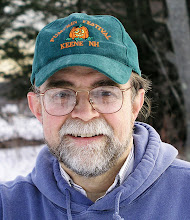
Jeff Newcomer had been a physician practicing in New Hampshire and Vermont for over 30 years. Over that time, as a member of the Conservation Commission in his home of Chesterfield New Hampshire, he has used his photography to promote the protection and appreciation of the town's wild lands. In recent years he has been transitioning his focus from medicine to photography, writing and teaching. Jeff enjoys photographing throughout New England, but has concentrated on the Monadnock Region and southern Vermont and has had a long term artistic relationship with Mount Monadnock. He is a featured artist in a number of local galleries and his work is often seen in regional print, web publications and in business installations throughout the country. For years Jeff has published a calendar celebrating the beauty of The New England country-side in all seasons. All of the proceeds from his New England Reflections Calendar have gone to support the Pulmonary Rehabilitation Program at the Cheshire Medical Center. Jeff has a strong commitment to sharing his excitement about the special beauty of our region and publishes a blog about photography in New England.
Showing posts with label Chickadee. Show all posts

Sunday, March 25, 2018

Backyard Birding


Downy Woodpecker

I am tired of waiting for the overdue hints of spring.  It is time to take matters in my own hands and post pictures of the birds that are flocking to my bird feeder.  They have been coming all winter, but they have become more enthusiastic.  I suspect they are storing up for important spring “activities”.


House Finch Pairing


Titmouse Glance

Along with a suet container, my feeder dangles just off our deck and within easy range of the sunroom.  It is still cold, but I can manage to settle in with the window cracked to get some unobstructed views of my many visitors.  From my location the 400mm lens brings me close, and with good light and an ISO of 800 I can get some great hand-held shots, holding the shutter at 1/500 to 1/1250 the of a second.  

These nervous little birds tend to flit in and out quickly, but I can often hold my focus long enough to get what I want.


Feeders, Spofford


Junco Lair

In a few short sittings, I have been able to capture Tufted Titmice, Gold Finches, House Finches, Purple Finch, Juncos, Downy Woodpeckers, Northern Cardinals and, of course, endless numbers of little Chickadees.  


Sparrow Bokeh


This year my feeding station is not as rich and elaborate as previously.  Given the devastation of previous bear attacks, I have simplified with one small feeder which proved effective in blocking the frequent squirrel assaults.  The reduced capacity required more frequent refilling, but it is less susceptible to  damage.


Northern Cardinal


Gold Finch Snack

Bird feeder photography is simple, especially when compared  to the usual birding techniques.  There is not lying for hours on the cold damp ground waiting for something to happen.  I sit in a comfortable chair with my coffee at my side, confident that the birds will be attracted to my bait.  The birds do not appear natural when they are perched on my feeder, but I have added a branch next to the dispenser.  Very often the birds land there, waiting their turn on the feeder.

As close as I am with my 400mm lens, the background always has a nice soft Bokeh, even with f stops from 11 to 22.  


Purple Finch


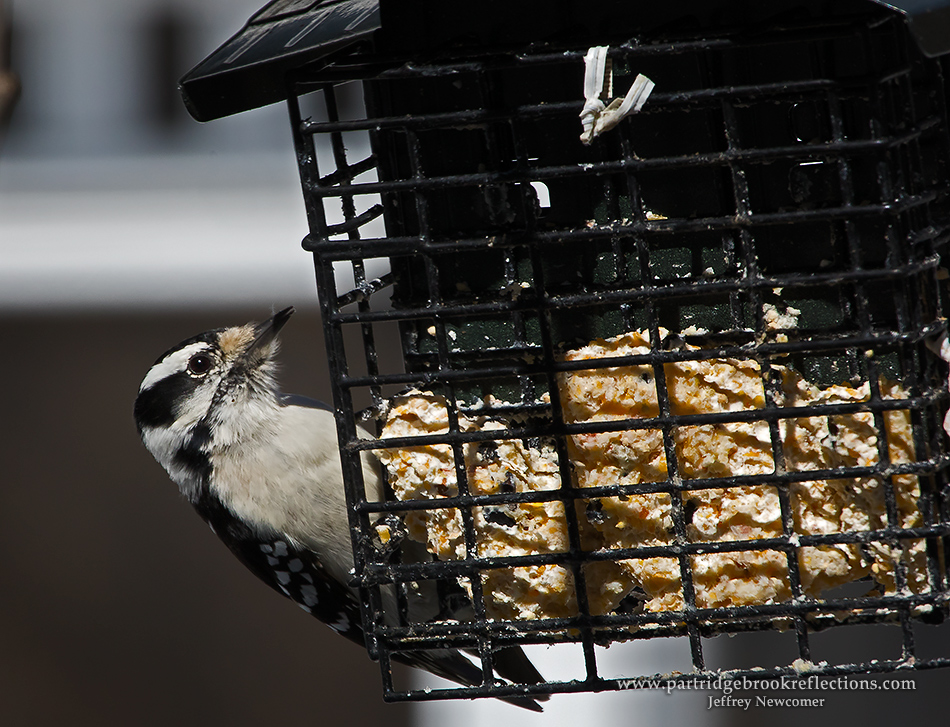
Downy Bite

I have never been able to detect when a bird will glance in the right direction or suddenly leap from the branch.  My action shots have all been a matter of luck and persistence.  I always feel fortunate if I get two or three “keepers’ from the hundreds of images I bring back to the computer, but, HEY this is Digital, and I can spare millions of trash pixels for every great shot.  


Chickadee Stare

As spring finally arrives, I’ll keep watching the greedy winged creatures.  The weather will get warm, but as the window becomes less chilly, it will be the black flies that will chase me from my spot.  All-in-all, I think I prefer the cold.  Soon it will be the threat of marauding bears that may force an end to my bird feeder season.   

Chickadee, Reach for Flight


Jeffrey Newcomer


Sunday, January 1, 2017

Bird Feeder Photography 2


Titmouse Take-Off


White Breasted Nuthatch


The birds are back to our bird feeders and, once again, I’ve been camping out in the sun room to get a front row seat.  I have always admitted to being a lazy bird photographer - I do landscapes.   Of course, I love the marvelous beauty and endless variety of birds, but I don’t have the enthusiasm of my birder friends, to crawl around in the mud and weeds for hours hoping for the perfect avian display.  


Blue Jay

I guess you could say that I photograph birds when it is unavoidable.  I couldn’t escape being a birder on the GalapagosIslands or in the rain forests of Costa Rica, where the birds are so breath-taking and uniquely accessible, but bird photography takes much more effort in New England.  Our birds are much more cautious of approaching humans.  We need some tricks.


Downy Woodpecker


Black Capped Chickadee
Knowledge of the special local opportunities can help, such as locating the lakes that are home to families of Loons, or the eagle nests that can be monitored for hatch-lings in the spring.  Much more exciting for me is when I find ways to cheat, and there is nothing easier than settling into a comfortable chair in my sun room with a cup of coffee at my side and my 100-400mm lens equipped camera in my lap, watching for the action at my feeders.  


European Starling
It is embarrassingly easy to capture a wide variety of birds as they feast on the bounty that I generously provide.  I have learned just a few tricks to get the most from photographing these greedy little creatures.


Viewing Comfort

Open Window View

First, a comfortable and unobtrusive viewing spot is important.  I have set up our feeders near the windows of our sun room.  I can settle into a chair and, without sudden movements, the birds have become unconcerned about my presence.  With my 100-400mm lens I can get up close.  I try to keep the glass clear, but reflections are a constant problem.  Fortunately, on all but the coldest days, I can crank the window open for an unobstructed view. 


House Finch
I have two feeders and a cage for suet.  The area is protected from the wind and from predators with an adjacent Yew tree.  We have tried various seed combinations, but have found that Black Oil Sunflower seeds are the most popular. From fall through spring the feeders are busy with a wide variety of birds.  The feeders commonly require filling every day.  It has kept me busy checking my Peterson Field Guide of Eastern Birds


This season our feathery visitors have included:


Chickadee
Tufted Titmouse
Downy Woodpecker
Hairy Woodpecker
Cardinal
Blue Jay
American Tree Sparrow
Blue Bird
White Breasted Nuthatch
Gold Finch
House Finch


And of Course : the industrious and, so far, frustrated Gray Squirrels


Props
Over the last couple of years, I have added perching spots for the birds, this year with a branch attached to the deck railing between the two feeders. The branches provide places for the birds to rest as they await their time on the feeders.  More importantly for me they also offer perches for photographing the birds in more natural positions.  I much prefer these organic views compared to the images of the birds hanging on the feeders.


Cardinal

 
Tufted Titmouse


In previous years, I have expanded the props to include arrangements of tree bark, and even a bird nest.  When setting out your feeders, it is important to be aware of the background.  A natural setting with trees and clear sky can help avoid distractions, especially when the background elements are far enough away to be in soft focus.  


Blue Bird

One of my favorite times to capture the winter birds is during snow storms.  The flecks of snow add a nice soft quality to the backgrounds.


Settings 
American Tree Sparrow
Camera settings largely depend on the light.  My goal is to have a fast shutter to capture birds in flight and to allow hand holding of my long lens, up to 400mm.  This usually means at least 1/400th of a second.  High ISO settings are often required, but with my Canon 5D Mark IV, I have been very happy with the quality up to an ISO of 16000.   


Junco
With the long lens, focus can be critical, but when it is nailed on the eyes, the shallow DOF creates a lovely Bokeh. The birds tend to come and go very quickly.  This is especially true of the Chickadees.  Take-offs are almost impossible to predict and it is here that shooting in burst mode can occasionally get some dramatic results.


Chickadee Take-Off : 2015


So get your feeders up help the birds survive another rough New England winter and, at the same time, settle in for some relaxed and easy birding.

Check out bird photos from the last couple of years:
Bird Feeder Gallery 

Fellow NEPG Member Jane Ogilvie has a nice article this week about her feeder:   Winter Photography at Feeders


Jeffrey Newcomer