About Me

My photo
Spofford, New Hampshire, United States
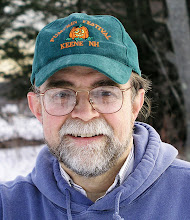
Jeff Newcomer had been a physician practicing in New Hampshire and Vermont for over 30 years. Over that time, as a member of the Conservation Commission in his home of Chesterfield New Hampshire, he has used his photography to promote the protection and appreciation of the town's wild lands. In recent years he has been transitioning his focus from medicine to photography, writing and teaching. Jeff enjoys photographing throughout New England, but has concentrated on the Monadnock Region and southern Vermont and has had a long term artistic relationship with Mount Monadnock. He is a featured artist in a number of local galleries and his work is often seen in regional print, web publications and in business installations throughout the country. For years Jeff has published a calendar celebrating the beauty of The New England country-side in all seasons. All of the proceeds from his New England Reflections Calendar have gone to support the Pulmonary Rehabilitation Program at the Cheshire Medical Center. Jeff has a strong commitment to sharing his excitement about the special beauty of our region and publishes a blog about photography in New England.
Showing posts with label Junco. Show all posts

Sunday, March 25, 2018

Backyard Birding


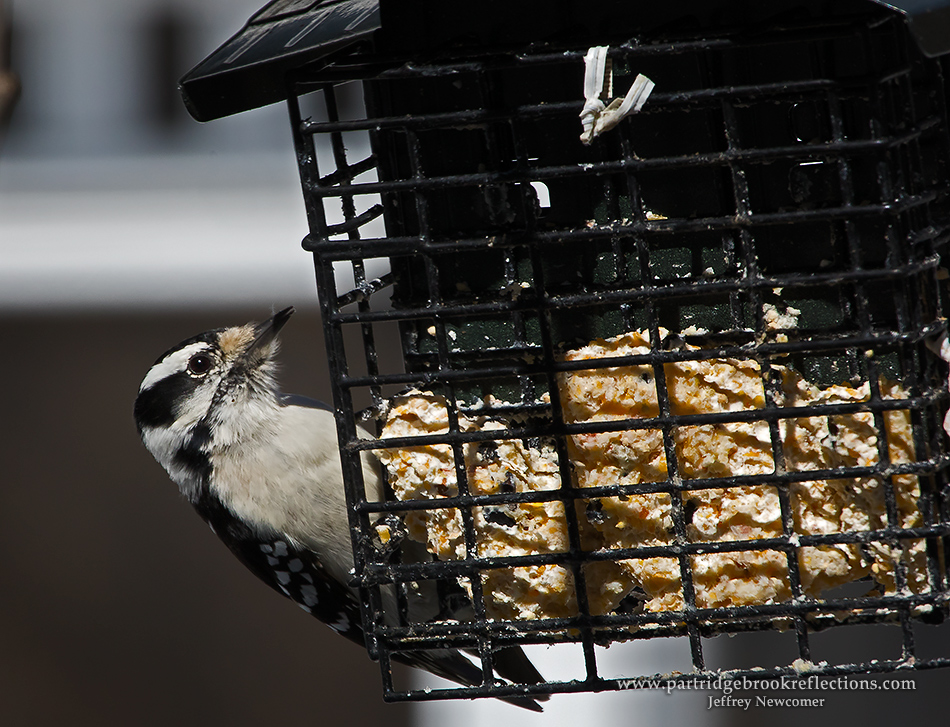
Downy Woodpecker

I am tired of waiting for the overdue hints of spring.  It is time to take matters in my own hands and post pictures of the birds that are flocking to my bird feeder.  They have been coming all winter, but they have become more enthusiastic.  I suspect they are storing up for important spring “activities”.


House Finch Pairing


Titmouse Glance

Along with a suet container, my feeder dangles just off our deck and within easy range of the sunroom.  It is still cold, but I can manage to settle in with the window cracked to get some unobstructed views of my many visitors.  From my location the 400mm lens brings me close, and with good light and an ISO of 800 I can get some great hand-held shots, holding the shutter at 1/500 to 1/1250 the of a second.  

These nervous little birds tend to flit in and out quickly, but I can often hold my focus long enough to get what I want.


Feeders, Spofford


Junco Lair

In a few short sittings, I have been able to capture Tufted Titmice, Gold Finches, House Finches, Purple Finch, Juncos, Downy Woodpeckers, Northern Cardinals and, of course, endless numbers of little Chickadees.  


Sparrow Bokeh


This year my feeding station is not as rich and elaborate as previously.  Given the devastation of previous bear attacks, I have simplified with one small feeder which proved effective in blocking the frequent squirrel assaults.  The reduced capacity required more frequent refilling, but it is less susceptible to  damage.


Northern Cardinal


Gold Finch Snack

Bird feeder photography is simple, especially when compared  to the usual birding techniques.  There is not lying for hours on the cold damp ground waiting for something to happen.  I sit in a comfortable chair with my coffee at my side, confident that the birds will be attracted to my bait.  The birds do not appear natural when they are perched on my feeder, but I have added a branch next to the dispenser.  Very often the birds land there, waiting their turn on the feeder.

As close as I am with my 400mm lens, the background always has a nice soft Bokeh, even with f stops from 11 to 22.  


Purple Finch


Downy Bite

I have never been able to detect when a bird will glance in the right direction or suddenly leap from the branch.  My action shots have all been a matter of luck and persistence.  I always feel fortunate if I get two or three “keepers’ from the hundreds of images I bring back to the computer, but, HEY this is Digital, and I can spare millions of trash pixels for every great shot.  


Chickadee Stare

As spring finally arrives, I’ll keep watching the greedy winged creatures.  The weather will get warm, but as the window becomes less chilly, it will be the black flies that will chase me from my spot.  All-in-all, I think I prefer the cold.  Soon it will be the threat of marauding bears that may force an end to my bird feeder season.   

Chickadee, Reach for Flight


Jeffrey Newcomer


Sunday, March 8, 2015

Bird Feeder Photography


In my long tradition of writing about things I know little to nothing about, I thought it would be appropriate to briefly recount the fun I have been having photographing the sturdy little birds that have been frequenting the feeders on our deck.


Given the relentless severity of this winter's weather Susan and I
Goldfinch
have tried to be especially diligent at keeping our two feeders full of Black Oil Sunflower Seeds. We are not experts on the selection of the best food for the long cold winter, but the sunflower seeds seem to be popular with a variety of birds. In the past, when we tried mixtures of various seeds and grains, but it always seemed that the sunflower seeds were a favorite, while the others were indignantly kicked onto the ground. My plan is to try adding suet to our station, but birders are always generous with their recommendations and I expect I will hear all about the best selection of feeds. Just please be kind.


Over the years I have tried to grab occasional shots of the birds visiting our feeders, usually with little success. These little creatures tend to flit in and out spending little time around the 
A Cardinal, Duh
feeder and on the rare occasions when I have caught one of our visitors it is usually a struggle to identify the species. This explains why most of my bird images carry titles such as "Yellow Bird", "Big Red" or simply "Fluff". A few weeks ago I happened to catch a beautiful bird next to the feeder that I, surprisingly, recognized as a Cardinal. I was sufficiently excited to decide that I would try to be more systematic with my feeder photographs. Of course the fact that I could shoot through the glass from the warmth of our cozy sun room probably contributed a bit to my enthusiasm.


Tufted Titmouse
After cleaning the sun room window, I slowly crept up to the glass cradling my 100-400 lens. It took a healthy dose of the patience, a trait that I don't routinely posses, to keep the nervous birds from flitting away, but I began getting some acceptable shots. With the long lens I could get up close to see the personalities of the birds and by zooming in I was able to crop away some of the background distractions.


Still I have much to learn about getting natural appearing images of 
these fascinating creatures, but I thought I would share a few of my early images. Hopefully, in a future article I will be able to recount more of what I have learned and show better quality images. To date I have seen the Cardinal just once, but frequent visitors have included Chickadees, Tufted Titmouse's (what is the plural of Titmouse?), Juncos, Pine Siskins and American Goldfinch. Or at least that's what I think I've seen. Did I mention that I'm really new at this bird stuff.
 Junco, Fluffed Against the Cold


For now, I can only list a few early lessons and goals for future work.


Watch the Background

Unfortunately, given the location of our feeders, most of the available viewing angles suffer from background distractions such as the deck railing, the gazebo and the other feeder. I have tried to find narrow angles of view that limit these problems and I used wide apertures to soften the background contamination, but I still find the frequent need to apply some editing to the backgrounds.

Chickadee in the Evergreen

 
Rapid Shutter

Most of the birds tend to be quite high strung and nervous, making rapid shutter speeds necessary to freeze their movement. The quick shutter is also necessary to reduce the effects of camera shake when trying to hand hold my long lens. A wide aperture helps, but I still need to increase the ISO when the light is low. The use of a tripod adds stability, but it also limits the ability to quickly respond to the birds as they jump about.


Goldfinch Perch

Focus on the Eyes

As with any portrait photography, the key to proper focus is to concentrate on keeping the eyes sharp. With my subjects incessant movement, continuous focus settings such as AI Servo on my Canon, are helpful to follow the action.


Mine !


Foreground Interest
I have to remind myself that the only reason that the birds are there is to feed, but it is easy to become tired of always capturing them with the feeder in view. Not a very natural setting. I have been able to catch a few among the branches of a nearby evergreen, which is a favorite secure roosting place, but I have also experimented with the placement of a number of more photogenic perches around the feeder. Early on it seemed that a branch stuck into the snow made some of the birds skittish, but a piece of tree bark and a old Barn Swallow nest placed on the railing next to the feeder seemed to be more attractive.  With time, the branch has also become a favorite perching spot.


Titmouse in the Nest


Goldfinch on the Branch


Birds in Motion

I found it especially challenging to catch these swift erratic birds in 
flight. I needed a shutter of at least 1/2000th to begin to capture
Titmouse Flight
their motion and that required a boost in the ISO to 1600. These little guys move incredibly quickly and are impossible to anticipate. The only thing predictable about the nervous Chickadees is that they seldom hold still for more than a second, but that behavior actually made them somewhat easier to catch in flight. At least I knew that when they landed on the perch they would be taking off a second later and I could fire a burst of images. The rest of the birds tended to dawdled around the feeder making their launch times impossible to predict. Thank goodness for digital photography. I didn't worry about the fact that I got one decent image for everything 20-30 exposures.


Chickadee Take-Off, While a Pine Siskin Watches


The Squirrel Issue


Please Sir, May I Have Some More?
We have our share of Grey and Red Squirrel in the yard. In the past we had tried various "Squirrel-proof" feeders all with little effect. Their greatest value has come from the entertainment of watching the ingenious long tailed rodents figure out how to defeat each device. Actually the Squirrels have seemed less bothersome since we stopped trying to thwart them. They seem to be concentrating more on the seeds on the ground, and, after all, their struggle to survive the harsh winter is no less perilous than our glutinous winged visitors.


Titmouse on the Bark


 I love the special photographic opportunities that a New England winter provides, but we are reaching the inevitable "Enough is Enough" part of the season. I'm ready for some signs of spring and this year our bird feeders have provided an especially welcome distraction from the record breaking cold and snow. I have a lot to learn, but eventually I may even be able to identify most of our winged friends.


And speaking of avian harbingers of spring, I discovered yesterday that the Eagles are back on the Connecticut River in Chesterfield, NH.  They seemed to be focusing on nest renovations, so hopefully we will see some action this year.  It is a long reach to the nest on the Connecticut and I've discovered that It is much easier to get sharp images when the birds are only a few feet away.


Jeffrey Newcomer

Partridgebrookreflections.com

Sunday, January 5, 2014

Accidental Bird Photography


Staying Off the Cold Ground!

Red Tail Hawk

Bird Torment
 This week I have the pleasure of talking about something that I have repeatedly insisted that I know nothing about, bird photography.  Some of my reluctance for shooting birds may come from early experiences of being tortured by the family Parquet, but a recent experience  got me thinking about my mostly, accidental bird photography.


A few days ago, I was doing errands around Keene, NH and I happened to see a regal appearing Hawk enthroned on a road-side sign.  Not wanting to be rear-ended, I continued down the road until
Road-Side Red Tail Hawk
I could safely turn around.  Fortunately I am almost never in the car without a camera.  Often my "carry around" camera is a Canon G11, but on this day the good news was that I had my Canon 5D Mark II.  The bad news was that I only had my workhorse 24-105 lens.  I would have loved to have been lugging my 100-400 lens with the new 2x tele converter.  800mm would have been incredible, but the important thing was to have a camera, any camera, in the car.  There was no cover, so I slowly approached the bird along the road.  I kept shooting knowing that at any moment the hawk might be startled by me or, more likely, the thundering traffic. Although the bird was stationary, I kept the camera set with high ISO and fast shutter anticipating the take-off.  When the Hawk eventually decided it was time to move on, I was able to grab a few sharp in-flight shots.  it was a treat and the whole experience got me thinking about the importance of having a camera always on hand and making do with what you have.  It was a perfect example of how I shoot birds.  I am a dedicated accidental birder.


I have immense respect for serious bird photographers. To be good
Barred Owl, Sugar Hill, NH
they must often spend hours stalking and waiting upon their prey.  This frequently involves long vigils.  When lucky, they are enclosed in a cold blind, but when less lucky their spot may be the frigid damp ground.  Birds are skittish, moving targets and may only offer quick glimpses of their beauty, requiring long, fast glass to catch the moment.  Perhaps most importantly birders  must be careful students of the habits of their targets.  Understanding bird behavior is a key to successful bird photography.  These guys have to possess levels of  knowledge, dedication and persistence that I find truly remarkable.
Barn Swallows Targeting My Car
I, on the other hand, am a landscape photographer, and no small part of the reason for that is that trees, mountains and lakes do not require stalking, and they don't skitter away when approached too quickly.  Of course there are many challenges to landscape photography.  Early mornings, cold weather, and missed diners, but seriously, I rarely have to spend hours laying in the dirt waiting for a rock to favor me with an appearance.


The Accidental Birder

All this said, I do occasionally grab an image of a bird.  Usually this happens when an annoying winged beast flies across my view when I am trying to capture a majestic landscape.  I have no choice but to wait until the little creep flies out of frame or try to grab a few images, hope that I might be able to  incorporate the guy into the scene in some poetic way.  Seriously, I love images of these glorious winged creatures, but my bird photography tends to be more accidental and opportunistic.  I rarely stalk, but I do try to be prepared to grab the chances when they arise, and that is what accidental bird photography is all  about.


You Can't Shoot it if You Don't Have a Camera

 We can talk about the best equipment for bird photography, but the first step of accidental birding is just to have a camera with you, and although they are getting much better, I'm not talking about a cell phone.  On the rare occasion that I go out purposefully to shoot birds, I pack my full kit; my DSLR, 100-400mm Canon glass, my 2x tele-extender and tripod, but more often I find my best subjects when looking for other opportunities.  Then it is a matter of getting the most out of whatever equipment I have within reach.

Using What you Have
Most importantly, when I can't use my fully phallic glass to close in on my subject, I have to zoom with my feet.  I try to avoid crawling

Sea Gull off the Isles of Shoals
but slow patient movement can narrow the distance.  In the end, to get a dramatic shot, I usually still have to crop in quite a bit and having the most pixels to start with is crucial.  Cropping out half of a 24 megapixel image still leaves 12 megs to deal with, but, if I start with 8 megapixels the quality is bound to suffer.  A camera with good high ISO capability is also important. Birds in motion require fast shutter speeds and  have learned to adjust the ISO to whatever is required to keep the shutter fast enough to catch the action. My Red Tail Hawk in flight was frozen with the shutter at 1/800th, requiring  an ISO of 800 at f 9.  Of course you can shoot birds with your point and shoot or even with a camera phone, but this is a situation where better gear does make a difference.  The first rule is to always carry a camera, but the second, and nearly as important, rule is to carry to best camera you can practically manage.

Seeing the Birds (The Power of Selective Vision)
In the early autumn of 2012 I joined a group of New England

Peacham, Vermont
Photography Guild members for quick day trip exploring the color in Vermont's Northeast Kingdom.  On the way home I drove with John Vose who is a great bird photographer.  As we ambled through the beautiful rural Vermont country-side, it became obvious that while I was watching the flow of the landscape looking for magic combinations of  foreground and background, John was scanning the trees for wildlife.  We each had entirely different ways of seeing and I found it very difficult to redirect my focus to catch the opportunities that he seemed to discover so
Cloud Forest Tucan
easily. The most impressive example of this capability for selective vision came during a trip to Maquipucuna, an immense wildlife preserve in the Ecuadorian cloud forest.   Our guide had the remarkable ability to spot exotic birds hidden in the canopy 100's of yards away. How he saw birds that I could barely make-out with binoculars remained a total mystery.


Shooting Birds, On Purpose!
Since I don't have the magic vision, I occasionally depend on

Blue Heron Nest, Westmoreland, NH
specific  locations that are suggested by my birder friends.  These may take the form of accessible nests or wet lands, any place that I can set up my tripod and settle into a lawn chair with my coffee and Ipod.  I have to be especially inspired to sit for hours waiting for the action.  Inspiration has come with the activities around a Blue Heron Nest on Harvey Pond in Westmoreland, NH or watching for Bald Eagles to return to a nest on the Connecticut River.   Closer to home I can catch the visitors to our bird feeder or check the activity in our barn as the swallows nest and enthusiastically poop on my car.


Bird Feeder Junco


Baby Albatross, Galapagos Islands
The experience that almost turned me into a birder was our trip to the unique Galapagos Islands in Ecuador.  The place is a birder paradise. With the wildlife so close that you have to step over them.  Even I could get intimate studies of the remarkably varied fauna.  It was an amazing experience, but it also spoiled me for the effort required to chase down New England birds. 


Blue Footed Booby, Galapagos Islands


As I get older it becomes increasingly unlikely that I will ever be attracted to hours of lying on the cold ground hoping for a feathered glimpse, but I will continue to keep the camera close,  ready for  the occasional happy accident to fly by.  Now can someone please hook me up with a Snowy Owl?


Landing Pattern, Harvey Pond


Jeffrey Newcomer
Partridgebrookreflections.com