About Me

My photo
Spofford, New Hampshire, United States
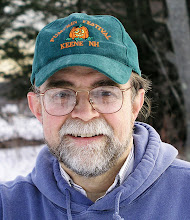
Jeff Newcomer had been a physician practicing in New Hampshire and Vermont for over 30 years. Over that time, as a member of the Conservation Commission in his home of Chesterfield New Hampshire, he has used his photography to promote the protection and appreciation of the town's wild lands. In recent years he has been transitioning his focus from medicine to photography, writing and teaching. Jeff enjoys photographing throughout New England, but has concentrated on the Monadnock Region and southern Vermont and has had a long term artistic relationship with Mount Monadnock. He is a featured artist in a number of local galleries and his work is often seen in regional print, web publications and in business installations throughout the country. For years Jeff has published a calendar celebrating the beauty of The New England country-side in all seasons. All of the proceeds from his New England Reflections Calendar have gone to support the Pulmonary Rehabilitation Program at the Cheshire Medical Center. Jeff has a strong commitment to sharing his excitement about the special beauty of our region and publishes a blog about photography in New England.
Showing posts with label Old faithful. Show all posts

Saturday, April 13, 2013

Night Time Photography, Searching for the Milky Way


Ancient Light, Westmoreland, New Hampshire


 Finding the Milky Way is an important step in getting great images of the night sky.  I've found a nice program that makes the search much easier.

This week is the International Dark Sky Week, to focus attention on the growing impact of light pollution on our ability to appreciate the
Night Photography, Old faithful
Old Faithful Geyser & the Milky Way
Yellowstone, Wyoming
glorious beauty of the night sky. Recently star photography has become very popular. The new, highly sensitive digital cameras have made it possible to look deeply into space, reveling dense star fields that couldn’t be imagined by the naked eye. Star field photography involves special techniques to capture the best depth of view, while limiting star movement and noise. It typically involves a balance between high ISO noise and the motion blur that occurs at longer shutter speeds. I have discussed star track photography in a previous article and there are many excellent, detailed tutorials which describe this process as well as techniques to record the stars as points of light. Fellow New England Photography Guild member Mike Blanchette, has wonderful series of articles in our NEPG Blog, beginning with "Aim for the Stars". Without much effort you can learn the simple requirements for stunning star photography, but in addition to the technical aspects, it is crucial to know when and where to look for the best show. 


Searching For the Milky Way
Nice Stars but No Way
Finding a location with limited light pollution and something interesting to place in the foreground is important, but, very often, the key factor is finding the Milky Way. Any review of star field images will show that the most of the striking star pictures include the Milky Way. A good part of its appeal comes from how difficult it is to see with unaided eye. Here in the country, with only a modest amount of light pollution, the Milky Way is usually seen as a vague smudge across the sky, hence the reference to Milky. Forget about it in the city.


When I first started capturing images of the night sky, I was stunned by how brilliantly the Milky Way exploded into my images. With the
Mt Hood and Milky Way, Night Time Photography
Milky Way Rising Over Mt Hood, Oregon
combination of high ISO and a long exposure, light from millions of distant suns becomes gloriously apparent in all of its luminous colors. But how do you find the Milky Way. How can you predict when it will be up in the sky, and how can you predict its location so you can find a view point with low light pollution and interesting foreground elements. In our region the Milky Way is highest in the sky during the summer months, sadly when the atmosphere is less clear, but it does show up this time of year especially in the early morning. My friends on the coast have an easier time finding clear views of the horizon across the water, while I must find high points with a view in the right direction.


There are many good night sky programs, which are wonderful for identifying constellations and planets, but often these are not great for locating the Milky Way and predicting the sky’s appearance in different locations on specific nights. If the program does not show the Milky Way, it is helpful to know that it is most prominent between the constellations of Sagittarius and Scorpio, but this doesn’t provide a sense of the full display across the sky. Enter Stellarium.


Stellarium

I haven’t done an exhaustive search but I have found a great free-ware program that does a beautiful job. It is a bit like a nighttime version of the Photographer’s Ephemeris. Stellarium is a free open source
Stellarium program finds the Milky Way, night time Photography
Stellarium : Chesterfield, NH
planetarium. It shows a realistic sky in 3D, just like what you would see with the naked eye, binoculars or a telescope. You can easily move the point of view to any GPS Coordinates or choose from a rather overly exhaustive list of locations. The date and time of day is easily adjustable and the sky shows the effects of developing sunrise and sunset. The range of possible display adjustment is amazing. Of
course you can show the constellations and planets, but you can also
Milky Way, As Predicted
Chesterfield, NH

adjust the level of atmospheric disruption and even the number of shooting star per hour. Most importantly for me, the program shows the full extent of the Milky Way. Once you select the date and your location, you can click through the hours watching the Milky Way appear and progress across the sky. Last weekend I used the program to find the Milky Way in the southern sky just before dawn. I was able to find a dark location with a clear view of the horizon. I was still competing with light from Brattleboro, the approaching sunrise, and scattered clouds, but Stellarium showed me what to expect and confirmed that I might be able to get a better look if I get there a little earlier next weekend.


Stellarium is one of those rare programs that beautifully solves a specific problem and it is FREE. Give it a try. You will find many other interesting features. One of my favorites is that, when you click on a star, the program tells you the name of the star and its distance in light years. The program is not a glitzy multimedia experience. I doesn’t offer high resolution images of the planets or other nighttime features, but for dynamically following the sky, it is great. The program is currently available for Mac, PC and Linux. An iPad version is out there but it doesn’t seem to be available in this country. I’m sure there other programs that work similarly. I would love to hear about them, but you can’t beat the price. 


Wish for some nice clear weather over the next couple of days and get ready to get up early.


Stellarium Web Site

Jeffrey Newcomer
partridgebrookreflections.com

Sunday, February 3, 2013

Taking a Fresh Look at Your Photography


How did I miss this yawning Galapagos Sea Lion?
Dope Slaps From the Past

Last week, as I was preparing my article about dealing with Chromatic
Aberration, I searched my RAW archives for images that demonstrated the phenomena. I eventually found some good examples, but I was reminded that, whenever I wander about in my archives, I always find neglected treasures. Images that I can't believe I left behind, unrealized.  All of the images here, except the broad Brattleboro glade, were rediscoverd during this one search.

Maine Shore Rediscovered
Pemaquid Shore, Maine
New Harbor Buoys, Maine


I know why it happens. When I get home from a shoot, I upload the images, convert them to DNG, geotag them, add appropriate meta data and rename. I then dive in, excited to get to work on the pictures with the most potential. There are always images that are obvious misses. I delete some, but not as many as I should. If I'm lucky there are a few that are worth further effort. I try to remember to label these with a yellow flags. As I complete work on the best, I change the flag to green on the parent RAW files, but inevitably, before I can get back to all my "yellows", I come back from my next shoot and the poor orphan images are forgotten. 


 Autumn Rediscovered
Minnewawa Brook, Marlborough, NH
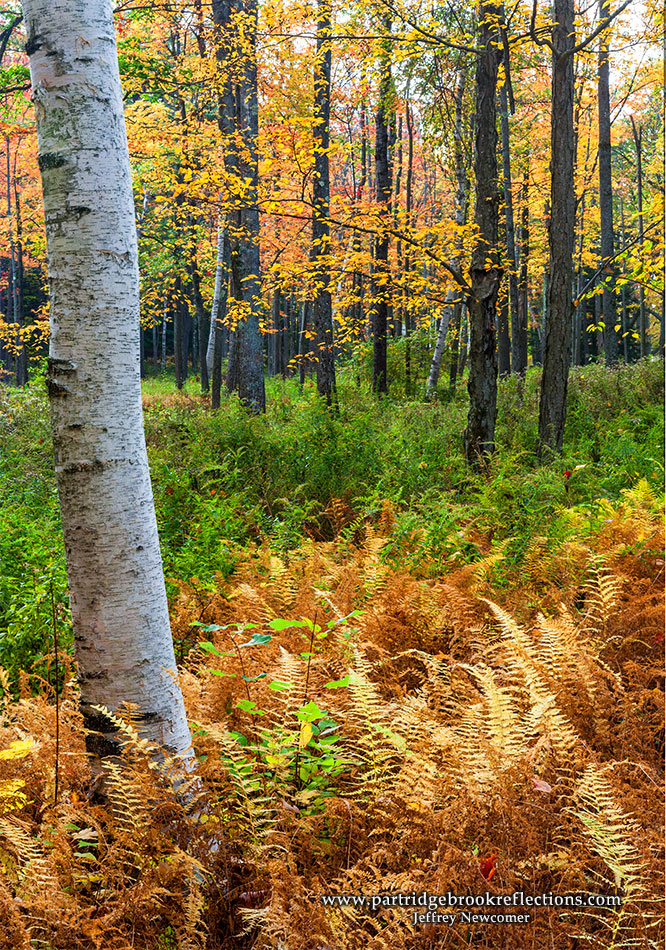
Golden Ferns, Spofford, NH


Bratttleboro Glade, My first Look
The sadly neglected images may be of entirely different subjects, but more often they are just different perspectives on familiar locations. The remarkable thing is that, when I return to these archives after months or years, I see them with a fresh eye. My usual thought is, "How could I have possibly missed that!". It is like mining for hidden treasure. Of course, when I find "new" images, I have to stop and edit them right away. I know that, if I move on, they may be lost forever. Last fall I captured
 some shots of the leaves outside of my old office in Brattleboro, Vermont. I ended up printing a nice broad image of the glade, but when I revisited the archive last week, a previously ignored close-up leaped out at me. After a well desired, self-inflicted, dope slap, I got to work on the image and now I like it much better than the original, rather routine, rendering.


I prefer this, new found, view of the glade in Brattleboro

 So my quick search for Chromatic Aberration became an exciting, several hours long, treasure hunt. I salvaged images from a previous ride along the Maine coast, autumn color from seasons past, our trip to Yellowstone last summer and from our amazing 2009 trip to the Galapagos Islands.


 Yellowstone Rediscovered
Faithful Run-Off, Yellowstone
Blue Recovery: Fringed Gentian


The value of a fresh look is remarkable and I urge you to take the
Sally Lightfoot Watching the Galapagos Sunset
journey regularly. You have a treasure chest of lonely pixels just waiting to be liberated. As for me, I plan to make a habit, each month, of scanning the archives from previous years. Not only do I expect to find “new” images, but I trust I will be reminded of locations that are worth another visit, perhaps with a new perspective. So get your fresh eye focused, dive back into those archives and get ready for the dope slaps.


Galapagos Islands Rediscovered

Galapagos Sea Lion Blocking our way home

Thursday, August 16, 2012

Photography in Yellowstone


Old Faith in the Dawn Light


How to get Geysered Out in 3 Days


I apologize for being largely out of touch and late with this posting. Susan and I are into our eighth day of our western trip, and we have been out straight trying to pack as much as we can into the short time we have in each location. This all started with an invitation to the wedding of our good friend’s daughter, Katherine, in Hood River Oregon. Of course, we took advantage of the event to take a couple of weeks to get there, visiting Yellowstone and Teton National Parks in Wyoming on the way.


Great Fountain Geyser
We flew to Salt Lake and then drove to Yellowstone, staying in a cabin at the Old Faithful area. Our 3 days in Yellowstone were wonderful, but completely inadequate for the exploration of our nations largest park. We got up early, and came back late, exhausted. I have had time only to upload, location tag and label my images. I have, at this point, processed just a few of the pictures to share but I’m sure I will be working on these for months to come.

I feel quite nervous about sharing my observations of Yellowstone since Gustav W. Verderber, a fellow New England Photography Guild member, literally wrote the book on the topic. Gustav’s beautifully illustrated guide “Photographing Yellowstone National Park” was a great help on our trip. I have just a few observations to share about our experience.

White Dome Geyser
First, Yellowstone is most famous for its thermal features, especially the many geysers and hot spring. One of our first stops on entering the park was at the Firehole Lake Drive where we were lucky enough to wait only an hour before the impressive Great Fountain Geyser erupted. This geyser erupts only twice daily at irregular intervals, but just a couple of hundred yards down the road the White Dome Geyser blasts more frequently and we were able to catch the double feature. Of course Old Faithful Geyser lives up to its name erupting every 60 to 90 minutes to the delight of the vast crowd encircling the scene. The geysers are unique and dramatic examples of nature’s power, but after the first day I began feeling a bit geysered out. I began looking for different ways to see the eruptions, and we increasingly appreciated the park's many other attractions.


Old Faithful Dawn

Being so close to Old faithful, I had the opportunity to try a variety of approaches to this classic. On two mornings I crawled out of bed for sunrises. The clouds on the horizon were problematic and the eruptions were a bit later than I would have preferred, but I got some interesting images. On the first morning I shot with the sun in the background. On the second, with the warm light illuminating from the side, I was able to get the plume to standout against the dark sky. On our last night I got out on a remarkably clear night to record the eruption with the Milky Way in the background. There was enough faint artificial lighting during the 45 second exposure to make the geyser brilliantly visible.


Milky Way Faithful


Firehole Spring
Geysers are not the only thermal attractions at Yellowstone. The steaming fumaroles and bubbling mud pots were interesting, but, photographically, the hot springs were the most beautiful. The deep emerald pools were intensely inviting, with the colors varying depending on the temperature which affects the level of thermophilic bacteria. I almost wanted to jump in, but reminded myself that these natural hot tubs would boil my skin away in a few seconds.


Bison on the Ridge

Falls at Grand Canyon of Yellowstone
Getting away from the geysers we explored Lake Yellowstone and Yellowstone's grand canyon area. The "Grand Canyon of Yellowstone" was spectacular but the trip there through the wildlife rich Hayden Valley was even more exciting. We saw Elk, Deer, Coyotes and herds of Bison. The bison in particular caused traffic jams as they unconcernedly meandered across the road. 

Yellowstone Elk


Mystic Falls
Despite our short time in the park, we were able to get away from the crowds on a couple of hikes into Yellowstone's back country. A fairly short trek from the Biscuit Basin area took us along the Little Firehole River to the lovely Misty Falls and on our last full day in the park we took a longer hike through beautiful woods and an expansive meadow to pristine Cascade Pond. After all the bustle of the parks popular locations the quiet isolation of this spot was a welcome relief.


Susan Lost in Cascade Lake Meadow


One of the best part of this experience has been that our daughter Abigail and her boyfriend Grayson have joined us for parts of the trip. At times they split off to do considerably more aggressive hikes, but last night in Jackson Hole they actually paid for dinner. Parenthood has finally paid off! 


Abby and Grayson Waiting for Old Faithful


I could go on about this portion of our trip, but we just finished our stay in the Tetons and I have many more images that I'm anxious to process. More later.