About Me

My photo
Spofford, New Hampshire, United States
Jeff Newcomer had been a physician practicing in New Hampshire and Vermont for over 30 years. Over that time, as a member of the Conservation Commission in his home of Chesterfield New Hampshire, he has used his photography to promote the protection and appreciation of the town's wild lands. In recent years he has been transitioning his focus from medicine to photography, writing and teaching. Jeff enjoys photographing throughout New England, but has concentrated on the Monadnock Region and southern Vermont and has had a long term artistic relationship with Mount Monadnock. He is a featured artist in a number of local galleries and his work is often seen in regional print, web publications and in business installations throughout the country. For years Jeff has published a calendar celebrating the beauty of The New England country-side in all seasons. All of the proceeds from his New England Reflections Calendar have gone to support the Pulmonary Rehabilitation Program at the Cheshire Medical Center. Jeff has a strong commitment to sharing his excitement about the special beauty of our region and publishes a blog about photography in New England.
Showing posts with label Documentary. Show all posts

Tuesday, July 17, 2018

Lessons Learned for Videography and a New Project


I love a project, especially when it involves doing something that is outside of my usual experience, something I can learn from.

Recently I was excited to hear from Dan White, who is overseeing the editing of our documentary celebrating Mount Monadnock’s history and special place in our region, that the film is nearing completion.  It has been a long road, and I have been frustrated that, for many months, it seemed that I was able to contribute very little to the progress of the project.  

Ayers Chamberlain Plaque
The work is now in the capable hands of the editors, so I was excited when Dan mentioned a couple of “holes” in the material available.  Apparently, they could use more footage showing the “Carry in and Carry Out” signs at the beginning of the trails. Also, different angles on the 1949 commemorative plaque celebrating the contributions of Philip W. Ayers and Allen Chamberlain would help illustrate the work done to protect the mountain..  Yeh, a project! – so I went to work.

Relearning Video Lessons
There is much that a still photography must learn when trying to capture video and this project provided the opportunity for me to be reminded of many of the important differences in technique.


Carry In Carry Out
The White Dot Trail
The first challenge was to find attractively located “Carry in Carry Out” signs that would work for a few seconds of video.  This simple slogan captures an important point about keeping the trails pristine. In discussions with the park rangers, it became apparent that my best option was to pick up one of the signs that I could place wherever it seemed optimal.  One part of being logistically “optimal” was to bring the sign to the park headquarters where the Ayers Chamberlain plaque is located at the base of the popular White Dot trail.

Finding the Right Spot
The folks at headquarters were, as always, delightfully friendly.  They provided a nice clean sign and the duct tape to place it wherever I wanted.  Ok, this was cheating, but the sign was on a real trail and real hikers walked by.  I first attached the sign to include a view of the Monadnock Visitor’s Center and then on a nice birch, with a view up the White Dot Trail. The challenge was trying to make a video of a plane white sign appear dynamic.  I was hoping for a little wind-blown tree motion, but finally tried to include hikers passing up the White Dot trail.  By far, my favorite was a close-up of the sign with a long line of hikers tromping by. 


Scale at the Visitor Center - I Don't Want to Know

The Priority of Shutter
Shutter speed is an especially important factor when shooting video.  It is generally recommended that the shutter be set close to twice the video frame rate.  With the usual rate of around 24 frames/ second, this yields a shutter of about 1/50.  This may seem a bit slow, but motion appears smoother when the frames have a slight tendency to blur together.  On sunny days, a slow shutter may require the use of a Neutral Density Filter, when even extremely small apertures and low ISO don’t allow a slow enough shutter speeds. 

The Poster Video 
For my poster shots, I was shooting in shadow and 1/50th was not a problem to maintain, but even at the slow shutter speeds, relative wide apertures resulted in shallow depth of field.  I could have substantially increased the ISO, but in this situation, I was happy with keeping the focus on the posture


Between the Rocks
The plaque was more of a challenge since it was partially blocked in front by a bolder.  My goals were to keep the inscription legible while including a small wedge of background greenery.  I had to view the plaque on a tangent, stopping down to get adequate depth of field.  This meant that I had to increase the ISO to 800 to nudge the aperture to f7.  It is always about compromises, but video seems to tolerate higher ISOs.


It was great fun working on a video project, as little as it was.  I hope I captured some useable footage for the film.  I will deliver many more options of stills and video than seen here. As always, at best, I might expect to see it flash by in 5-10 seconds of the final documentary.  Regardless, it was exciting to have an excuse to get back into shooting moving images and remembering  all the mistakes I have made in the past.

Here are just a few lessons 
I have learned from painful mistakes:

·      Shutter speed is the first element to consider in setting the exposure.  About twice the frame rate, usually 1/50 – 1/60th.  Shutter is the priority, with aperture and ISO adjusted to achieve optimal exposure and meet any special needs.  The settings should be fixed in manual mode to avoid sudden changes in brightness.  Faster shutter speeds can be used but might result in a choppy look that can be distracting, but effective in special situations.  Check out the first hectic scenes in “Saving Private Ryan”.

·      Without special equipment such as a fluid tripod head and devices for smooth “follow focus”, limit the amount of panning and focus changes. I am a devoted “B-Roll” shooter.   I like to keep the camera steady on a tripod and cut together short takes, and I avoid auto-focus.

·      
Gina in Vertical
When I first started shooting video, I actually shot a couple of scenes with the camera held in the vertical orientation.  Duh, don’t do that unless you are one of what seems to be the majority of smart phone videographers.

·      Good audio is as essential as good video.  As can be seen in these rough clips, the audio on my camera are generally crappy.  In the final film, these clips will be overlaid with nice audio, but when I want to capture the live sound I use a separate mic and field recorder.

That’s it!  I can’t wait to see the next cut of the film and of course the final product.  In the meantime Dan, I am always ready for another project.

Jeff Newcomer
www.partridgebrookreflections.com

Sunday, December 29, 2013

The "Best" of 2013


 Best Images Stories of 2013

This is the time of year when we see many photographers showing
Graze the Fence, Alstead, NH
what they feel are their best images of the year. I decided to do the same, picking favorite images is like picking favorite children.  I found myself regretting the pictures I had to leave out more than celebrating the few selected.  I ended up with   over 100 "favorites", but chopping this down to 10 was agony.  Then it occurred to me that what was really worthy of celebration was not the images, but the experiences, the locations, the people and the ideas that I have been privileged to explore over the past 12 months.  Pretty pictures are great, but they are really just the frosting on the cake.  What attracts me to photography is the treasure hunt as I learn more about the unique beauty of our region and the hunt doesn't end when I get home. In the digital darkroom I continue to search for the best ways to uncover the full potential of my images.  My goal is always to place the viewers feet in my place, to have them feel that they have stepped into the scene.  That they can see what I saw and feel what I felt.

Why I Blog


One of the major advantages of doing a weekly blog is that it forces
Farrier's Touch
me to define a mini self-assignment every week. I must assemble images and information to highlight the beauty of a  special location or theme, or to illustrate a technical point about photographic technique or post processing.  Often my photography and study is dominated by the needs of the upcoming blog, but it is a great way to keep my photography moving forward. I usually learn much more than I teach. 

So this week, instead of sharing what I think are my best images, I want to recall some of the experiences of 2013. The images may not be considered my best, but they will hopefully recall some of the best stories of this busy year. 

If you are desperate for the pretty pictures, check out my slide show at the end of the article.   Pick whichever 10 you like.

Back Roads and Unexpected Treasures
 Many of my blogs focus on the attractions of a specific New England location, some of which are familiar to me and others that I must discover along with my readers.  Here are just a few of my favorite shoots of the past year.


Meandering Vermont's Back Roads
Mill Brook, Townsend, Vermont
One of my favorite activities is to get lost on the back roads of my region.  After years of exploration it still surprises me how easy it is to finds paths I have never explored.  I started 2013 with a meander on the back roads of southeastern Vermont. As always I found new photographic opportunities and many spots to ad to my "must return" list.
Vermont Meander


Treasures of Dummerston Vermont 
My blog article on the attractions of Dummerston, Vermont was
Dummerston Sunset
another good example of the value of self-assignment.  My home is  just across the Connecticut River, and I had many great images of this classic New England town, but the "assignment" was the stimulus to explore new areas and angles.  I think I saw just about everything in the village, except Tom Bodette, "leaving the light on". Yes there is a Motel 6 in Brattleboro.
 Dummerston, Vermont


Blow Me Down Mill, Cornish
 
Not all assignments are self generated.  Last spring I got a call from
Aspet House, St Gaudens Historic Site
Cam Mirisola, Senior Editor for New Hampshire To-Do Magazine looking for images for an up-coming article about Cornish, New Hampshire.  I already had plenty of pictures of the Cornish-Westminster Covered Bridge and St. Gauden's Historic Site, but the third site that she mentioned was entirely new to me.  Built in 1891, the Blow Me Down Mill was associated with the famous Cornish Art Colony.  I had a great time exploring the Mill From all angles.  The light was harsh and the trees bare, but I got some reasonable shots and last spring, I was reward with my images in NH To Do Magazine, including a two page spread.
 Blow Me Down Mill, Cornish, NH


Tale of Two Trees
 
I am Primarily a landscape photographer so, by definition, I love trees. This year I had the opportunity to celebrate two special trees
Only a Memory
one which is a grand champion and the other whose grandeur is only a memory.  This summer the great Red Oak in Chesterfield's Friedsam Town Forest was identified as the largest in the county.  The tree is in good shape, but, sadly, the once majestic White Oak on the hill-top of Alyson's Orchard in Walpole had to be cut to the ground this year after being irretrievably damaged by a lightning strike.  The two events gave me the opportunity to appreciate both the strength and vulnerability of these magnificent living things that do so much to enrich our experience on earth.

Tale of Two Trees


Green River
Green River, Vermont
Green River is a small village in the Vermont town of Guilford. 
The village is quintessential New England with a classic covered bridge, a lovely timber frame dam and water fall, a typically austere white New England church, a welcoming country Inn and of course the mandatory red barn.  For me, the place has been a favorite photography spot for years. No matter how many times I return, I always find new inspiration.   This year I finally, and reluctantly, shared the secret of this hidden treasure. 
Green River, Vermont


Seeing in the Dark
This was a year for exploring the night sky as everyone seemed to discover the capability of fast digital sensors to probe deep into space and time.


Comet PanSTARRS


Comet PanSTARRS
2013 brought the promise of two, potentially spectacular Comets.  As it turned out Comet ION was a disappointment, but earlier in the year I was able to chase down Comet PanSTARRS.  The comet was barely visible to the eye, but, though the power of my digital camera's high IOS capability, I was able to capture it on a couple of evenings.  I even was able to sucker my friend Bob to join me for a cold evening to see the comet from the hill at Apryl's Orchard in Walpole, New Hampshire.
Comet PanSTARRS


In Search of the Milky Way
In any photographic exploration of the night sky, the most
prominent feature by far is the Milky Way.  We have become aware of capability of high ISO sensors to show the band of light from our galaxy at an intensity far beyond the ability of our eyes to perceive,  even on the clearest night.  The digital camera has become a time machine capable of looking back in time tens of thousands of years.  This year I learned more about the techniques needed to capture the night sky, how to predict the location of the Milky Way and  how to plan my shoots to place the Galactic band behind interesting foregrounds.  The Milky Way is the obvious center of
Old Faithful & Andromeda
attention in many night sky images, but one of my favorite attractions is the Andromeda Galaxy.  Our closest neighboring large galaxy is 2.5 Million lights years away and to the unaided eye is a barely perceptible smudge in the sky, float below the constellation Cassiopeia. It is much better seen through the digital camera. I first discovered the galaxy by accident about a year and one-half ago while taking night photos of the eruption of Old Faithful in Yellowstone, but  now I'm always looking for this distant neighbor.  It is remarkable to look at light which has been traveling since the human species was in its early development.
The Glory of the Milky Way


Back to the Sea and That Means Lighthouses


Whaleback Dawn
I grew up on the New England coast and I try to get back as often as I can.  This year I was fortunate to have a few fruitful trips.  After failing last year, this year's annual summer visit to Rye Beach, NH was rewarded with a spectacular sunrise over  Whaleback
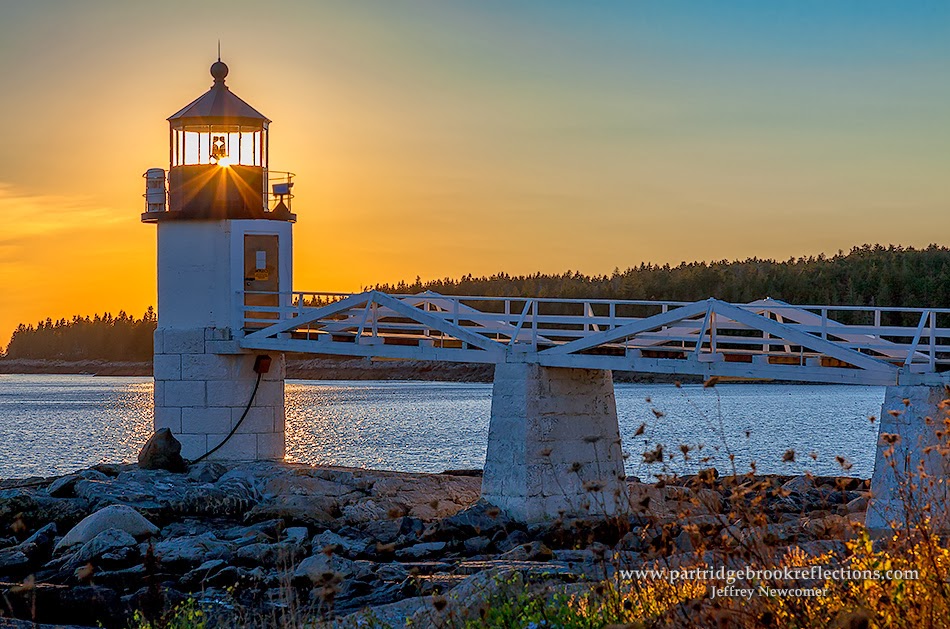
Lighthouse and a dramatic full double rainbow floating over the ocean.  In the autumn, Susan and had great time exploring around Camden, Maine.  The weather started rainy, but I was able to capture early morning light on Camden Harbor and a classic sunset at Marshall Point light.  Finally I got to Nubble Light when I was able to sneak away from an admittedly lovely wedding of the daughter of one of our good friends.

Rye Beach and Whaleback Lighthouse

Camden and the Middle Maine Coast
Atlantic Rainbow, Rye Beach, NH


Special Projects
In 2013 I had the opportunity to shift from my usual photography and explore new modes of expression.

Monadnock Documentary
In 2013 I continued to enjoy being a small contributor to Rabbit Ear Films as we work to produce a feature length documentary
about our region's iconic feature, Mount Monadnock.  Most of the filming has been completed and the difficult editing phase is underway.  Our goal is to complete the film next year.  For me it has been a unique learning experience as I have come to understand the differences between what works for video as opposed to stationary landscape photography.  As a member of the Rabbit Ear Board of Directors I am experiencing the many complexities of assembling a top quality film, from the fund raising, to coordination of script, video, music and narration, and planning for promotion and distribution.  It is fascinating, but at times it reminds me of how easy it is to go out and photograph a tree. 
Monadnock Documentary Film (Check out our Trailer)


Chesterfield Conservation Commission Web Site
This year, I finally renovated our Chesterfield Conservation 
Commission web site.  The previous site dated back to a time when I was still coding by hand in HTML.  Needless to say, it was getting very clunky.  The overhaul was simplified by the fact that I used Zenfolio, the portfolio system that I had just used to redo my own photography web site.  The Commission site is loaded with great information, including descriptions and maps of public lands, information on events and general conservation resources.  The system makes updates simple and intuitive and most importantly changes can be easily made by any member of the commission.
Chesterfield Conservation Commission Web Site


Sound
At the end of last year I upgraded my portfolio site using Zenfolio.

Recorder & Dead Cat
Part of the program is the capability to create beautiful slide shows. At first I tried adding music to the shows, but then I decided to use the sounds of nature.  I started roaming the back roads with my Zoom H4n field record looking for the sounds of birds and crickets without the background drone of civilization.  I learn how hard it was to find real quiet, how to edit audio and what exactly is a dead cat.  it was worth the effort to add the music of a New England field, the washing of waves on the Atlantic shore or the drama of a summer thunderstorm to my images.
Sounds of Nature


And Finally Christmas Lighting
My last self-assignment this year was capturing Christmas

Central Square, Keene, NH
Lighting.  My approach to this project was similar to that for  many of my blog articles.  I started by searching my photo archives for pictures of holiday lighting.  I uncovered some general themes but most importantly I discovered that I haven't shot a lot of Christmas lights. I went to work, studying the work of talented photographers, assessing where my own work had fallen short and then getting out to shoot with a fresh eye.  The goal was not just to find pretty pictures, but also to illustrate the important rules that I had learned for beautiful and memorable Christmas lights photography. 
 Christmas Lights


This process of reflection and study is a perfect example of how much I learn every week through the effort to assemble information that I hope will be of interest to my fellow photographers. No matter how much I think I know about a topic there is always more to discover.  I love sharing my fascination for photography with others, but it is the self discovery that keeps me coming back every week.  So I look forward to another year of explorations into the endless potential for artistry within the Digital Camera.  Thank you for coming along and sharing with others.


 Check out some of my favorite images from 2013, and Nature's sweat accompaniment.

Sunday, May 12, 2013

Monadnock, The Documentary Film

The Mountain That Stands Alone

"Monadnock, the Mountain that Stands Alone" will be a feature length HD Documentary with history and personal stories along with beautiful imagery and music written and composed in New Hampshire.”

 
Anyone who lives or has ever passed through the Southwestern corner of New Hampshire must be aware of the one prominent feature that identifies and defines our region. Mount Monadnock is often referred to as the mountain that stands alone. At only 3165 feet the peak is not one of the tallest in New Hampshire. In fact it just misses being included in the top one hundred, but the mountain stands more than 1000 feet higher than any peak within 30 miles in any direction. In fact geologists refer to any isolated peak, standing alone above the surrounding landscape as a "monadnock". The mountain's rocky summit offers expansive views from Mount Washington to the Buildings of downtown Boston. It is not surprising that this accessible peak is one of the most climbed in the world, but Mount Monadnock means much more to our region than merely a nice place for a hike.


Sheridan grazing under the mountain
Mount Monadnock can be seen from everywhere in the Monadnock Region and its proud, independence has marked the philosophy and character of those who live under its gaze. Much like the mountain, the Monadnock region lies somewhat isolated from the major cities of New Hampshire and New England. As I often say, the region is drawn together by miles of bad road, in every direction. As a result, the people have always looked to each other for support and to solve their problems. Mount Monadnock has remained the perfect symbol of this “independent” interdependence. 


The mountain means something different to everyone in our region. It may seem inevitable that Monadnock should remain natural and pristine, but it was only through the intense effort and dedication of many people over centuries that Monadnock has escaped the forces of development. How our mountain has been protected in its heroic state is a great story of teamwork, persistence, and quite a bit of dumb luck. It is that unappreciated story, along with how the mountain inspires people in our own time, which will be central to the upcoming feature length documentary film, "Monadnock, the Mountain that Stands Alone". 


Over the last several years I have been privileged to watch and help, in small ways, the efforts of a dedicated core of people who have been

Steve Hooper discussing the film
working on the first documentary film about our mountain. Rabbit Ear Films is led by photographer Steve Hooper and by documentary film producer and editor, Dan White. Our script has been written by Craig Brandon, author of "Monadnock More Than a Mountain". 
Larry Siegel of Westmoreland, NH is collaborating with Rabbit Ear Films to compose music for the film based on his original composition of Monadnock Tales.  Our group has been assembling
interviews, scanning archival images, and collecting video of the
mountain in all its seasons and moods. The video has all been recorded in high definition in anticipation of the production of a 90
minute, broadcast ready, film of the highest quality. Our plan is to
Dan White Editing
Image by Steve Hooper


present the documentary at film festivals, schools and historical societies. The group also will seek presentation on PBS. My role has been to contribute video of the mountain using the High Definition Video capabilities of my Canon 5D Mark II. It has been a fascinating experience learning to make the transition from still photography to video and I have come to appreciate the special demands of videography. 

Learn more about the Crew


Author Craig Brandon and  former park manager Charlie Royce
Gaze at the Mountain

All of the work on the film has been carried out by a small group of people with a broad range of talents, but a narrow focus on producing
a film worthy of its subject. Largely working as volunteers, we have made great progress, but are now reaching the final stages; the difficult, and expensive, task of melding the visual elements with music and narrative into a coherent and compelling story. We are striving to produce a top quality film on a shoe string budget, and although we have had significant financial support from generous individuals, corporations and foundations, we are looking for a final push to get us over the top for completion by the end of this year. 


We have been sharing our vision with the community.
Here in Marlborough, NH


Top quality documentary films are not cheap. Our total budget of $150,000 is really amazingly low largely because of the volunteer work that has gone into the production. For the final $15,000 that we need to complete post-production tasks, we have decided to reach out to the community of Monadnock for “crowd funding” . Now is your opportunity to help complete this project. We have begun a fund raising campaign through Indiegogo, the world's largest global crowdfunding platform. Any help no matter how small would be greatly appreciated and donating is easy AND rewarding. We are offering some nice thank-you gifts from Mt. Monadnock Magnets and Rabbit Ear Films caps, to your name in the films credits. If you are really generous we might make you an “executive producer”.

 Please check out our Donation Page and help tell the story of our unique mountain . 


Check out our film trailer at:  Extended Trailer


The mountain is calling to you.


Jeffrey Newcomer
partridgebrookreflections.com