About Me

My photo
Spofford, New Hampshire, United States
Jeff Newcomer had been a physician practicing in New Hampshire and Vermont for over 30 years. Over that time, as a member of the Conservation Commission in his home of Chesterfield New Hampshire, he has used his photography to promote the protection and appreciation of the town's wild lands. In recent years he has been transitioning his focus from medicine to photography, writing and teaching. Jeff enjoys photographing throughout New England, but has concentrated on the Monadnock Region and southern Vermont and has had a long term artistic relationship with Mount Monadnock. He is a featured artist in a number of local galleries and his work is often seen in regional print, web publications and in business installations throughout the country. For years Jeff has published a calendar celebrating the beauty of The New England country-side in all seasons. All of the proceeds from his New England Reflections Calendar have gone to support the Pulmonary Rehabilitation Program at the Cheshire Medical Center. Jeff has a strong commitment to sharing his excitement about the special beauty of our region and publishes a blog about photography in New England.

Sunday, January 23, 2011

I Do Windows ... Is That Wrong


Whenever I can't decide where to go shooting I know I can't go wrong by heading south on Route 124 from Keene NH. I don't believe there is a stretch of road in the Monadnock Region that can match the concentration of classic New England scenes along the 12 miles from Marlborough to Jaffrey. Mt. Monadnock's dramatic profile is the major attraction, but one of my favorite stops is the old Jaffrey Center with its quintessential colonial New England meeting house. It is an amazing building with an amazing story. The Jaffrey Meetinghouse was raised on June 17, 1775, the day of the Battle of Bunker Hill. It was recorded that the workers could hear the distant canon fire from Charlestown over 60 miles away.

I have captured the meetinghouse from all angles and in all seasons. On this day I was concentrating on framing the pristine white building with the surrounding trees. As I came around to the front I was horrified to discover that the three windows along the spire had been removed and replaced with black wood panels. I assume that this is part of necessary renovations, but they COULD have checked with me first! Nothing to do but take the shots. The view looking up the road to the front provides nice framing and had the added advantage of being relatively straight on making adjustments in post a little easier.
Back at home I had to decide what to do with this image. To me there was little choice. The black panels clearly did not reflect the essence of this historic structure and since my goal was not to faithfully record the progress of the renovation, I had to move some windows. This is where purist are allowed to gasp ..... OK moving on. Happily the front of the building is full of excellent candidates for copying. I elected to select the window panes to a new layer rather than cloning since this allows the necessary rotation and scaling to make the proper fit. It wasn't too complicated. Just took a tittle time. The small features, such as getting the snow on the sill to remain in front of the glass, were the most painstaking. I believe that the result represents what you see when the meetnghouse is in its glory. The windows are identical to those that were there originally and my window replacement service is A LOT cheaper.


I hope few are offended, but this is just one of the miracles of digital photography. Ansel Adams once commented on criticism he received for spotting out graffiti that had polluted the rocks on one of his classic images; "I am not enough of a purist to perpetuate the scar and thereby destroy - for me, least - the extraordinary beauty and perfection of the scene". If I am criticized I can only respond, "Ansel made me do it".

Tuesday, January 18, 2011

Dumb Luck and Foreshortening

Yesterday, after some errands in Keene NH, I decided to loop my way home through Gilsum, Alstead and Walpole to take advantage of the late afternoon light. On the way I stopped at the Filter Connection in Gilsum to pick up some sensor cleaning solution. A few years ago I was surprised to discover that a great on-line filter reseller was actually just down the road. I have since become friends with the owner and staff, but they were initially surprised when I informed them that I would be dropping by to pick up my order. Their building is remarkably unimpressive, but their stock, prices and knowledgeable support are first rate. Most importantly, they also welcome my dog Nellie to come in and play with the office canines. Check them out at 2filter.com and yes, the Lamas belong to the owner.


As I wandered along, the evening light was warm and clear, but I didn't find much that I found exciting to photograph. I had just about given up, but sometimes you just have to accept dumb luck. On the way home from Walpole, I thought I would check out how the sunset light was playing on the hilltop of Alyson's Orchard. Looking up I was floored by the nearly full moon positioned perfectly over the great Oak at the top of the hill. If anyone asks, I had checked the tables and planned my arrival for this convergence. I started at the bottom using my 400mm to magnify the moons appearance over the tree. Then I work my way up the hill. Each switchback provided different angles to exploit and also gave me a nice example of the phenomena of foreshortening with a long lens.


Foreshortening refers to the apparent enlargement of distant objects compared to the foreground when telephoto lens are used. It is argued that this is actually just an optical illusion and it is true that when taken from the same location images recorded with long and wide angle lens have the same perspective. When the wide angle image is enlarged to match the telephoto they appear identical with exception of the narrower depth of field with the telephoto. The power of foreshortening comes when you move. As can be seen in these two images, when I was further away from the subjects using a longer focal length the moon appeared much larger in relation to the tree. The upper image was taken from the bottom of the hill at 235mm, the lower was closer and at 160mm. I frequently back up to increase the size of background elements in a composition. The important thing is to avoid backing into the lake or off the cliff. So a day that hadn't been working out well ended up yielding a nice photo opportunity and a couple of images that I suspect will find their way into a talk sometime.

Dumb luck rules!

Friday, January 14, 2011

Winter Plan of Attack


I often think I have a great ideas for blog posts but invariably get discouraged by the sense that I have too much to say to keep it interesting. Eventually I get frustrated and wander off to do the never finished work of editing my images. So, lets see if I can hold myself to one simple point.


A week ago I was working on photographing this classic high pasture fence at Roads End Farm in Chesterfield NH. I have shot this fence before, but never in the winter and it reminded me of a simple rule about approaching photography in the snow; you should always plan your path of attack before beginning to shoot. In the summer I was able to roam all over this hill experimenting with different angles, but in the snow each "roam" places irreversible tracks that may scar other angles of view. Before I start tromping I try to remember to think through all the possible angles that I may want to capture. I then start shooting from the farthest locations and work my way closer only after I feel I have exhausted the more distant opportunities. At times I suspect I appear rather ridiculous as I take long circuitous routes around a scene to avoid contaminating the view. I am often tempted to run right in close to catch what looks to be the best angles, but untrampled snow is a precious resource for photography and should be treated with care. It is true that homogeneous appearing snow can be one of the simplest candidates for cloning out imperfections, but avoiding the problem saves a lot of time.


Of course, as can be seen, after I'm done with a location it is unavoidably ruined for all other photographers coming by - but, hey, they should have been up earlier!


Wednesday, April 21, 2010

Early Spring


One of the most spectacular and fleeting signs of spring in the Monadnock region is the explosion of color which engulfs Keene’s Central Square as the flowering trees burst into bloom. Every year I keep my eye on the square trying to catch the day or two of the maximum display. I am aided by reviewing my images from previous years which tell me that peak usually hits about the first week in May. This year all bets were off. Whether it was because of the unusually warm and wet March weather or due to the effects of global warming, I was surprised to find the trees already just a bit past peak when I came by to check this Monday. This was at least two weeks early. I was able to catch a only few images during short burst of sunlight, but I feel lucky that for some reason I came by to check the square. It would have been very easy to miss the show completely this year. It is just another demonstration of how you can never take New England weather for granted.

Wednesday, April 7, 2010

Crowd Control

This past weekend we loaded up a rental truck and headed down to Washington DC. My daughter Abigail just got a job as a policy analyst for a Washington DC agency dealing with social policy for low income people, and we were helping her move her stuff out of our barn and into a house in Columbia Heights. As usual my daughter chose the bedroom on the 3rd floor so much of our time was spent laboring the bed, dresser and more up the narrow stair cases. On Monday, after visiting Abby's office in the city, we finally got a brief chance to get down to see the Cherry Blossoms. It was about 4 or 5 days past peak, but still beautiful. Sadly we only had about one hour before we had to to catch a train back to New Hampshire, but I've included a few pictures on my flickr site : http://www.flickr.com/photos/27036710@N05/


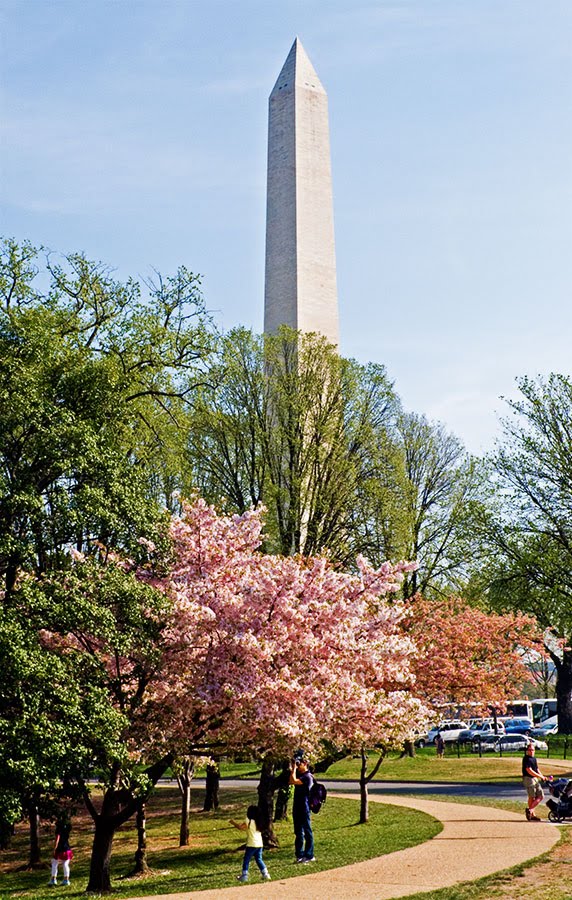
Whenever I travel to the city I am reminded of the annoying fact that crowds of people tend to gather around famous and beautiful sites. This is especially true during Washington's famous Cherry Blossom Festival. Even though the flowers were begining to fade and fall, It was hard to catch a moment when there were not hordes of people in every scene. This view of the Washington Monument was one example. I loved how the single vivid tree was framed by the curving walk-way, drawing the eye up the monument. At first there was just one persisent photographer in the scene capturing the detail of the blossoms. I stuck it out for about five minutes waiting for him to move on and was finally rewarded by the arrival of a whole family of peepers. With my wife becoming increasingly frustrated, I finally decided to give up, and instead took several images with people moving around the scene. Even though the shots were hand-held I was able to register a couple of the images closely enough to allow masking out of nearly all the tourists. One additional thing to remember when doing this kind of editing is that it is important to remove the shaddows cast by the people you have deleted. With just a little minor cloning I ended up with the final, unnaturally prestine, image. It took a little work, but there is something perversely satisfying about "eliminating" people in this nonviolent way.

Wednesday, March 24, 2010

Forty Foot Falls & Below


With all the rain recently the water has been surging over Forty Foot Falls in Surry NH. This water fall, which is part of Merriam Brook, is one of the least well known in the region, but can be quite spectacular. This anonymity is probably due to a number of factors including the fact that the falls is tucked away at the end of a neglected unmarked dirt road and is partially accessed across a decaying bridge. Unfortunately, the actual falls are at the head of a deep, narrow ravine, bordered by shear rocky cliffs. It is nearly impossible to get a full view of the falls. Probably the best angle comes from above the falls as seen here, but I have also captured views from across the bridge looking up stream. I have always felt that the best part of Forty Foot Falls is actually the other, more accessible, waterfalls and cascades that are below the tallest drop. Yesterday the flow over this section was almost too intense. Heavy flows tend to become indistinct during the long exposures required by the fading light. I had to try to find views that included rocks to break up the surge and focus on areas were the drop was more pronounced, combing the water into many smaller strands. Shorter shutter speeds can help, and I tried using an ISO of 400 with wider apertures to get the exposure to less than one second. It was great getting back out to this interesting spot. It was certainly worth dealing with the off an on rain. Photographers live for bad weather.


Sunday, March 21, 2010

Flowing Water Season

For Photographers there are really 6 seasons in New England. Winter, Spring, Summer and Fall each holds special image making opportunities, but the challenging seasons are the other two. Between the glorious fall colors of October and the pristine beauty of winter lies November, or as we call it "stick season". Although I try to find photographic opportunities during this barren period, I typically spend my time working on the back-log of autumn images while praying for snow. We are now in that other transition season, which I think should be called "flowing water season". In March the buds begin to show, but the trees are every bit as bare as in November. What saves us is the spring run-off . Waterfalls that for much of the year display a trickling flow explode in glory during this brief period. We all grab our tripods and head out to catch the satiny pattern of flowing water taken in a long exposure. Water NEVER actually looks like that, but who cares!


I finally got out for a few hours yesterday for my end of season "Calendar Tour", circling through the region picking up money and unsold 2010 New England Reflections Calendars. We had a good year, selling over 700 Calendars to benefit the Pulmonary Rehabilitation at The Cheshire Medical Center in Keene, NH. Naturally I was looking for images along the way, but yesterday was a beautiful warm sunny day - it was terrible for flowing water. There are a number of ways to deal with harsh bright light. The first is to get up early and shot during the "golden hour". Unfortunately, since I knew I had to do my store rounds when the stores were actually open, I slept late. One of first places I stopped was in Mill Hollow. The old mill sits next to Camp Brook which drains from Lake Warren in Alstead, NH. The Brook was roaring, but the bright sun was right in my face creating terrible contrast. I grabbed a few miserable pictures, but then noticed a small wisp of cloud that was creeping toward the sun. After about 15 minutes the cloud veiled the light long enough for 3 quick images. The result was a workable shot. I then spent the next 45 minutes jumping from cloud to cloud before finally moving on. By the time I took the image along the brook in Gilsum there was no chance for a cloud reprieve. Here I was able to combine ISO of 100, f20 and a polarizer to slow the shutter to a water softening 1/10 second. The problem was that, with all that depth of field, the foreground tree tended to be lost in the sharply detailed background. In this case I used the bright light as a spotlight on the tree and darkened the background in post. It's not perfect, but what do you expect from crappy light. Let the water flow ! But a Little green will be nice too.