About Me

My photo
Spofford, New Hampshire, United States
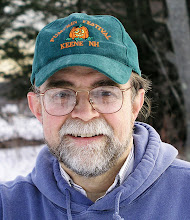
Jeff Newcomer had been a physician practicing in New Hampshire and Vermont for over 30 years. Over that time, as a member of the Conservation Commission in his home of Chesterfield New Hampshire, he has used his photography to promote the protection and appreciation of the town's wild lands. In recent years he has been transitioning his focus from medicine to photography, writing and teaching. Jeff enjoys photographing throughout New England, but has concentrated on the Monadnock Region and southern Vermont and has had a long term artistic relationship with Mount Monadnock. He is a featured artist in a number of local galleries and his work is often seen in regional print, web publications and in business installations throughout the country. For years Jeff has published a calendar celebrating the beauty of The New England country-side in all seasons. All of the proceeds from his New England Reflections Calendar have gone to support the Pulmonary Rehabilitation Program at the Cheshire Medical Center. Jeff has a strong commitment to sharing his excitement about the special beauty of our region and publishes a blog about photography in New England.
Showing posts with label birds. Show all posts

Thursday, April 9, 2026

Bear-be-Gone

Bluebird Glance


Downy Woodpecker

We are avid winter bird feeders, blowing through pounds of Black Oil Sunflower seeds every winter and being rewarded with a wide variety of feathered visitors throughout the snowy months.   We love helping our birds survive the sparse winters and it is always with reluctance that we decide to pull in our feeders as the weather warms and the snow melts away.  


Hungry Visitor (Summer 2020)
We would gladly keep the feeders up
all year round, but too often over the years our feeders and shepard’s hooks have been demolished by the spring arrival of ravenous bears.  We try to delay the inevitable for as long as possible, but with the 
halting arrival of April’s warmth, we had to accept that we needed to protect our feeders for next season, trusting that our friends will be able to forage the newly exposed ground.  

Titmouse at the Feeder

Over the years I have taken advantage of the visitors to our feeders to grab some nice and easily obtained bird photographs.  I am far from a dedicated bird photographer, but when I can grab images from a chair in my comfortably warm sunroom, even I can’t resist.  This year, as I prepared to remove the feeders, it suddenly occurred to me that I had neglected to capture any images of our glutinous visitors. Before the removal, I grabbed my chair and settled in behind a newly cleaned window overlooking the feeders.  I rested my camera with its 400mm lens on my lap and waited for the action.   

Black Capped Chickadee


House Finch

The birds are frequent attackers of the seeds coming from my feeder as well as the suet hanging from its cage, but I prefer to capture the birds in a more natural environment.  For this I attach random branches near the feeder and find a location with an uncluttered view of the birds as they perch, awaiting their turn to settle on the feeder.  I have discussed this approach in a couple of more detailed previous blogs.

Bluebird Perch


The trouble with zip tying branches to my deck railing is that in the course of a harsh New England winter the twigs got progressively pruned, to the point that my marvelous cluster of perches were reduced to a single blunt stick pointing skyward.  


Fresh Perch

Fortunately, the spring melt yielded an abundance of sticks cluttering the lawn and I was able to graft an fresh set of branches to the old structure. 


Gold Finch (Early Color)

In a short time, I was able to capture many of my feeders ”greatest hits”, including the Tufted Titmouse, House Sparrows, Nuthatch, Black Capped Chickadees, Gold Finch, and Downy Woodpecker.  I only missed the brilliant Cardinals and the fluffy Juncos.  


Of course, I couldn’t avoid our ubiquitous intruders, but hell, they didn’t ask to be Squirrels and Squirrels deserve to eat as well.  Besides who else can my dog fruitlessly chase up the trees.  


Nuthatch Hanging On

I was very pleased with the performance of my relatively new Canon R5 mirrorless camera.  With the adapter, I was able to shoot, handheld, using my old 400mm lens. Even with significant cropping, I was able to capture clear and sharp images at ISO 1600.


Gold Finch Takes Wing

Sadly, the feeders are now stored away awaiting another “birding” season.  It is amazing how quickly all my fickled feathered friends have deserted me. About all I have left are the barn swallows nesting above my car and pooping on my hood.  It’s time to enjoy the gathering warmth and await the bursting glories of spring.  Benji and I can’t wait.


Benjamin, Always Patient

Jeff Newcomer
www.partridgebrookreflections.com

Friday, August 14, 2020

Birds and a Bear


Proud Goldfinch
So here is the story.

For years Susan and I have been frustrated by periodic bear attacks on our bird feeders.  The feeder would suddenly be missing or dragged away down the embankment toward Partridge Brook, and the Sheppard hook would be bent down in a curve, often impossible to straighten.  Sometimes we could salvage the sadly mauled feeder, but after our most recent attack this summer the poor thing was devastated beyond repair.

Male Cardinal

We love our birds, with the feeders attracting Chickadees, Titmouse, Woodpeckers, Cardinals, Nuthatches, Purple and House Sparrows, and, this year, an especially prolific and brilliant collection of Goldfinch.  We could not forsake our feathered friends, so we got a new feeder and set it out among a collection of branches hung to provide convenient perching locations.  The branches also provided me the opportunity to photograph the birds in more natural appearing settings.

Chickadee
Over the last couple of weeks, the birds have gone crazy, camping on the branches, and draining our new, larger, feeder every day.  Because the bears have always attacked at night, we resumed bringing the feeder into the house every evening.  No problem?

Over the years, our feeders have probably been bear smacked 6-7 times.  It is annoying, but most frustrating for me as a photographer is that during all this time, I have never seen, much less been able to photograph, one of these felons. 


Earlier this week on my return from a walk, I noticed that the feeder was missing.  It was noon, and I knew that it could not have been a bear attack, not in the middle of a bright and busy summer day, but the feeder was gone.  And then I saw the bear lurking at the edge of the steep bank leading down to Partridge Brook. For just one second, I cursed my presumptions about daytime attacks, and then I ran into the house to get my camera, quickly attaching my 100-400mm telephoto.  When I returned outside, the bear was gone, and I cursed myself a second time for not grabbing a quick and fuzzy iPhone pic of the beast when I had the chance. I was certain that my compulsion to “gear-up” had robbed me of the chance to finally capture a shot of our bear.

The bear was nowhere to be seen and I heard no rustling in the woods.  Dejectedly, I wandered to the edge of the bank hoping to catch a glimpse of the bear retreating far below along the brook. 

Peek-a-Boo!

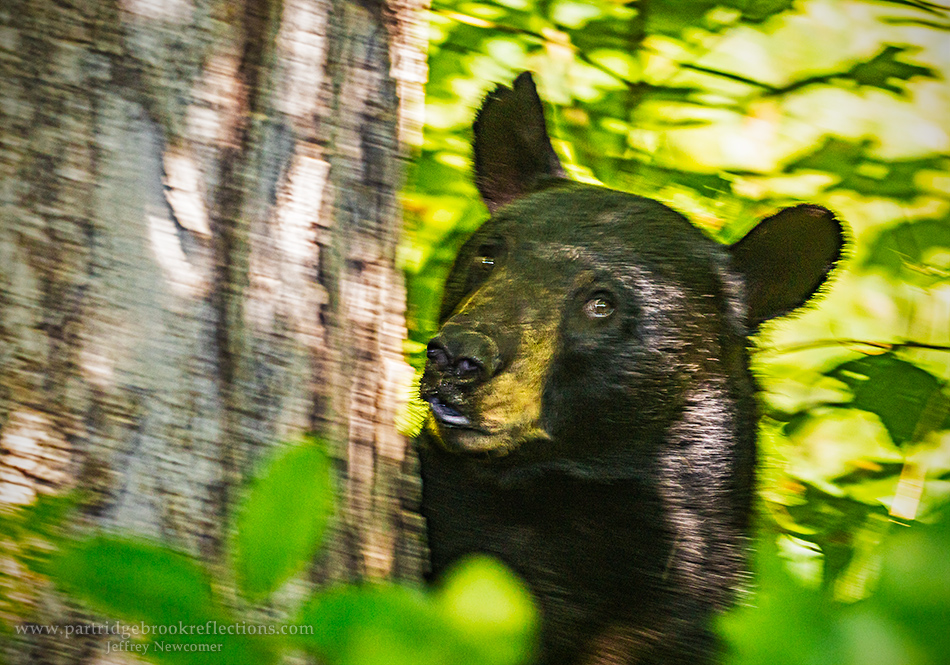
Then suddenly, a black apparition jumped from behind a tree, just 20 feet from my nearly soiled underwear. We stared, he huffed, and then something strange and stupid happened.  Before I retreated to our deck, I actually stood and snapped several quick pictures of the face-off. I don’t know what I was thinking.  I can only guess that my photographer’s brain must have taken over and refused to miss yet another chance to “bag” my bear.  I don’t remember if I attempted to focus, but I must have tried, since the focal length was 320mm and I was expecting to see something far down the bank.  I had no chance to make any other adjustments and, on aperture priority of f14, the shutter was only 1/25th second.  Not surprisingly, two of the three images were a bit blurry, but miraculously, one shot was passably sharp.  In retrospect, I am only happy that I had no pictures of massive claws descending onto my head. Good sense quickly took over, and I scampered back to the relative safety of our deck.


Again, the bear had disappeared, but just as I caught my breath, Mr. Bear returned.  He meandered along the bank edge and nearly chased us into house when he ventured further into the yard.  He turned out to be a very cooperative model, but my decision to grab my telephoto was vindicated.  I was able to get sharp close-up shots with the lens stabilized on the deck railing. He was an impressive beast, probably at least 250-300 lbs., but my estimate may have been affected by our earlier close encounter.  Incidentally, I feel comfortable referring to the bear as “he” since review of my images provided ample evidence of his gender.


I finally bagged my bear and learned some important lessons. First, we can no longer feed our birds in the summer.  Removing the feeder at night is no longer proof against increasingly bold animals.  We hope to salvage our feeder from down by the brook, but it won’t be rehung until after hibernation in the winter.  Second, being surprised by a bear, 20 feet away, is not the time for photographs – duh!  Black bears generally do not attack humans, but that was crazy.  Finally, I will miss all my beautiful birds, but during the summer they will have no problem finding food.  I will be there for them when the snow flies.


It may be awhile before I get another chance to capture such great bear shots, but I will be satisfied grabbing many more pictures of our little grandson, “Bear Cub” Owen.

Jeff Newcomer, NEPG
www.partridgebrookreflections.com


Monday, March 30, 2020

Isolation Photography 1


Photography, and especially photography in New England is always about finding ways to make the best of the condition with which you are presented. Rain, fog, snow or just “bad light” all have their own particular challenges.  Capturing special images is always about getting the most from what nature provides.

Captain Rodolph Bowles Sargent
In the last couple of weeks, we have been faced with a frightening new challenge with impacts far beyond trivial questions of photographic subjects.  We are learning about Covid 19, about disinfecting, social distancing and “flattening the curve”.  I trust we are all doing what we can to blunt the awful effects of this pandemic, and for many of us, that means isolating ourselves in our homes.  During ancient plagues, measures were a bit more draconian such as bloodletting or flagellation.  A little time at home on the couch with Netflix doesn’t seem so terrible, but we are all looking for other options for sanity preserving entertainment.  Photography could be part of the answer.


For some professional photographers, social distancing and cancellations can be a devastating issue.  I assume wedding, sports and event photographers are hurting, but for most recreational and landscape photographers, there is still plenty to shoot.  I don’t have to worry about social distancing from trees, lakes or mountains.  All I must do is stay away from other photographers.  Still, self-quarantining has affected our lives in many ways and since photography offers chances for escape from these pressures, I thought it might be helpful to suggest some photographic opportunities both in and out of the home. 


Since on the outside, we are still in the middle of the dismal gray spring “stick season”, this week I’ll start with photography within the house.

Photography “In Place”

Details Matter
We live in a beautiful part of the country, but what can you shoot when you are stuck inside of your home.  After hip surgery, a few years ago, I was largely restricted to the house.  After the Hycodan wore off, I started looking within my limited sphere for things to photograph and actually found quite a lot.  I started with macro photography, and discovered detail all around that I had never noticed before. I hobbled from room to room scanning for compositions made from some of the simplest things, a clock face, detail in an old portrait and the decoration on a gourd from the Galapagos Islands.  Indoor plants and flowers were also great subjects.


Galapagos Gourd


Back-lighting


In floral photography, precise focus is always important.  The key is to make sure that, if nothing else, the stamen is sharp, and the background is soft and uncluttered. You might try shooting some of the flowers with backlighting.  Trans-illumination can have an electric effect on the floral colors.  You will find that the indoor macro subjects are endless.  You don’t need a special camera or lens to photograph the familiar around the house, but as you move close, depth of field and shutter speed can become an issue  A tripod or some other means of stabilization can be helpful to keep your images sharp.


Finding Friends
Nellie at Eye Level
As the days of isolation pile on, photographs of our aggravated fellow human cellmates may be problematic, but our pets always seem to enjoy the heightened attention. You can get close to your cats, dogs, turtles and more – none of them can get the virus.  Since we lost our Nellie a few years ago, Susan and I have desperately missed having a dog, and never more than since we have been isolated.  It is great to catch your pets in cute or mischievous activities, as long as they have nothing to do with chewing up the toilet paper. 


Just two quick keys to better pet photography.  First get down on your knees (if they still work), or lay on the floor, to shoot your friends at eye level.  Whether you are photographing wild animals or your pets, this is always a more personal and dramatic angle.  Secondly always focus on the eyes.  Everything else can be fuzzy, but if the eyes are sharp, no one will notice.


Black-capped Chickadee
Feeder Through the  Open Window
Don’t have any pets?  Just hang a bird feeder close to house near a convenient window, sit quietly and wait for the action to start.  As we see warmer weather, you can get clearer shots by opening the window.  Again, keep the background clear of distractions, but some stage dressing can help. Try sticking a few branches into the ground to provide more natural appearing perches.  Finally, unless you want to experiment with bear photography, you might want to bring the feeder inside for the evenings.
House Finch Pair


Image Management
Drowning Pool Iceland
Finally, considering all the extra time you have on your hands, you may want to consider editing some of the piles of pictures you have clogging your hard drive(s).   I have just finished my Iceland images, and now I’m neck deep in the mass of pictures from our autumn tour of Ireland.  This is a great time to learn how to use Lightroom, Photoshop or some other image management and editing software.  If the phrase “software program” tends to give you the hives, you can always start by just deleting all those pictures of your feet or those that are hopelessly out of focus. It’s a start.


Lightroom Magic


I hope this brief discussion will trigger your own photographic exploration of your restricted space.   I would welcome your ideas about other sources of indoor inspiration.  For the members of Keene State College’s CALL program Photography Club, I look forward to seeing some of your pictures as you find ways to brighten this challenging time.   To spare my mailbox, please send only small jpg images.


Tufted Titmouse


Doolin Rainbow, Ireland


For more inspiration, check below for some other links to my relevant blogs.  Also go to Part II of my Isolation Blogs where  I will explore some of the opportunities available outside as the drab “stick season” gives way to the buds of early spring.


Jeffrey Newcomer, NEPG
www.partridgebrookreflections.com
jeffn49@myfairpoint.net

Sunday, March 25, 2018

Backyard Birding


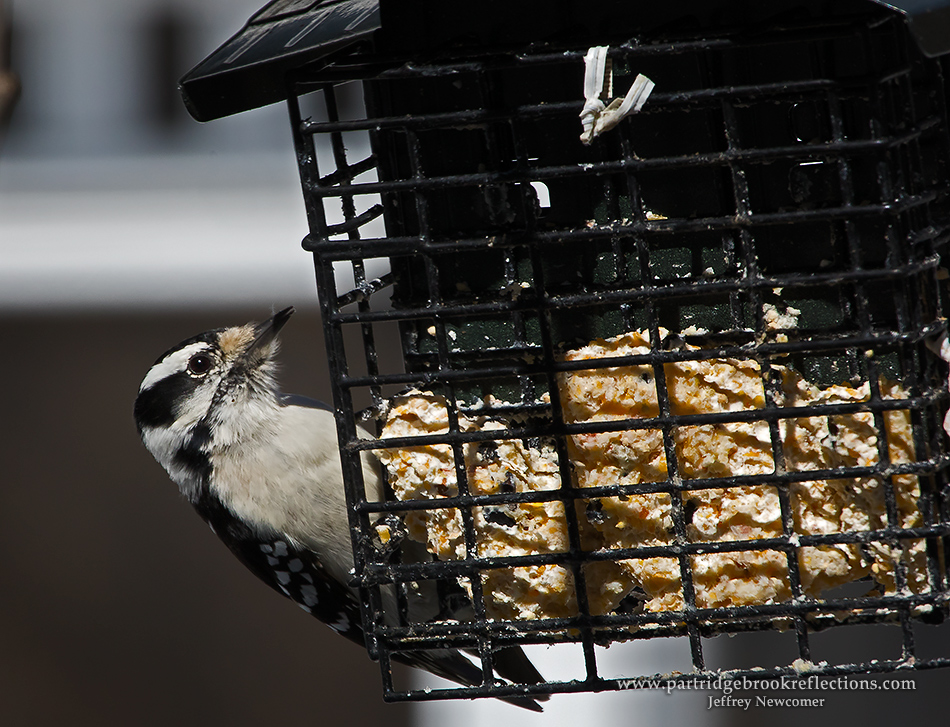
Downy Woodpecker

I am tired of waiting for the overdue hints of spring.  It is time to take matters in my own hands and post pictures of the birds that are flocking to my bird feeder.  They have been coming all winter, but they have become more enthusiastic.  I suspect they are storing up for important spring “activities”.


House Finch Pairing


Titmouse Glance

Along with a suet container, my feeder dangles just off our deck and within easy range of the sunroom.  It is still cold, but I can manage to settle in with the window cracked to get some unobstructed views of my many visitors.  From my location the 400mm lens brings me close, and with good light and an ISO of 800 I can get some great hand-held shots, holding the shutter at 1/500 to 1/1250 the of a second.  
These nervous little birds tend to flit in and out quickly, but I can often hold my focus long enough to get what I want.


Feeders, Spofford


Junco Lair

In a few short sittings, I have been able to capture Tufted Titmice, Gold Finches, House Finches, Purple Finch, Juncos, Downy Woodpeckers, Northern Cardinals and, of course, endless numbers of little Chickadees.  


Sparrow Bokeh


This year my feeding station is not as rich and elaborate as previously.  Given the devastation of previous bear attacks, I have simplified with one small feeder which proved effective in blocking the frequent squirrel assaults.  The reduced capacity required more frequent refilling, but it is less susceptible to  damage.


Northern Cardinal


Gold Finch Snack

Bird feeder photography is simple, especially when compared  to the usual birding techniques.  There is not lying for hours on the cold damp ground waiting for something to happen.  I sit in a comfortable chair with my coffee at my side, confident that the birds will be attracted to my bait.  The birds do not appear natural when they are perched on my feeder, but I have added a branch next to the dispenser.  Very often the birds land there, waiting their turn on the feeder.

As close as I am with my 400mm lens, the background always has a nice soft Bokeh, even with f stops from 11 to 22.  


Purple Finch


Downy Bite

I have never been able to detect when a bird will glance in the right direction or suddenly leap from the branch.  My action shots have all been a matter of luck and persistence.  I always feel fortunate if I get two or three “keepers’ from the hundreds of images I bring back to the computer, but, HEY this is Digital, and I can spare millions of trash pixels for every great shot.  


Chickadee Stare

As spring finally arrives, I’ll keep watching the greedy winged creatures.  The weather will get warm, but as the window becomes less chilly, it will be the black flies that will chase me from my spot.  All-in-all, I think I prefer the cold.  Soon it will be the threat of marauding bears that may force an end to my bird feeder season.   

Chickadee, Reach for Flight


Jeffrey Newcomer