About Me

My photo
Spofford, New Hampshire, United States
Jeff Newcomer had been a physician practicing in New Hampshire and Vermont for over 30 years. Over that time, as a member of the Conservation Commission in his home of Chesterfield New Hampshire, he has used his photography to promote the protection and appreciation of the town's wild lands. In recent years he has been transitioning his focus from medicine to photography, writing and teaching. Jeff enjoys photographing throughout New England, but has concentrated on the Monadnock Region and southern Vermont and has had a long term artistic relationship with Mount Monadnock. He is a featured artist in a number of local galleries and his work is often seen in regional print, web publications and in business installations throughout the country. For years Jeff has published a calendar celebrating the beauty of The New England country-side in all seasons. All of the proceeds from his New England Reflections Calendar have gone to support the Pulmonary Rehabilitation Program at the Cheshire Medical Center. Jeff has a strong commitment to sharing his excitement about the special beauty of our region and publishes a blog about photography in New England.
Showing posts with label Sugar Hill. Show all posts

Sunday, July 1, 2018

Lake Morey Retreat, Each to their Own


Misty Sunrise Lake Morey Vermont

Summer is now in full swing.  This year, we have been blessed with several opportunities to enjoy the season, and for very little money.

Last weekend we enjoyed a couple of days at the Gurney’s Resort in Newport Rhode Island, and this week, we insisted the Lake Morey Resort in northern Vermont.  Susan had won a raffle at last year’s Prouty Golf Tourney and we were treated to two nights on Lake Morey with meals, all the golf Susan could get and all the photography I could enjoy throughout the beautiful countryside.


Lake Morey Shore


Glen Falls 
Glen Falls, Lake Morey
We arrived on Sunday and while Susan hit the links, I found a Lake Morey trail map which showed a path to “Glen Falls”.  Of course. Chose the wrong trail and ended up high at the edge of the gorge.  To get to the falls, I had to slide on my but down a ridiculously steep and damp trail.  Later, I discovered that another trail easily reached the falls from a point on the lake road.  Despite my death-defying slide, the falls were worth the plunge.  I would love to return earlier in the spring, when the flow would be more dramatic.


Fields of Lupine in Sugar Hill
On Monday I headed north to see how the Lupines were standing up in Sugar Hill New Hampshire. I knew that the Lupines would be a couple of weeks past peak, but I was hoping to find some persistent color.  Sugar Hill’s Fields of LupinesFestival is typically most colorful during the first week in June, but I found a few patches of blue flowers, especially in the field below the St Mathew’s Church.  In the evening we had the chance to take a pontoon boat tour around the Lake.  Our guide, Betsy, was charming, and of course, it turned out that Susan knows her aunt.  

St. Mathew's Church, Sugar Hill, NH


Misty Sunrise
Tuesday morning, I got up early to capture the mist peacefully floating on the lake.  It was a magical time, especially as the rising sun painted the clouds.  HOURS later, Susan got up to grab one more round of golf and I explored north through the idyllic farm land to Bradford Vermont.  


Morning Pier, Lake Morey
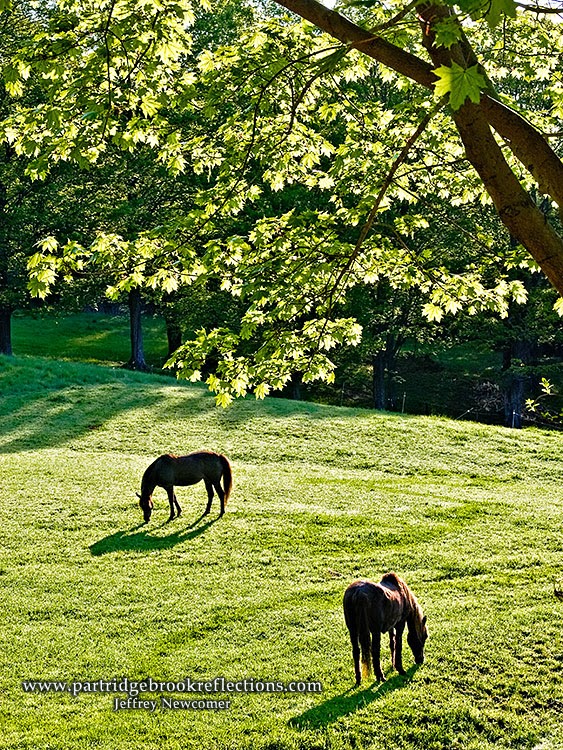
Bradford Grazing

Bradford Mill
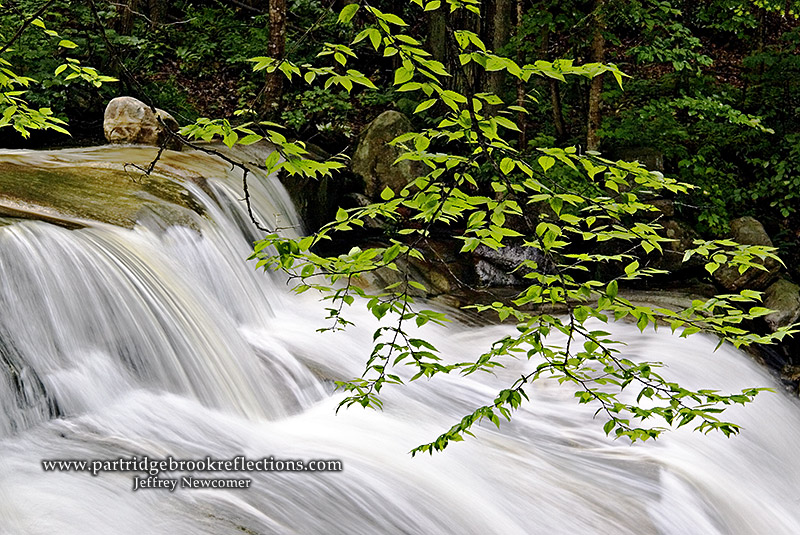
Bradford Mill on Waits River
Bradford is notable for a dramatic old mill falls formed as the Waits River Cascades toward the Connecticut River.  Even through the sun was bright, I was able to soften the falls with a combination of a polarizer and a 3 stop ND filter.


Bradford Farm


Betsy at the Helm
We had a wonderfully relaxing stay at the Lake Morey Resort.  Susan and I each had the opportunity to do what we enjoy most and the folks at the Resort could not have been more accommodating.  This weekend we are looking forward to escaping the heat to Martha’s Vineyard, where we will be staying with friends. It should be a blast, and I may actually bring along my camera.

Lake Morey Resort


Add caption
That will be the end of our “free” summer escapes.  Next comes my passive “supervision” of the construction of my new barn studio and getting ready for Abigail and Grayson’s big marriage celebration at the end of August.  Retirement is great!


Jeffrey Newcomer

Sunday, March 9, 2014

I'm DONE !


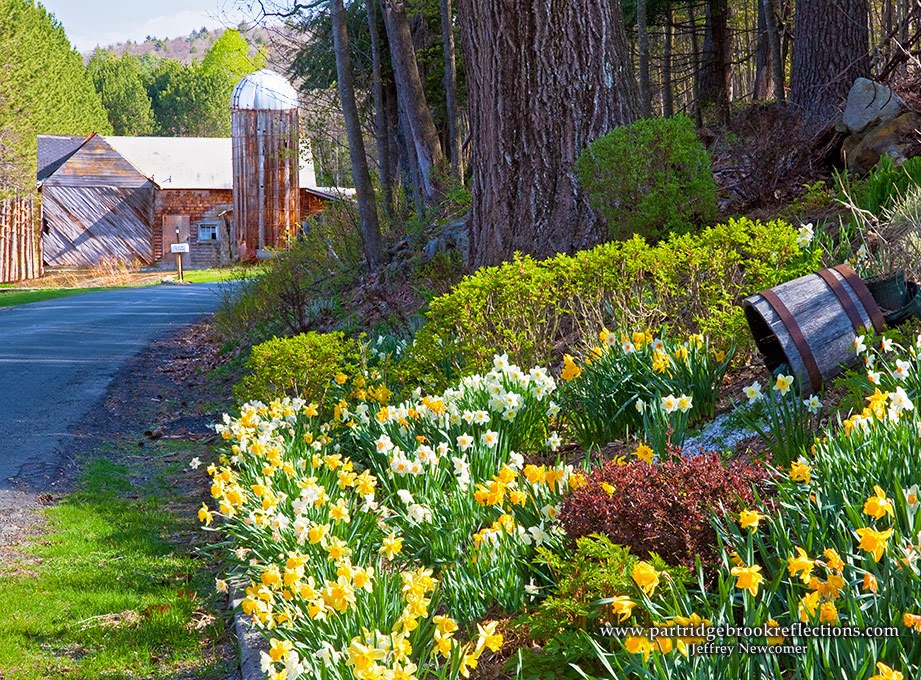
Daffodil Barn, Keene, NH

Enough with the Glorious Winter Already

Cold Franconia Sunrise
I had nearly completed my blog article for this week about the restoration of antique photographs and then it hit me.  I’M DONE.

I have always loved winter, especially the unique photographic opportunities that the pristine white blanket provides in the sparse angular light of the season.  We had a good share of snow this winter, but it is this year’s persistent body and soul numbing cold that has finally wrecked my spirit.  Perhaps it is my aging circulation that makes the cold more difficult to tolerate, but all would agree that this winter has been unusually frigid and without the occasional thaws that normally serve to trigger at least a breath of hope for nature’s resurrection.   I am hoping that by this weekend when I publish
this article the temperatures may have moderated a bit,

Perkins Pond Spring, Troy, NH
 but at this moment I REALLY need spring and I suspect that there are many out there that share my desperate longing.   So I have decided to drop everything and spend some time strolling through my spring images, selecting a few of my favorites to share with my frozen neighbors.  These may not be my most artistic images, but rather ones that speak strongly to me of the warmth and burgeoning new  life that is the essence of spring.

I hope that these few images provide a brief respite from the chill, but if not, that's ok, this one is for me.  Feel free to prolong your vernal escape by browsing the Spring Archive on my web site.


St Matthew's Lupine, Sugar Hill, NH


The Annual Lupine Festival in Sugar Hill New Hampshire, just north of Franconia Ridge, is a blast of spring color is a spectacular setting, but for me, the real attraction of spring is the endless variety and richness of the newly erupted greens. 


Fresh Green, Brattleboro, Vermont
Too soon the soft colors become fixed in their deeper shade of summer green.


Huntington Cascade, Dixville Notch, NH


Early spring is waterfall season, with the vigorous winter run-off being the main attraction until the leaves start popping out. The season comes late to New Hampshire's North Country and it is possible to follow the early spring north much like the fall colors can be tract as they move from north to south.


Table Rock, Balsams, NH


The Balsams Grand Hotel seen from Table Rock in Dixville North, New Hampshire.  Sadly the resort is now closed, but there is hope that this classic might open again with plans for an expanded ski resort.


Curious Goat, Dummerston, Vt


Spring also is reflected in the excitement of the animals as they escape from the barn into fresh pastures with the sweatiest grass of the season.  


Dawn Pasture, Dummerston, VT


This exuberance is no better seen than in Stonewall Farm's annual "Dancing of the Ladies" when the cows go wild,  running jumping and head bumping, as they are released to pasture for the first time.
 
Dancing Lady, Keene, NH


Central Square Blossoms, Keene, NH


Every spring for just a few days Keene's Central Square becomes a festival flowers.  The trick is to fine the day when the sun is full.  I can look back on the dates of old images from the event to gauge when the vigil should begin.


Orchard Maple, Walpole, NH


 Sadly, I can't anticipate that all these favorite icons of spring will return.  Tragically, the great Oak on the Hilltop at Alyson's Orchard in Walpole, New Hampshire is now only a memory It was devastated by a  lightning strike and had to be removed last fall. 


Wildflower Barn, Westmoreland, NH


Openings, Marlborough, NH


I found one of my favorite Birch groves by accident in Reading Vermont, while looking for the famous Weathersfield Birches.  I eventually discovered that fable grove is now overgrown and no longer the treasure about which I had read.  This spot was a worthy conciliation.


Spring Birches, Reading, Vt


As I complete this prayer to spring, I'm thrilled to report that yesterday the temperature climbed tentatively into the 40's.  Anything above freezing brings hope, but next week promises colder temperatures and a chance for another storm.  That's New England.  All we can do is make the best of what nature gives us and occasionally escape into our photographs to be assured that spring will come.

Slide Show of My Full Spring Archive


Oh, and one more sign of spring arrived yesterday.  I discovered that the eagles have  returned to their nest on the Connecticut River, and they appear to be faithfully on guard.  Hopefully chicks will be emerging soon.

Bald Eagles on the nest, one guarding, the other bringing supper.

Spring in New England (Photo Archive)


Jeffrey Newcomer
Partridgebrookreflections.com


Sunday, June 17, 2012

Freezing the Foliage : ISO Stacking


Getting ISO Right in the Digital Camera II


I know that I’m in trouble when I insist at the beginning of a blog that “This will be a short one”. It usually means that it will go on for pages, but this time, I am committed. I have a talk to prepare for the Worcester Camera Club and I have much more to do. I could always dust off one of my old talks, but my plan has been to do a new presentation covering a lot of the “Getting It Right in the Digital Camera” articles that I have been publishing of late. So, HONESTLY, this will be a brief extension of my recent “ISO Control” article. 


ISO 100 Moving Foliage
Two week ago I discussed the use of the expanded ISO range in many of our newer digital cameras and the benefits of being able to control ISO with the turn of a dial. The capability to adjust ISO as shooting situations change has provided an important new control over exposure. I have talked previously about the benefits of bracketing photos including both exposure and focus. ISO can also be bracketed in some challenging situations.


 ISO Stacking
In my landscape photography, I am often faced with trying to get broad depth of field in situations where the wind is moving the foliage.When I stop down to expand the depth of field the resulting long exposure usually leaves the foliage a blurry mess, especially in the foreground.

ISO 100, 1.3 Seconds
Detail


ISO 1600. 1/8 Seconds
Detail
One approach, which I have discussed before, is to focus bracket or stack, using
Stacked Image with Foliage Motion
"Painted out"
multiple images with a wider aperture to allow faster shutter speeds, but sometimes this isn’t enough to freeze the gyrating greenery and the shallow depth of field of each image may not fully overlap leaving gaps of soft focus. Another strategy is to capture an image with the aperture and shutter adjusted to freeze the motion with acceptable depth of field and then adjust the ISO to balance the exposure. This may only be required in the foreground image(s) where the motion is most noticeable. Greater noise reduction may be required for these slices, but they can then be stacked with the images taken at lower ISO to construct a complete picture with full DOF and sharp leaves, horses or whatever else was moving.  
 
 
Example:
For my example I am using the same image that illustrated my first ISO Control article.  The picture taken at ISO 100 and 1.3 seconds had the best image quality, but with blurred foliage, both on the foreground tree and in the background.  ISO 1600 gave me a shutter speed of 1/8 second which was sufficiently fast to freeze the movement and had good DOF at f20.   I simply stacked the ISO 1600 above the ISO 100, aligned the two with Auto-Align and then painted a mask to reveal the sharp foliage over the areas of blur.  With the use of noise reduction and the application of the high ISO image only where needed the final picture retained high image quality.

That’s IT. I told you this would be short. In this case the "best image from the camera" was actually two images at different ISOs.  Give it a try and let me know how it comes out.


OK, I can’t resist. Just one more point while we are talking about moving foliage. Another technique I use occasionally to freeze motion is based on the fact moving foliage does not all move at the same time. If you take a number of images at the same focal length you can often combine parts of each to isolate times when each region is relatively still. This is inevitably a tedious process of selective masking, but the results can be quite effective.

That’s it, I promise. Now off to Powerpoint.