About Me

My photo
Spofford, New Hampshire, United States
Jeff Newcomer had been a physician practicing in New Hampshire and Vermont for over 30 years. Over that time, as a member of the Conservation Commission in his home of Chesterfield New Hampshire, he has used his photography to promote the protection and appreciation of the town's wild lands. In recent years he has been transitioning his focus from medicine to photography, writing and teaching. Jeff enjoys photographing throughout New England, but has concentrated on the Monadnock Region and southern Vermont and has had a long term artistic relationship with Mount Monadnock. He is a featured artist in a number of local galleries and his work is often seen in regional print, web publications and in business installations throughout the country. For years Jeff has published a calendar celebrating the beauty of The New England country-side in all seasons. All of the proceeds from his New England Reflections Calendar have gone to support the Pulmonary Rehabilitation Program at the Cheshire Medical Center. Jeff has a strong commitment to sharing his excitement about the special beauty of our region and publishes a blog about photography in New England.
Showing posts with label sculpture. Show all posts

Sunday, July 12, 2015

The Ruth and James Arts Awards


Celebrating the Monadnock Region's Vibrant Arts Community


I am thrilled to have been selected as one of the first recipients of the Ruth and James Ewing Arts Awards, sponsored by the Keene Sentinel and Arts Alive .


Craig Stockwell


I don't generally submit my photographs to contests or for awards consideration, and there are a number of reasons for my reluctance. I would like to be able to loftily proclaim that "I don't require the acknowledgement of others to validate my work", but the truth is that I crave approval as much as most artists. No, the unfortunate fact is that I simply fear rejection far more than I require external approval.  Sad, but there are other reasons, beyond my delicate ego.


Lee Dunholter

 In recent years there has been an

Swift water, Gill Truslow
explosive increase in the number of photography contests, and often they seem to be more about profiting from submission fees than honoring excellence. Many require unreasonably broad releases, which can result in the loss of control of my images, even if I don't "win".  Then there is the lazy factor.  Given the complexity of submissions, I could spend most of my time entering contests, with little remaining for actual photography.  So, why the Ewing Arts Awards?  First it was the local focus of the awards and the remarkable people for which it was named.


Ruth & James Ewing


The Ewings
James Ewing was the owner and publisher of the Keene Sentinel and both he and his wife Ruth were strong supporters of the arts within the Monadnock Region. Local organizations that benefited included Apple Hill Chamber Music, the MacDowell Colony and the Grand Monadnock Arts Council. I can't think of any two more deserving of this recognition.


Monadnock Focus
 
The Apple Hill Quartet
Given the Monadnock Region's insulation from the rest of New Hampshire, the geographic focus of the Ewing Awards is especially appropriate. I often say that our corner of the state is drawn together by endless miles of bad road. The fact that major roads circle around us, tends to shield the Monadnock Region from the rest of the world and draws all of us together, including the artistic community. Through organizations such as the Monadnock Area Artist Association, The Art Walk and the Fall Foliage Tour, I have come to know many of our local artists, including several of this year's Ewing winners. Some of them are even willing to talk to a photographer!


Canopy, Deborah Lloyd Kaufman


The Artistic Community

 
President Lincoln, Tim Campbell


The Monadnock Region is blessed with a wide variety of marvelously talented artists and instead of focusing on a single genre, the Ewing Awards was open to all types of artists, in both the performance and visual arts. They were even willing to consider photography, and I'm especially pleased that the student winner is photographer Annika Kristiansen. I was also attracted by the fact that the awards were not based on the judging of one or two pieces, but on a greater body of work and on the relationship of the artist and his work to the Monadnock Region.


Annika Kristiansen

  
Grazing the Fence


An award focused on my home region and in the name of two remarkable community leaders, this was not your typical photography contest. So I went through the arduous process of submitting my work, my story and my ego to the prestigious panel of judges and was excited to be considered worthy to be among the 14 other amazing recipients. To me it is wonderful that, in addition to the talented painters, the judges also recognized music and dance, sculpture, set design and, yes, even photography.


Animaterra Women's Chorus


"We want to showcase in some small way the amazing creativity that surrounds us", said Keene Sentinel Editor Terrence Williams, "This is a wonderful beginning." 


I certainly agree, and all I need to do is bask in the radiant glory of these talented artists:

  • Lee Dunholter, painter and theatrical set designer, Peterborough
  • Peter Roos, painter, Walpole
  • Deborah Lloyd Kaufman, painter, Spofford
  • Gill Truslow, painter, Keene
  • Jeanne Maguire Thieme, painter, Swanzey
  • Tim Campbell, painter, sculptor, Keene
  • Annika Kristiansen, photographer, Keene (student winner)
  • Craig Stockwell, painter, Keene
  • Richard Whitney, painter, Stoddard
  • Animaterra Women’s Chorus, musical performers, Harrisville
  • Frank Wallace, classical guitarist, Antrim
  • MoCo Arts, dance performers, Keene
  • Apple Hill String Quartet, musical performers, Nelson
  • Chamber Singers of Keene, musical performers, Keene


Monadnock Orchard, Richard Whitney

Next Thursday, July 23rd, The Ewing Awards recipients will be recognized at a reception in Keene State College's Redfern Arts Center. I will try to jam 2-3 examples of my photography (those shown here) into the 48 inches of "running wall space" that has been allotted to each of the visual artists. Even "running", 48 inches isn't much, but more excitingly, there will be performances by the performing artist winners. I hope to see a few of my friends at the event.

Here are the details:

Ten visual artists and five performing artists or groups will be recognized with the first Ruth and James Ewing Arts Awards. A reception and awards program are planned for these recipients on July 23 at Redfern Arts Center on the campus of Keene State College.


Farrier's Touch
The program on July 23 will be from 6 p.m. until 7:30 p.m. with a reception to follow. It will feature a gallery showing some of the work of the visual artists and a sample of performances by the performing artist winners. The Sentinel is publishing a glossy magazine with feature stories and photography of all the winners. The magazine will first be available at the event and then will be inserted into all copies of The Sentinel the next day. 

Tickets — $25 for adults and $10 for students 18 and under — will go on sale Friday, June 26m.  Tickets can be reserve at 603-352-1234 x 1004 or aruest@keenesentinel.com.

I hope to see you there.

Jeffrey Newcomer
partridgebrookreflections.com
603-363-8338

Saturday, June 23, 2012

Saint Gaudens' Retreat


The Thornless Honey Locust in front off Aspet House has continued to thrive
since its planting in 1886, just one year after Saint-Gaudens first summered here.


August Saint-Gaudens
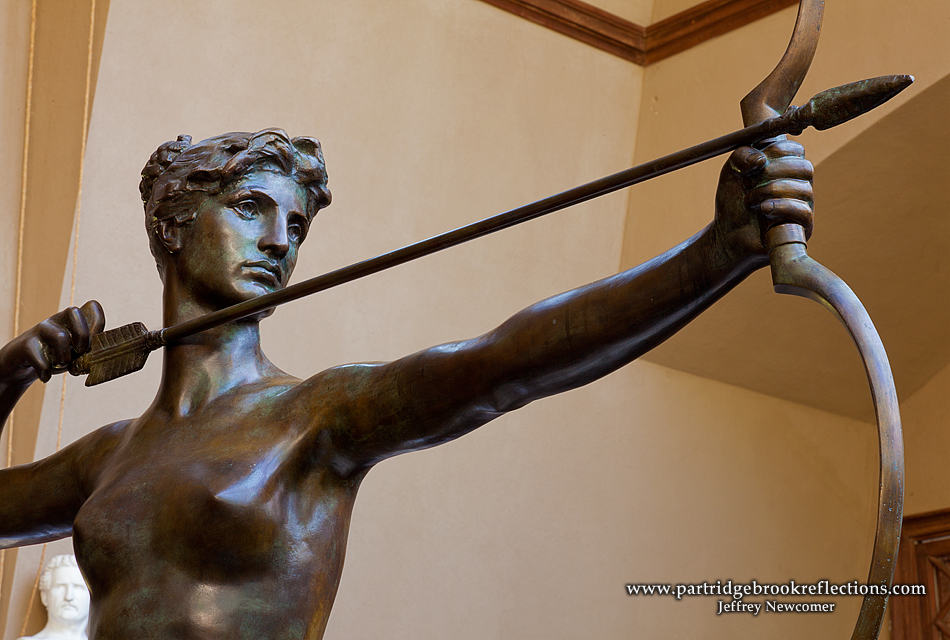
Augustus Saint-Gaudens (1848-1907) was a renown 19th century sculptor who was a leader in the renaissance of American art of that time. He was born in Ireland, raised in New York City and received his early artistic training in Europe. He is most widely known for his monumental sculptures, but also created delicate cameos. Many of his statues celebrate the heroes of the civil war and can still be seen decorating parks and other public places throughout the country. His “double Eagle” gold piece is felt to be the most beautiful American coin ever struck. Later in his life Saint-Gaudens spent much of his time at his retreat along the Connecticut River in Cornish New Hampshire. Here a distinguish group of American artists gathered, forming what became known as the “Cornish Colony”. Included among this group was Maxfield Parish, whose intensely romantic New England landscape paintings have been a strong influence on my photographic vision.


Amor Caritas
in the Atrium
After Saint Gaudens death in 1907 his estate was preserved as a National Historical site managed by the National Park Service. The park includes acres of beautiful gardens which are decorated with examples of some of Saint Gaudens' most famous works. Over 100 pieces of his sculpture are housed in a number of galleries which had been his work shops.. The artist’s home, “Aspect House” sits on a knoll overlooking Mount Ascutney. The peak, which is across the river in Vermont, was considered by Saint Gaudens to be his “Mt. Olympus" and he placed his building to take maximum of advantage of this vista. 


Mount Ascutney from the "Little Studio"


The Faragate
Cornish is only one hour north of our house, so it is surprising that my first visit to the site was just a couple of weeks ago. Sue and I traveled up along the river late in the afternoon of an unusually warm spring day and found the estate to nearly deserted. It was marvelous to wander undisturbed among the gardens and galleries. The soft afternoon light played beautifully off the sculptures, changing their appearance from moment to moment as the sun settled toward the Vermont hills. 


The Shaw Memorial
Some of the most affecting pieces included the triumphant Robert

Shaw Memorial
Gould Shaw Memorial, the Standing Lincoln and the deeply introspective Adams Memorial. All of these works still stand in their original locations throughout the country, but it is amazing how fully, and beautifully, realized are the “copies” that Saint Gaudens created and that now grace the gardens and galleries in Cornish.  Of all the works, New Englanders may be most familiar
with the Shaw Memorial which stands at the edge of Boston Common just across the street from the Massachusetts State House. Shaw was the commander of the all black 54th Massachusetts
54th Massachusetts
Infantry Regiment in the Civil War, and was killed, in July 1863, at the battle of Fort Wagner in South Carolina. The monument is a striking relief featuring Shaw on Horseback, but it is perhaps most notable for the strong, determined faces of the black soldiers marching to their fate. At a time when blacks were often represented in unflattering stereotypes, Saint-Guadens modeled about 40 portrait heads in clay before settling on the 16 that best portrayed the strength and humanity of his subjects. 


The Adams Memorial
The Adams Memorial is a much different piece of funereal art. It is

Adams Memorial
a contemplative, shrouded figure memorializing the wife of the historian Henry Adams. Adams was a member of the Adams political family and the great grandson of John Adams. His wife Marian suffered from depression and died by suicide. Adams disliked labels, and bristled when observers tried to name the sculpture “Grief”. He preferred that the work be seen as asking a question, not giving answers. The sculpture in Cornish sits in a quiet, isolated garden alcove. A marvelous aspect of sculpture in natural light is that the viewing experience can change depending on the angle and quality of the light. When I first saw the Adams memorial, the light was stark and flat, but later in the evening its features were better define and glowed in the evening illumination, and the shadows from the surrounding foliage poetically framed the figure. 


Birch Allee
Study of
Gen William Tecumseh Sherman


The Puritan
Aspet Iris


Diana in the
Little Studio
I could go on about the many remarkable pieces at Saint-Gaudens, each has its own story, but I would rather let the images speak and encourage you to find the time to come by.  Saint Gaudens' work has a power and presence that can only be fully appreciated in person. It is well worth the trip, but be sure that you give yourself enough time to quietly linger and contemplate. Contemplation is what Saint-Gaudens’ country retreat is all about. 


Diana in the Little Studio


The grounds of The Saint Gaudens Historic Site are accessible year round, but the exhibit buildings are open only from the Saturday of Memorial Day weekend to October 31 from 9:00 a.m. to 4:30 p.m. and the grounds until dusk. For more information, check out the park web site. The site includes a very helpful IPad App, which describes most of the attractions and provides a virtual tour of the grounds and galleries. 


Little Studio

http://www.nps.gov/saga/index.htm