About Me

My photo
Spofford, New Hampshire, United States
Jeff Newcomer had been a physician practicing in New Hampshire and Vermont for over 30 years. Over that time, as a member of the Conservation Commission in his home of Chesterfield New Hampshire, he has used his photography to promote the protection and appreciation of the town's wild lands. In recent years he has been transitioning his focus from medicine to photography, writing and teaching. Jeff enjoys photographing throughout New England, but has concentrated on the Monadnock Region and southern Vermont and has had a long term artistic relationship with Mount Monadnock. He is a featured artist in a number of local galleries and his work is often seen in regional print, web publications and in business installations throughout the country. For years Jeff has published a calendar celebrating the beauty of The New England country-side in all seasons. All of the proceeds from his New England Reflections Calendar have gone to support the Pulmonary Rehabilitation Program at the Cheshire Medical Center. Jeff has a strong commitment to sharing his excitement about the special beauty of our region and publishes a blog about photography in New England.
Showing posts with label Monopod. Show all posts

Monday, October 17, 2016

Walkikng Stick Camera Stabilization


It has been awhile since I have come up with an article for the “Tips and Tricks” section of my blog, but this is the time for something simple and very quick.  This week, commitments have piled up.  I am continuing my Introduction to Digital Photography course, I am working on my Fall Foliage Workshop which will begin Friday evening, and I discovered that It was my turn to publish an article for the New England Photographers blog.  The foliage Workshop has been taking most of my time as I wander all over the region checking out the color and trying to predict where it will be best over the weekend. 


So with all the demands, I decided to go quick and simple, with a trick I discovered last week to add to my options for camera stabilization.  Holding the camera steady is a key part of obtaining sharp images and, in various articles, I have discussed a range of approaches.  These have included stable hand-holding and low impact shutter release techniques (aka the “Finger Roll”), the use of external stabilizers from trees and walls to mono pods, and sturdy tripods.  They all have their place, but what if all you have is a simple hiking pole?

Blue Hour Autumn
Balancing on the Stick
A few days ago I stopped on the side of the road to try to capture an autumn scene in the last of the evening light.  Susan and I were coming home from a concert by the great Apple Hill String Quartet.  On the way to the concert, I had caught a glimpse of a narrow path cut in the foliage, and I hoped that there would be enough light to grab an image on the way home.  By the time we returned, the scene was already into the blue hour.  Of course I had no tripod or monopod.  I needed some source of external stabilization and my only choice was my walking stick.  I balanced the camera firmly on the top of the stick, but with only marginal results.

Eureka
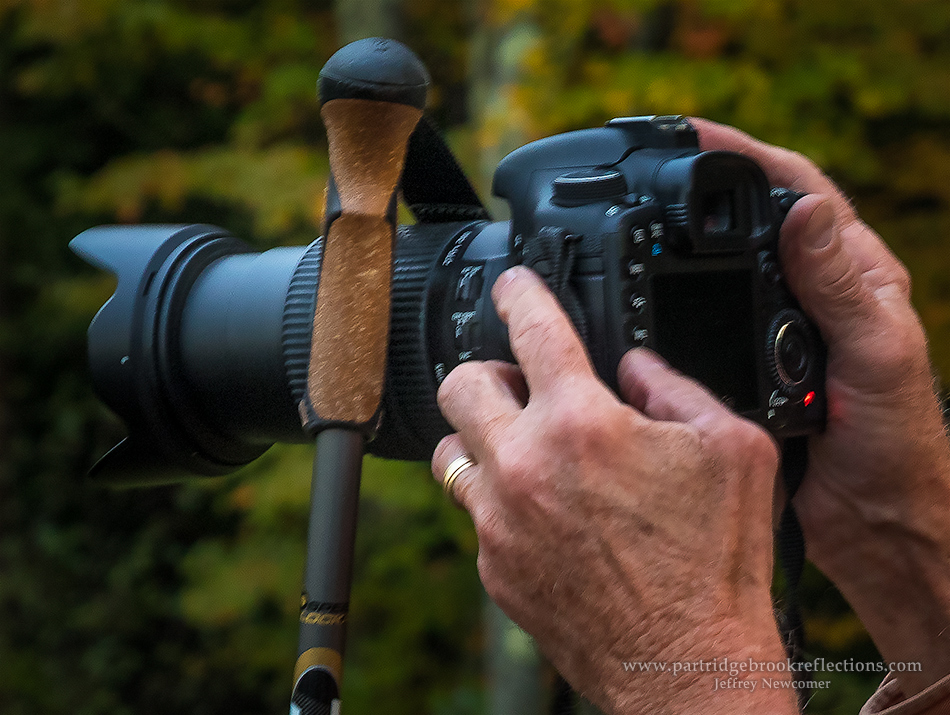
As I was struggling to get a steady shot with enough depth of field, another photographer pulled in.  He was trying to capture a picture of Mount Monadnock in the evening fog.  He was also “tripodless” and was struggling with the impossibility of hand-holding his longer lens.  I offered my stick.  Having never tried a walking stick for stabilization, he took a fresh look at the devise, and without even one “eureka”, slipped the lens into the hand strap.  Brilliant!  Why have I never thought of that?  Slung from the strap, the camera could be pulled down and stabilized against the shaft of the stick.  

In the Loop


It’s not perfect but in a pinch it does offer a nice solution when you are in your wife’s car without a tripod.  I tried it on my dark autumn path and, with a little practice, it worked rather well.  I didn’t get the gentlemen’s name, but I would like to thank him.  It goes to show that a fresh look at a problem can result in a new solution.  It also was a reminder to always throw a tripod in the car, and it means that I have to add a couple of slides to my talk on camera stabilization.


That is my quick and simple, now back to work!

Sunday, September 13, 2015

My Problem with Monopods


September Kiss


Pasture Hollow


Once again I promise that this will be a quick tip. I have to get ready for my Basics of Digital Photography course which begins next week, and I also have a New England Photography Guild blog article due in a couple of days. I'm still waiting for the appearance of the relaxation part of my retirement.


This week, I have a very simple story to tell. Let's see if I can tell it simply.


Monopods
Monopods don't have the stability of a tripod, but the theory behind it is sound. A single stick that is easy to carry around and provides substantially better stability than when hand-holding your camera. With my deteriorating left hip a monopod also serves as a secret cane, masquerading as a photo accessory.  I have two monopods, the first is of traditional single purpose design intended solely as a camera support and the second is a hiking pole which is
Hiking Pole Camera Adapter
equipped with a camera mount in its head. The camera adapted hiking poles are becoming more popular and are easy to use. Just unscrew the ball at the top to reveal the screw-type camera mount. The poles work well to provide convenient stability, but they are not as solid as a dedicated monopod.  For my purposes, both have one major problem.


A Question of Compatibility 

 My DSLRs have L-brackets which fit Arca Swiss heads and, unless I go through the major hassle of removing the L- bracket, they don't fit on the standard monopod screw mount. I faced a similar connection incompatibility on my old, heavy, Manfroto tripod and solved the problem by attaching an Arca Swiss adapter to the tripod's proprietary Manfroto head. The result was a chunkier, but more stable tripod that I use most of the time for shots within close proximity to my car. For hikes and travel I still depend on my much lighter Carbon Fiber Gitzo. It's great to have a choice to match all situations.


My "New" $30 Tripod


Monopod Solution

 I used a similar solution for my monopod dilemma. It was easy to screw a simple and cheap Arca Swiss adapter to the stick's screw head and for just $30 I have a monopod that works for my L-bracketed DSLRs. I feel as if I should somehow make this sound more complicated, but the happy fact is that it is just that simple. The mount also allows me to easily shoot in either landscape or portrait orientation.  With a standard screw mount the camera is fixed in portrait mode. To make my old monopod work as a serviceable walking stick, I improvised a grip, wrapping the top with tennis racket handle tape. The Arca Swiss adapter makes it a bit a awkward to grab the top of the stick, but otherwise it works well.  It is light, easy to carry and fits nicely into most of my camera bags and packs. The adapter is also easy to remove if a camera requires the traditional screw mount.


Other Problems
A problem with monopods is that the camera is rigidly fixed to the
pole. When shooting in any direction other than straight ahead the pole must lean forward or back and this can affect stability. One solution is to attach a flexible connection, such as a ball head, to the top of the monopod, but the added weight can adversely affect the balance of the pole and make it difficult to use as a hiking stick. Lighter ball heads are available but they may only be sufficiently sturdy for smaller cameras. By the time you add a heavy head, strong enough for a full size DSLR, you might do as well with a regular tripod. For now I'm happy with my feather lite Arca Swiss Adapter.  When I must angle the stick, I can stabilize it against my foot or even slip it into my shoe.


My old monopod had been gathering dust in the back of a closet for years.  It's nice when something so simple can bring an old friend back to usefulness. The question is, what took me so long. Now if I can only find a use for all my old film cameras.  Door-stop comes to mind.

Jeffrey Newcomer
Partridgebrookreflections.com