About Me

My photo
Spofford, New Hampshire, United States
Jeff Newcomer had been a physician practicing in New Hampshire and Vermont for over 30 years. Over that time, as a member of the Conservation Commission in his home of Chesterfield New Hampshire, he has used his photography to promote the protection and appreciation of the town's wild lands. In recent years he has been transitioning his focus from medicine to photography, writing and teaching. Jeff enjoys photographing throughout New England, but has concentrated on the Monadnock Region and southern Vermont and has had a long term artistic relationship with Mount Monadnock. He is a featured artist in a number of local galleries and his work is often seen in regional print, web publications and in business installations throughout the country. For years Jeff has published a calendar celebrating the beauty of The New England country-side in all seasons. All of the proceeds from his New England Reflections Calendar have gone to support the Pulmonary Rehabilitation Program at the Cheshire Medical Center. Jeff has a strong commitment to sharing his excitement about the special beauty of our region and publishes a blog about photography in New England.

Tuesday, August 28, 2012

The Columbia River Gorge, Mount Hood, Waterfall Alley


Columbia River Gorge Oregon
After our time in Yellowstone and the Grand Teton National Park, we traveled across the desiccated, drought plagued, landscape of central Idaho and Eastern Oregon to the comparatively lush Columbia River Gorge, east of Portland. Happily we had a couple of days to explore before our trip climaxed with Katherine and Rama's wedding in Hood River. It was refreshing to escape the dry landscape to the dense forest and spectacular waterfalls, and to tour the farms and orchards around the gorge. Of course the whole region is dominated by 11,249 foot Mount Hood floating on the horizon to the south. Although on a different scale, Mount Hood has a similar iconic, "stand alone" stature as that of Mount Monadnock in my home corner of New Hampshire. 


 Mountain Orchards


Hood River Valley

The Hood River Valley is filled with lovely orchards and farms, featuring pears, apple, and some of best cherries I have tasted. Although a bit late in the season, the flowers were standing up well to the heat and we found a Lavender farm spreading a blue carpet before distant Mount Hood. The valley's many vineyards also provided a nice variety for the wedding party.


Lavender Fields


Mountain Stands Alone


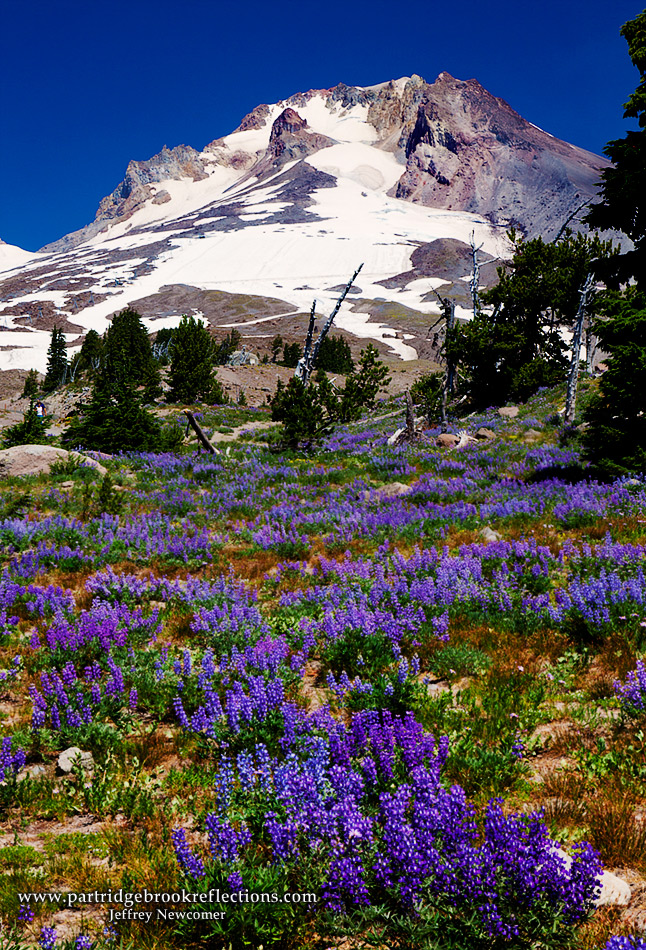
Mt Hood Lupine

Mount Hood lies south of Hood River and is Oregon's highest point. The glacier above the Timberline lodge provides the only year-round, chairlift serviced, down-hill skiing in the United States. On a warm afternoon, we traveled up to the classic 1930s lodge, on the south side of the mountain, at 6000 feet. The snow capped mountain contrasted nicely with the fields of wildflowers and with the lines of skiers heading to the glacier.


Trillium Lake

 Waterfall Alley


Multnomah Falls

One of the most unique photographic attractions of the Columbia River Gorge are the waterfalls. Lining a 13 mile stretch of a scenic byway along the Oregon side of the gorge, are an amazing collection of dramatic falls, all easily assessable, at the road-side or along lovely trails. It is with good reason that this is called "Waterfall Alley". Knowing how popular these sites are, I was glad that I got up at dawn to explore the route. I was able to get to three waterfalls, that morning before the crowds arrived, including Horsetail, 


Wahkeena Falls
 
Multnomah and Wahkeena. Sadly Latourel falls was closed for construction. Multnomah Falls is the most famous, and deservedly so. The two tier falls drops a total of 620 feet with a perfectly positioned fairy tale foot bridge spanning the gap between the two levels.
Multnomah Glimpse
Even at 6 am I had to wait a few minutes for the young lovers to leave the bridge for a more secluded spot, allowing the one other photographer and I to get our pristine shots. It was well worth the early hour. Two days later I came by again at about 11 AM.  It was impossible to park within a half mile of the falls
Bridalveil Falls
and as I rolled by I could see that there were at least 30 people crowding the bridge. I was not surprised to discover that nearly 2 million people visit Multnomah Falls annually. On that second trip along the scenic highway, Susan and I hiked the short trail to Bridal Veil Falls, another beautiful two tier waterfall in a more secluded setting. I wish I had the time to hike to some of the other falls along this remarkable stretch of road, but it was amazing that over a couple of hours I was able to experience so much world class falling water.


Horsetail Falls


And A Wedding
Katherine & Rama
Finally, Katherine and Rama's wedding, the whole reason for the trip, was held in a beautiful pine grove, overlooking Mount Hood. The ceremony was attended by a wonderful group of friends, new and old. We live in a closely knit New Hampshire community and therefore it is not surprising that so many of Katherine's "village" family made the trip across country to celebrate with her and her parents, Bob and Lynn. It was a lovely, relaxed event in an idyllic setting . 


Wedding Swing


After the party Susan and I spent a couple of days exploring the Oregon coast south of Portland, before flying home. I'll share some of those photos next week as I continue to work through the more than 2000 images from this amazing trip. 


Mount Adams
 

It has been tough to catch my breath from our "vacation", since today I had to set up a show at the wonderful Burdicks Restaurant in Walpole New Hampshire and I will be at the "Art in the Park" in Keene New Hampshire, all this coming weekend. Pray for good weather and come visit if you are in the area. I'll be the guy sleeping in the lawn chair.

Jeffrey Newcomer

Wednesday, August 22, 2012

Photographing the Grand Teton National Park


Smoke Gets in Your Eyes
Jackson Lake Smoke Grand Teton National Park
After our all to short visit to Yellowstone Susan and I headed south to Jackson Hole and the Tetons. It was years ago that we had driven by these mountains on our way across country, and we were excited to finally have a few days to explore. We stayed in a great bed and breakfast in Jackson, but, sadly, we discovered that the dramatic mountains were largely obscured by the smoke from several forest fires in Idaho. We still had a wonderful time hiking the mountains and exploring the trendy town of Jackson, but photographically, the experience centered on trying to find ways of getting past the murk to capture memorable images of this iconic location.

So what can you do when smoke or haze obscures your beautiful landscape?

Patience
First you can wait and hope for a storm to pass through blowing away the grime. Unfortunately this didn't happen for us. I shrugged and promised to come back again, sometime, and then I had to make do. 


Get Close

Inspiration Point Trail
The impact of smoke and haze is magnified by distance. Some of the Tetons’ classic viewpoints, such as the Mormon Row of deserted farms, are several miles east of the mountains. On clear days, the classic barns and fences make wonderful foreground material against the rugged mountains, but through the smoke, the peaks were just a faint pastel backdrop. I quickly learned to seek out viewpoints closer to the peaks. The smoke still had its impact, but especially when hiking among the mountains, the effect was much reduced. And, of course, close encounters with the wildlife were always clear.


Mule Deer Fawn

Bull Moose


Celebrate the Foreground
Mormon Row Foreground

When the distant vistas are murky, it is a good time to focus on the foreground. I always look for good foregrounds to compliment my expansive landscapes, but in this situation, the sharp, clear foreground elements helped to offset the lack of distant majesty. Fortunately the Tetons are full of great detail; rocks, flowers, animals and old structures can all become nice foci of interest.  


Embrace the Smoke

Mormon Row Sunset
On our first night in the Tetons I decided to check out Mormon Row. This is traditionally a morning site with the warm sunrise illuminating both the barns and the distant mountains. Although I knew that the peaks would be obscured, I hoped to use the smoke to augment the sunset light. I was excited to see that by shooting through the murk the
Smoke Filtered Sunrise
waning sun was given added dimension. As it dropped behind the mountains, the rays of light became vividly palpable and with the mountains in silhouette the images became much more about the light and the foreground with the smoke just a necessary piece of the puzzle. The next morning from the same spot, the smoke still shrouded the mountains, but when I turned to face the sun, it was so heavily filtered that I was able to shoot the rising disc without blowing out the surroundings.


Back in the Digital Darkroom
Jackson Lake
Sharp Mask Enhanced Contrast
Of course post-processing can always help. With a careful selection, the mountains can be isolated for enhanced contrast and vibrancy. The Unsharp Mask tool can also be used to enhance contrast. In the Unsharp Mask menu (Filter/Sharpen/Unsharp Mask), I raise the radius setting to around fifty and then adjust the strength to achieve the desired level of contrast enhancement. This technique can work wonders on flat images regardless of the cause, including smoke and haze. It is a powerful tool that can be easily overdone, but in this case, I used a mask to limit the effect to the distant mountains and then fine tuned the impact by adjusting the layer's opacity slider.


HDR
HDR to the Rescue
HDR techniques can also be helpful. The image of the mountains behind the north end of Jenny Lake combines most of the techniques I have discussed. It was taken closer to the peaks and had strong foreground elements, but additionally I found that with HDR I could do a better job cutting through the smoke. I captured 7 bracketed images, and then used Photoshop’s HDR Pro just focusing on enhancing the contrast in the mountains.


Black & White Conversion
Smoke and haze unavoidably mutes the vibrancy of color in images and, in these situations, conversion to black and white can restore the photograph's impact.  Black and white images can be more aggressively edited without affecting color quality.  Finally contrast enhancement or HDR can be combined with black and white conversion and local adjustments to further restore the snap in those murky distant peaks.


Black & White Conversion, Schwabacher Road


Hidden Falls
The Grand Teton National Park is an amazing place and although I was terribly disappointed by the smoke, I enjoyed the challenge and, in the end I came away with images that have a different quality than those that are the typical postcard shots. Every now and then it is good to be forced adjust to challenging conditions, and vacation is the perfect time for fresh experiences.

Enough lame rationalizations. The next episode will feature Hood River and the Columbia River Gorge, highlighting spectacular waterfalls, majestic Mount Hood and of course a wedding. And all with much less smoke!


Thursday, August 16, 2012

Photography in Yellowstone


Old Faith in the Dawn Light


How to get Geysered Out in 3 Days


I apologize for being largely out of touch and late with this posting. Susan and I are into our eighth day of our western trip, and we have been out straight trying to pack as much as we can into the short time we have in each location. This all started with an invitation to the wedding of our good friend’s daughter, Katherine, in Hood River Oregon. Of course, we took advantage of the event to take a couple of weeks to get there, visiting Yellowstone and Teton National Parks in Wyoming on the way.


Great Fountain Geyser
We flew to Salt Lake and then drove to Yellowstone, staying in a cabin at the Old Faithful area. Our 3 days in Yellowstone were wonderful, but completely inadequate for the exploration of our nations largest park. We got up early, and came back late, exhausted. I have had time only to upload, location tag and label my images. I have, at this point, processed just a few of the pictures to share but I’m sure I will be working on these for months to come.

I feel quite nervous about sharing my observations of Yellowstone since Gustav W. Verderber, a fellow New England Photography Guild member, literally wrote the book on the topic. Gustav’s beautifully illustrated guide “Photographing Yellowstone National Park” was a great help on our trip. I have just a few observations to share about our experience.

White Dome Geyser
First, Yellowstone is most famous for its thermal features, especially the many geysers and hot spring. One of our first stops on entering the park was at the Firehole Lake Drive where we were lucky enough to wait only an hour before the impressive Great Fountain Geyser erupted. This geyser erupts only twice daily at irregular intervals, but just a couple of hundred yards down the road the White Dome Geyser blasts more frequently and we were able to catch the double feature. Of course Old Faithful Geyser lives up to its name erupting every 60 to 90 minutes to the delight of the vast crowd encircling the scene. The geysers are unique and dramatic examples of nature’s power, but after the first day I began feeling a bit geysered out. I began looking for different ways to see the eruptions, and we increasingly appreciated the park's many other attractions.


Old Faithful Dawn

Being so close to Old faithful, I had the opportunity to try a variety of approaches to this classic. On two mornings I crawled out of bed for sunrises. The clouds on the horizon were problematic and the eruptions were a bit later than I would have preferred, but I got some interesting images. On the first morning I shot with the sun in the background. On the second, with the warm light illuminating from the side, I was able to get the plume to standout against the dark sky. On our last night I got out on a remarkably clear night to record the eruption with the Milky Way in the background. There was enough faint artificial lighting during the 45 second exposure to make the geyser brilliantly visible.


Milky Way Faithful


Firehole Spring
Geysers are not the only thermal attractions at Yellowstone. The steaming fumaroles and bubbling mud pots were interesting, but, photographically, the hot springs were the most beautiful. The deep emerald pools were intensely inviting, with the colors varying depending on the temperature which affects the level of thermophilic bacteria. I almost wanted to jump in, but reminded myself that these natural hot tubs would boil my skin away in a few seconds.


Bison on the Ridge

Falls at Grand Canyon of Yellowstone
Getting away from the geysers we explored Lake Yellowstone and Yellowstone's grand canyon area. The "Grand Canyon of Yellowstone" was spectacular but the trip there through the wildlife rich Hayden Valley was even more exciting. We saw Elk, Deer, Coyotes and herds of Bison. The bison in particular caused traffic jams as they unconcernedly meandered across the road. 

Yellowstone Elk


Mystic Falls
Despite our short time in the park, we were able to get away from the crowds on a couple of hikes into Yellowstone's back country. A fairly short trek from the Biscuit Basin area took us along the Little Firehole River to the lovely Misty Falls and on our last full day in the park we took a longer hike through beautiful woods and an expansive meadow to pristine Cascade Pond. After all the bustle of the parks popular locations the quiet isolation of this spot was a welcome relief.


Susan Lost in Cascade Lake Meadow


One of the best part of this experience has been that our daughter Abigail and her boyfriend Grayson have joined us for parts of the trip. At times they split off to do considerably more aggressive hikes, but last night in Jackson Hole they actually paid for dinner. Parenthood has finally paid off! 


Abby and Grayson Waiting for Old Faithful


I could go on about this portion of our trip, but we just finished our stay in the Tetons and I have many more images that I'm anxious to process. More later.

Sunday, August 5, 2012

Enriching Foliage Photography


It's not easy being green

Susan and I are rushing around getting ready to head out a trip to Yellowstone, the Tetons, and Columbia River Gorge, so this week's blog will, hopefully, be short. Just a couple of techniques, one in the camera and one during processing, to improve your images of our most abundant natural attraction, foliage. 


If there is one thing that we have in abundance in New England, it is leaves. In the spring, they explode with every imaginable shade of green, and mature during the summer to a lush, swaying umbrella, deflecting the summer heat. Of course the fall provides our all-to fleeting, riotous, celebration of color initially in the trees and then as a luxurious carpet until the winter snows allows us to catch our breath. Leaves contribute a limitless palate of colors and shades to landscape photography, but their brilliance is opposed by one pernicious factor, reflection.


When light reflects off the surface of the leaves the brilliant colors
Unpolarized
become muted and dull. The problem is magnified when moisture coats the foliage after rain or in the morning dew. This is why the color of fall foliage is generally best captured on overcast days, and why normal people look upon photographers as crazy when they curse the "beautiful sunny weather". The muting effects of reflection can't always be illuminated, but there are a couple of techniques that can help control the problem.

You Must Have a Polarizer 


Polarized, Unprocessed
A polarizer is designed to cut through reflection and is the landscape photographer's most essential filter. Direct sunlight reflecting off most surfaces becomes polarized to a specific angle which can be filtered by rotating the polarizing filter to block that angle. The degree to which a polarizer can filter out the
glare is related to the direction of the light, being most effective when it is at 90 degrees to the subject. On the other hand, when the
Polarized Processed
light is coming from behind or in front of the camera, the effect is essentially nonexistent. But when the illumination is in the right direction a polarizer can do a wonderful job cutting through the glare. The filter is great for darkening skies, seeing beyond reflection into the depths of lakes and streams and improving the color saturation of foliage. It is often noted that the ability of a polarizer to block reflection is one of the few filter effects that can not be duplicated by digital editing and it is for that reason that it is considered THE essential filter, but there are Photoshop techniques that can enhance foliage and among these my favorite is the Shadow / Highlight filter.

Shadow / Highlight

The Shadow/Highlight function (H/S) is found in newer versions of

Unpolarized processed with Shadow/Highlight
Photoshop in the "edit menu, under adjustments. It is a remarkable tool for salvaging detail in both bright and dark parts of images, but It is also great for enhancing saturation in brightly illuminated foliage. Unlike a polarizing filter its effect is the same regardless of the direction of the light.  In these situations I concentrate on the Highlight sliders adjusting the Amount to get richer color off the reflecting foliage. I then adjust the Tonal Width
Shadow / Highlight Tool
to limit the effect to the desired range of brightness and the Radius to avoid obvious halos. The effects of this filter could be duplicated with a complicated manipulation in curves, but the ease and control of Highlight / Shadow makes it one of my favorite tools and one of the features that makes upgrading worthwhile if your version of PS doesn't have it. If you already have this in your toolbox, give it a try. The best way to understand the power of H/S is to play. Although it will never be able to do all that a polarizer can do, with a little experience I would guess that, like me, you will think of H/S as a frequent early piece of your editing process, especially when it's not easy being green. 

Now back to packing.  I will try to post some images over the next couple of weeks as our travel allows.


Monday, July 30, 2012

Whaleback Light


 Searching for an Eddington Moment


Einstein and Eddington

On May 29, 1919, Arthur Eddington was watching a rainy, cloud filled sky on the remote island of Principe off the west coast of Africa.  He had come from England to observe the solar eclipse
Arthur Eddington
hoping to confirm or refute Albert Einstein's controversial theory of relativity. It was no small matter that, just after the carnage of the First World War, it was an Englishman who had set out to test a German theoretical physicist's theory, which, if confirmed, would overthrow the god of English science Sir Isaac Newton.  Einstein's theory predicted that light passing by a massive object like the sun, would be noticeably deflected, but the only time to measure such an effect would be when the sun's brilliance was blocked by a solar eclipse. Eddington had planned carefully for the experiment and had traveled more than 3500 miles to be in the right spot at the right time. Despite all the preparation, the observation almost never happened, as the obscuring clouds parted only briefly during the period of totality. The result was that Einstein was confirmed and most of the rest of the world was left hopelessly confused and nostalgic for the simple days of Sir Isaac. Eddington had the luck that all photographers lust for, but even such a profoundly religious man was enough of a scientist not to depend entirely on providence. He sent a second expedition to Brazil as a hedge against bad weather.

This is all a round-about way to bemoan the fact that I had no hedge against bad weather this weekend and despite all my careful planning the sky did not open at just the right moment as I tried to catch Whaleback Light against the rising sun. Since I live about 90 miles from Atlantic coast in the beautiful southwest corner of New Hampshire, I treasure every opportunity to make it to the ocean. I don't have the luxury of returning time and again until the conditions are right. I have to make the best of what nature gives me, truthfully that is a major part of the fun. 


The Rye Weekend
Every summer our good friends Tom and Paula become even better

Whaleback Lighthouse, Portsmouth Harbor
friends when they rent a cottage on the New Hampshire coast at Rye Beach. It is a great excuse to spend a weekend by the water, to eat and drink, and to sit watching the various sizes and shapes of humanity strolling along the beach. Of course I also have to photograph and this year I had a plan. Whaleback Lighthouse at the entrance to Portsmouth Harbor is a classic and I wanted to try to capture the sun rising behind the tower.  Before leaving for Rye, I went to my favorite program, The Photographer's Ephemeris, and discovered that the sun could be seen rising behind the lighthouse, at 5:30 Sunday morning , from a spot on the beach at Odiorne Point State Park in Rye. I was able to find the exact location on the beach and determined
that Whaleback had to be at 63 degrees from my vantage point to be perfectly aligned. Knowing that I would be crossing the park in the dark, Tom and I scouted the location Saturday afternoon. The park is a lovely wooded oasis away from the bustle of the beaches and is crisscrossed with a web of secluded trails. Once on the beach, I was able to find the spot which placed the lighthouse at 63 degrees. Since I would be returning in the dark the next morning I built a small stone cairn to mark the location. Like Eddington, after the preparations, I could do nothing but wait for the weather.  Unlike Eddington, I could return to the cottage on the beach for a wonderful dinner and too much wine.

Tom Scouting the site
Carin Building
Photo by Tom Dustin


 You Have Fewer Friends at 4:30 in the Morning
Odiorne Point State Park, Rye NH
Less spooky in daylight
When I arrived at the park the next morning there were just a few small , hopeful, breaks in the clouds. I worked my way along the dark trails, guided by the narrow column of my headlamp. It was a bit spooky, but I figured that it was unlikely that potential muggers would decide to seek their prey from the Poison Ivy along a lonely wooded trail at 4:30 in the morning.  By the time I reached my spot on the beach the sky was completely overcast. I setup my tripod and, accompanied only by the mosquitoes, settled in to await the miracle. Sadly there was no Eddington moment.  5:30 came and went without a trace of morning gold. Once it was clear I was not going to get the perfect sunrise, I settled in to work the site for whatever I could get. 


Making Do
The cool blue light had its own attraction and the rocky shore

Odiorne Point Shore
provided some nice framing opportunities on the lighthouse, but the low light imposed its own challenges. For the lobster boat image, I framed the lighthouse through the rocks, locked down my tripod, and then took several exposures focusing on each of the foreground, middle rocks and the lighthouse (focus stacking). It was helpful to use Live View to nail the focus in the dim light and the long exposures created a nice soft appearance to the rolling waves. Then, keeping the camera in position, I waited for a boat to come by and added the final piece of puzzle. I had to boost the ISO up to 3200 for this image to freeze the moving boat, but in the end the composite brought it all together for the best representation of the lovely scene.

I spent two hours on that peaceful beach and, although I was disappointed about the lack of a spectacular sunrise, the quiet solitude was well worth the trip. I knew that, behind those clouds, the sun was rising and that it would be there for me on another day. Despite the best planning nature doesn't always cooperate, but photography would loose its excitement and challenge if every shoot was an Eddington moment. 


Angry sky over Rye Beach New Hampshire
A nice oppoertunity for a little HDR

Jeffrey Newcomer
partridgebrookreflections.com