About Me

My photo
Spofford, New Hampshire, United States
Jeff Newcomer had been a physician practicing in New Hampshire and Vermont for over 30 years. Over that time, as a member of the Conservation Commission in his home of Chesterfield New Hampshire, he has used his photography to promote the protection and appreciation of the town's wild lands. In recent years he has been transitioning his focus from medicine to photography, writing and teaching. Jeff enjoys photographing throughout New England, but has concentrated on the Monadnock Region and southern Vermont and has had a long term artistic relationship with Mount Monadnock. He is a featured artist in a number of local galleries and his work is often seen in regional print, web publications and in business installations throughout the country. For years Jeff has published a calendar celebrating the beauty of The New England country-side in all seasons. All of the proceeds from his New England Reflections Calendar have gone to support the Pulmonary Rehabilitation Program at the Cheshire Medical Center. Jeff has a strong commitment to sharing his excitement about the special beauty of our region and publishes a blog about photography in New England.

Monday, July 30, 2012

Whaleback Light


 Searching for an Eddington Moment


Einstein and Eddington

On May 29, 1919, Arthur Eddington was watching a rainy, cloud filled sky on the remote island of Principe off the west coast of Africa.  He had come from England to observe the solar eclipse
Arthur Eddington
hoping to confirm or refute Albert Einstein's controversial theory of relativity. It was no small matter that, just after the carnage of the First World War, it was an Englishman who had set out to test a German theoretical physicist's theory, which, if confirmed, would overthrow the god of English science Sir Isaac Newton.  Einstein's theory predicted that light passing by a massive object like the sun, would be noticeably deflected, but the only time to measure such an effect would be when the sun's brilliance was blocked by a solar eclipse. Eddington had planned carefully for the experiment and had traveled more than 3500 miles to be in the right spot at the right time. Despite all the preparation, the observation almost never happened, as the obscuring clouds parted only briefly during the period of totality. The result was that Einstein was confirmed and most of the rest of the world was left hopelessly confused and nostalgic for the simple days of Sir Isaac. Eddington had the luck that all photographers lust for, but even such a profoundly religious man was enough of a scientist not to depend entirely on providence. He sent a second expedition to Brazil as a hedge against bad weather.

This is all a round-about way to bemoan the fact that I had no hedge against bad weather this weekend and despite all my careful planning the sky did not open at just the right moment as I tried to catch Whaleback Light against the rising sun. Since I live about 90 miles from Atlantic coast in the beautiful southwest corner of New Hampshire, I treasure every opportunity to make it to the ocean. I don't have the luxury of returning time and again until the conditions are right. I have to make the best of what nature gives me, truthfully that is a major part of the fun. 


The Rye Weekend
Every summer our good friends Tom and Paula become even better

Whaleback Lighthouse, Portsmouth Harbor
friends when they rent a cottage on the New Hampshire coast at Rye Beach. It is a great excuse to spend a weekend by the water, to eat and drink, and to sit watching the various sizes and shapes of humanity strolling along the beach. Of course I also have to photograph and this year I had a plan. Whaleback Lighthouse at the entrance to Portsmouth Harbor is a classic and I wanted to try to capture the sun rising behind the tower.  Before leaving for Rye, I went to my favorite program, The Photographer's Ephemeris, and discovered that the sun could be seen rising behind the lighthouse, at 5:30 Sunday morning , from a spot on the beach at Odiorne Point State Park in Rye. I was able to find the exact location on the beach and determined
that Whaleback had to be at 63 degrees from my vantage point to be perfectly aligned. Knowing that I would be crossing the park in the dark, Tom and I scouted the location Saturday afternoon. The park is a lovely wooded oasis away from the bustle of the beaches and is crisscrossed with a web of secluded trails. Once on the beach, I was able to find the spot which placed the lighthouse at 63 degrees. Since I would be returning in the dark the next morning I built a small stone cairn to mark the location. Like Eddington, after the preparations, I could do nothing but wait for the weather.  Unlike Eddington, I could return to the cottage on the beach for a wonderful dinner and too much wine.

Tom Scouting the site
Carin Building
Photo by Tom Dustin


 You Have Fewer Friends at 4:30 in the Morning
Odiorne Point State Park, Rye NH
Less spooky in daylight
When I arrived at the park the next morning there were just a few small , hopeful, breaks in the clouds. I worked my way along the dark trails, guided by the narrow column of my headlamp. It was a bit spooky, but I figured that it was unlikely that potential muggers would decide to seek their prey from the Poison Ivy along a lonely wooded trail at 4:30 in the morning.  By the time I reached my spot on the beach the sky was completely overcast. I setup my tripod and, accompanied only by the mosquitoes, settled in to await the miracle. Sadly there was no Eddington moment.  5:30 came and went without a trace of morning gold. Once it was clear I was not going to get the perfect sunrise, I settled in to work the site for whatever I could get. 


Making Do
The cool blue light had its own attraction and the rocky shore

Odiorne Point Shore
provided some nice framing opportunities on the lighthouse, but the low light imposed its own challenges. For the lobster boat image, I framed the lighthouse through the rocks, locked down my tripod, and then took several exposures focusing on each of the foreground, middle rocks and the lighthouse (focus stacking). It was helpful to use Live View to nail the focus in the dim light and the long exposures created a nice soft appearance to the rolling waves. Then, keeping the camera in position, I waited for a boat to come by and added the final piece of puzzle. I had to boost the ISO up to 3200 for this image to freeze the moving boat, but in the end the composite brought it all together for the best representation of the lovely scene.

I spent two hours on that peaceful beach and, although I was disappointed about the lack of a spectacular sunrise, the quiet solitude was well worth the trip. I knew that, behind those clouds, the sun was rising and that it would be there for me on another day. Despite the best planning nature doesn't always cooperate, but photography would loose its excitement and challenge if every shoot was an Eddington moment. 


Angry sky over Rye Beach New Hampshire
A nice oppoertunity for a little HDR

Jeffrey Newcomer
partridgebrookreflections.com

Tuesday, July 24, 2012

Rainbow Photography


Finding the Pot of Gold


Rainbows have always been a popular subject for photography. They are among the most dramatic and colorful of the natural phenomena. It is little wonder that rainbows have always been a subject of superstition and mythology, and our scientific understanding of their origins and behavior has only minimally diminished our sense of wonder at their surprising beauty. Part of the mythology about rainbows describes a Leprechaun's elusive pot of gold that can be found at the end of these colorful celestial arcs. Of course a rainbow is not a physical structure and it's end can never be defined, but I would suggest that, in a photographic image, a rainbow can have a visual pot of gold and that treasure has to do with the strength and interest of the foreground.

Not Just a "Pretty Thing"
Photographs of rainbows always show a lovely spectrum of colors, but the best images are more than just a "picture of a rainbow".  It is the surrounding compositional elements which provide a sense of place and context, that makes a rainbow image compelling and not just a snapshot of a colorful "pretty thing". This is actually one of my central compositional rules. A great landscape photograph is seldom just a picture of a" pretty thing". Whether it is a spectacular mountain, a quiet lake or a colorful autumn tree, images are made especially memorable by how you arrange the elements around the "pretty thing" to provide contrast, context, balance and to draw your eye. This particularly true of rainbows.

Foreground Hunting

Chesterfield New Hampshire Town Hall
When I see a rainbow forming my first thought is "Where can I go
to place something interesting in front of the color".  An immediate corollary of that thought is, "How far can I go before the rainbow disappears and from what angle is the light coming".  I was working in my studio one afternoon when I noticed a beautiful rainbow forming in the eastern sky. I grabbed my camera and leaped into my car.  I knew that time was fleeting, so I headed up to Chesterfield Town Center and arrived just in time to have about 2-3 minutes of the bright colors, against the dark sky, before the sun sank into the clouds. The colors were beautiful, but It was the old stone town hall, bathed in the sunset glow that made this picture special. 


The Physics, I Promise, NO Equations
Sometimes catching a rainbow in a great location is a matter of

Light Through a Raindrop (Wikipedia)
luck, but a basic understanding of the physics of rainbow formation can help you improve your chances. Rainbows are formed by the summation of light refracted and reflected through millions of rain drops. The light is refracted (bent) as it enters the drop. Light of different waves lengths or color are bent by different amounts during refraction, the red light is bent less than the blue, creating the rainbow effect. The light is then reflected off the back of the drop and refracted once again as it passes out of the drop and on to your eye. In the atmosphere, the reflected light comes out of the drop at an angle of about 42 degrees down from the angle of the sun's rays. The light can actually bounce around in the raindrop twice creating a secondary rainbow which is less intense and  is seen above the original.  Interestingly secondary rainbows show the colors in reverse order. Tertiary rainbows are also possible, but are quite rarely seen.


Double Rainbow


My goal here is not a physics lesson, but the physics does provide some helpful photographic lessons.

  1. First rainbows are always most intense when shot with your back to the sun. A simple way to think of this is to try to place your shadow on a line between the sun and your foreground subject.
  2. The colors become more intense as the sun drops toward the horizon and, because of the angle of refection, rainbows don't generally appear until the sun drops to below 42 degrees in the sky. Before that time, unless you are at altitude, the rainbow is actually below the horizon. In southern New Hampshire, during July, this means that we would not expect to see rainbows until after 4:30 in the evening.
  3. Of course you can't have a rainbow without the combination of raindrops and sunlight. Most often this comes from a clearing storm, but fog or sea mist may also create a rainbow. The best bet is to wait until the first light after an evening storm has past by and look away from the sun. With luck, the rainbow will be shining against the receding dark clouds.
  4. Finally, since rainbows are often fleeting and pop up unexpectedly, you might want to keep your own list of prime observing sites close to home. Look for interesting foregrounds that can be viewed against the eastern sky with the sun at your back.  Technology can help improve your odds of finding a great show.  Using my IPad I can now follow the progress of storms on radar and then find the best locations using the Photographers Ephemeris to discover the direction of the sun at any time.

So keep your eyes on the sky after a storm, feel the warmth of the sun on your back, watch the foreground and you may just find your own pot of gold.

Sunday, July 15, 2012

My Mother's Touch


My mother died peacefully this Friday afternoon after a long and full 92 years. In recent years she vigorously resisted my efforts to take her portrait, complaining of the wrinkles that I thought beautifully outlined her strong character. But as I sat watching her drift away, it was her hand that drew my gaze. This hand that was the source of so much support, comfort and love is, to me, her most fitting portrait and one that I hope she would approve.

Sunday, July 8, 2012

Independence Day Fireworks on Harvey Pond


Harvey Pond Revisited

It has been a busy summer for me and I suddenly realized that It has been several weeks since I dropped by Harvey Pond to watch the Great Blue Herons improving their nest for their anticipated brood. Harvey Pond is next door in Westmoreland New Hampshire and it is a great place to enjoy and photograph nature's summer transformations. Life is bubbling at the pond and I decided that there could be no better time to witness this celebration than on the occassion of our nation's birthday party. Other commitments kept me from witnessing the fireworks this year, but things were exploding on the pond. Harvey Pond is located next to the Glebe Road in Westmoreland making access very easy, but the other advantage of this proximity to car and pedestrian traffic is that the animals are conditioned to human presence and seem more easily approachable than at more isolated locations.

Chicks
My prime reason for returning to the pond was to check the progress of the Blue Heron chicks, and I was not disappointed.

Josting Chicks
Early morning is the best time to view the action on the nest as the parents return from hunting to feed their voracious offspring. The chicks have already grown considerably and are getting quite active on the nest. Although I had been told that three had hatched, I only identified two suggesting that a smaller, a late hatching, chick may have been lost. The two remaining chicks were quite healthy and energetic and It seemed that they became particularly aggressive with each other as soon as a parent returned to the nest. I am sure that this playful jostling was all about competition for food, and training for survival.  No one got hurt, and mom seemed to prefer to ignore the whole scene.   Heron photography involves prolonged periods with the lens trained on the nest waiting for something to happen. Patience is essential, but difficult with so much entertainment going on all over the pond.

Geese on Parade 


The Canada Geese were also quite busy on the pond, shepherding their chicks among the proliferation of lilies that now dominate the shallow areas. They paraded back and forth in front of us despite the fact that Nellie was right at the shore, frozen in rapt attention. The Geese appeared to have such patriotic spirit that I almost expected a fife an drum to appear at the front of their procession.

Snapper
At one point our attention was drawn from the pond to see a

Snapping Turtle
massive Snapping Turtle ambling across the road. We rushed to shield the prehistoric beast from on-rushing traffic, but he seemed more annoyed than grateful for our close approach. Snapping Turtles are especially aggressive when on the land, so we kept our distance until he sunk, gratefully, into the pond. The picture here suffers from a lack any means of scale, but I can add that his carapace was more that two feet long. Snapping Turtles have been know to live close to 50 years in captivity. I would love to know how long this old guy has been stalking the depths of Harvey Pond.

Summer Concert

Croaking
My favorite residents of Harvey Pond are the frogs. They also seemed to lack any fear of Nellie or Me and allowed us to approach quite closely. I was especially excited when the pond burst into a chorus of croaking and I was able to capture the concert. I noticed later that I had also recorded the vibrations spreading out from the frog's ballooning gullet. I was only sorry that I didn't have my field recorder along.

Beauty and the Beast

Sublime Rapture
In my opinion, the ultimate prize in frog photography is what I call the "Beauty and the Beast" moment, when I'm lucky enough to catch a frog next to a fully resplendent Water Lily. Luck was on my side this day, but I wonder whether luck is often helped by the frog's own appreciation for beauty. Why wouldn't a particularly sensitive amphibian become transfixed by such a spectacular but fleeting floral display in their otherwise drab universe. 


Harvey Pond Display


Blue Heron chicks , parading Geese, singing frogs, a antisocial Snapping Turtle, and an explosion of Water Lilies, now THAT is a fitting Independence Day celebration. 


Check my about Harvey Pond earlier this Spring
For more images of the pond check out my Harvey Pond Flickr Set 


Saturday, June 30, 2012

Waterfall Treasures of Hillsborough County

Lower Purgatory Run-off
This week it is once again my turn to contribute an article to the New England Photography Guild Blog. The Guild is a wonderful organization of talented photographers who concentrate their efforts on recording the unique beauty and character of our corner of the country. I am honored to be among such a great group of photographic artists who live in New England and know it so well.

I have always enjoyed waterfall photography and my article for the NEPG blog is about a wonderful cluster of beautiful falls in Hillsborough County. Unlike on my personal photography blog,  the NEPG Blog has conscientious editors who place strict and completely appropriate limitations on my usual verbosity and on the number of images I can display. As I did on my last Guild blog about Monadnock’s Route 124, I will use this weeks personal blog as a album for some of the other images of the Hillsborough's falls that I couldn’t squeeze into the main article.


Enjoy and please go to the New England Photography Guild Blog for much more information about these great Waterfalls of Hillsborough County.


1) Purgatory Falls, Mt. Vernon & Milford, NH
Upper Purgatory Falls Pool, Mt. Vernon, NH
Upper Purgatory Falls, Mt Vernon, NH


Lower Purgatory Split, Milford, NH
Lower Purgatory Falls


Purgatory Brook
Above Lower Purgatory Falls


2) Tucker Brook Falls, Wilton


Tucker Brook Swirl

Tucker Brook Falls


3) Sentor Falls, Lyndeborough

Sentor Falls, Lyndeborough, NH
Through the Trees Sentor Falls


4) Garwin Falls, Milford

Garwin Falls, Wilton, NH
Below Garwin Falls, Wilton, NH


Return to the New England Photography Guild Blog:
"Waterfall Treasures of New Hampshire's Hillsborough County". 

Saturday, June 23, 2012

Saint Gaudens' Retreat


The Thornless Honey Locust in front off Aspet House has continued to thrive
since its planting in 1886, just one year after Saint-Gaudens first summered here.


August Saint-Gaudens
Augustus Saint-Gaudens (1848-1907) was a renown 19th century sculptor who was a leader in the renaissance of American art of that time. He was born in Ireland, raised in New York City and received his early artistic training in Europe. He is most widely known for his monumental sculptures, but also created delicate cameos. Many of his statues celebrate the heroes of the civil war and can still be seen decorating parks and other public places throughout the country. His “double Eagle” gold piece is felt to be the most beautiful American coin ever struck. Later in his life Saint-Gaudens spent much of his time at his retreat along the Connecticut River in Cornish New Hampshire. Here a distinguish group of American artists gathered, forming what became known as the “Cornish Colony”. Included among this group was Maxfield Parish, whose intensely romantic New England landscape paintings have been a strong influence on my photographic vision.


Amor Caritas
in the Atrium
After Saint Gaudens death in 1907 his estate was preserved as a National Historical site managed by the National Park Service. The park includes acres of beautiful gardens which are decorated with examples of some of Saint Gaudens' most famous works. Over 100 pieces of his sculpture are housed in a number of galleries which had been his work shops.. The artist’s home, “Aspect House” sits on a knoll overlooking Mount Ascutney. The peak, which is across the river in Vermont, was considered by Saint Gaudens to be his “Mt. Olympus" and he placed his building to take maximum of advantage of this vista. 


Mount Ascutney from the "Little Studio"


The Faragate
Cornish is only one hour north of our house, so it is surprising that my first visit to the site was just a couple of weeks ago. Sue and I traveled up along the river late in the afternoon of an unusually warm spring day and found the estate to nearly deserted. It was marvelous to wander undisturbed among the gardens and galleries. The soft afternoon light played beautifully off the sculptures, changing their appearance from moment to moment as the sun settled toward the Vermont hills. 


The Shaw Memorial
Some of the most affecting pieces included the triumphant Robert

Shaw Memorial
Gould Shaw Memorial, the Standing Lincoln and the deeply introspective Adams Memorial. All of these works still stand in their original locations throughout the country, but it is amazing how fully, and beautifully, realized are the “copies” that Saint Gaudens created and that now grace the gardens and galleries in Cornish.  Of all the works, New Englanders may be most familiar
with the Shaw Memorial which stands at the edge of Boston Common just across the street from the Massachusetts State House. Shaw was the commander of the all black 54th Massachusetts
54th Massachusetts
Infantry Regiment in the Civil War, and was killed, in July 1863, at the battle of Fort Wagner in South Carolina. The monument is a striking relief featuring Shaw on Horseback, but it is perhaps most notable for the strong, determined faces of the black soldiers marching to their fate. At a time when blacks were often represented in unflattering stereotypes, Saint-Guadens modeled about 40 portrait heads in clay before settling on the 16 that best portrayed the strength and humanity of his subjects. 


The Adams Memorial
The Adams Memorial is a much different piece of funereal art. It is

Adams Memorial
a contemplative, shrouded figure memorializing the wife of the historian Henry Adams. Adams was a member of the Adams political family and the great grandson of John Adams. His wife Marian suffered from depression and died by suicide. Adams disliked labels, and bristled when observers tried to name the sculpture “Grief”. He preferred that the work be seen as asking a question, not giving answers. The sculpture in Cornish sits in a quiet, isolated garden alcove. A marvelous aspect of sculpture in natural light is that the viewing experience can change depending on the angle and quality of the light. When I first saw the Adams memorial, the light was stark and flat, but later in the evening its features were better define and glowed in the evening illumination, and the shadows from the surrounding foliage poetically framed the figure. 


Birch Allee
Study of
Gen William Tecumseh Sherman


The Puritan
Aspet Iris


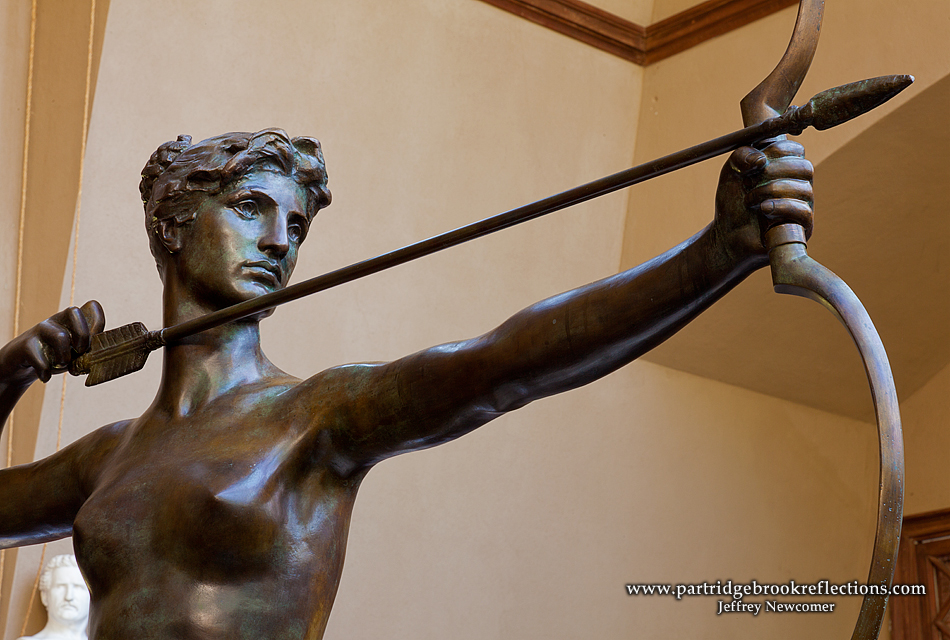
Diana in the
Little Studio
I could go on about the many remarkable pieces at Saint-Gaudens, each has its own story, but I would rather let the images speak and encourage you to find the time to come by.  Saint Gaudens' work has a power and presence that can only be fully appreciated in person. It is well worth the trip, but be sure that you give yourself enough time to quietly linger and contemplate. Contemplation is what Saint-Gaudens’ country retreat is all about. 


Diana in the Little Studio


The grounds of The Saint Gaudens Historic Site are accessible year round, but the exhibit buildings are open only from the Saturday of Memorial Day weekend to October 31 from 9:00 a.m. to 4:30 p.m. and the grounds until dusk. For more information, check out the park web site. The site includes a very helpful IPad App, which describes most of the attractions and provides a virtual tour of the grounds and galleries. 


Little Studio

http://www.nps.gov/saga/index.htm